Those who love to holiday in tourism’s latest popular fashion, motorhoming, will need to plan carefully their holidays in Spain in 2026, as regional policies have created vastly contrasting environments for their journeys.
Ibiza in the Ballearics has adopted probably the most aggressive tactics to restrict overnight stays, while Cantabria in the north of Spain is welcoming the travelling homes with open arms. Motorhomers are going to benefit greatly from a little advance verification of local conditions to prevent cold welcomes.
Ibiza motorhome rules are leading to aggressive enforcement and fines
The Ballearic island’s governance is sticking with zero tolerance for motorhomes parking outside licensed campgrounds during high season. Fines can reach a shocking €30,000 for any attempt to park up on rustic ground, public streets, or unauthorised spots between June and September. Only five official campgrounds accept such vehicles, and reservations long in advance are proving essential for legal entry.
Daily quotas limit non-resident vehicles entering the island with 2026 figures set at 17,668 total, cars included, and fewer than 3,700 private tourist vehicles (motorhomes, caravan and campervans) after accounting for rentals.
There are multiple statutes to strengthen this position. Vehicle control legislation caps summer traffic to counter tourist overloads, while rustic land laws prohibit any camping away from established sites. Politically, this stance is a bit of a shot in the foot for the Ibiza hospitality business, as rents have soared on the island, meaning that many working in hotels and restaurants have little choice but to make their homes on wheels.
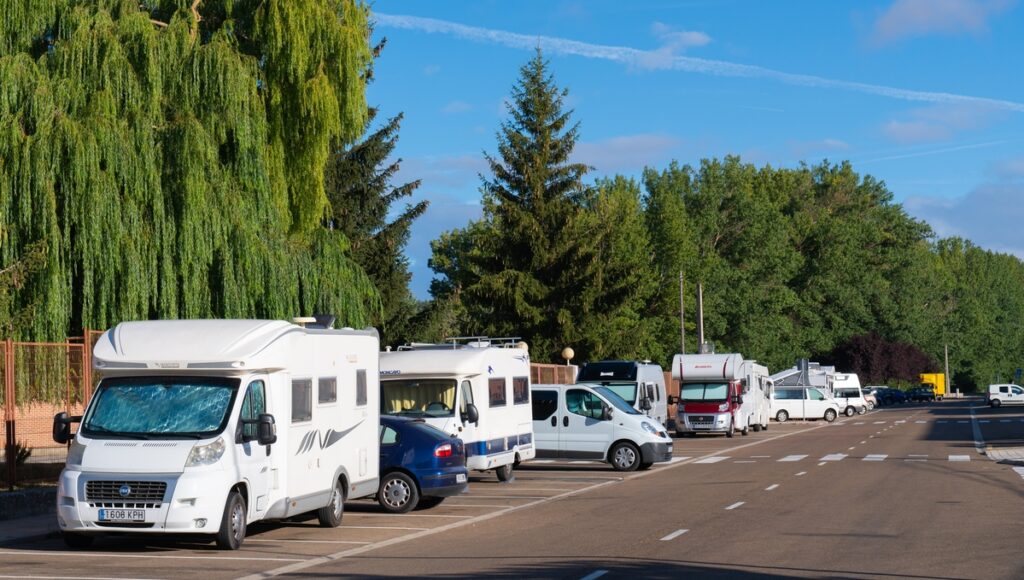
Street-parking motorhomes under scrutiny. Credit: Charlesy – Shutterstock
Access applications submitted online require proof of campground bookings for motorhome owners. No dedicated motorhome service areas exist on the island, so options narrow sharply to saturated campgrounds charging €40 to €60 per night.
Town areas impose stronger constraints. Council bylaws restrict parking to 24 hours in public spaces, with teams using drones to detect habitation signs inside vehicles.
Autonomous motorhome groups are furious about the numerous fines. Appeals cover cases including one €20,000 fine for extended parking deemed by local police as improper. Seventeen reports filed so far in 2026 target rustic land infractions with fines varying between €10,000 and €30,000. The previous year saw 13 similar fines dished out in areas like Sant Antoni.
Jesús Gallardo, president of the Plataforma Autocaravanas Autónoma (PACA) and expert in law over vehicle homes is indignant about the high fines motorhome owners have received. “It costs a lot less to bail someone out of jail than the fine for parking just three days!” he says. “We are talking about workers, people who can’t afford the luxuries of a hotel.”
However, not all of Spain is at war with motorhomes
As well, technical demands have been relaxed without quality reductions, allowing better adaptation to current sector needs. Requirements for opening a dedicated campsite for motorhomes, such as road width, shops, and first-aid rooms, are being waived to encourage more entrepreneurs into the business.
Administrative efficiency is improving markedly with a revised legal text that condenses 44 articles organised into a preliminary title plus two main sections covering activity commencement and operational regimes.
Cantabrian politicians view motorhome tourism as vital for local economies. This segment supports rural development, helps extend seasons beyond peak periods and draws visitors seeking nature-based sustainable experiences. New rules make Cantabria a favourite destination for moving tourism through orderly and competitive models.
Motorhome drivers benefit from checking where they are headed first
Diverse regulatory landscapes across Spanish regions mean that careful preparation prior to travel is becoming essential. Ibiza demands campground reservations and quota adherence to avoid ridiculously high fines, whereas Cantabria facilitates new site developments for greater flexibility.
Ibiza is quite characteristic of the Balearics, complaining about overtourism and singling out tourists as the source of their woes. And without considering that tourism is the number one mover of their economy, they the deal out punishments rather than coming to political settlements within their own political environment that might limit tourism numbers. But, while they argue amongst themselves about the best ways to tackle overcrowding on their islands, other areas of Spain, it seems, are more than happy to welcome the overflow and can’t wait for more motorhomes to visit.
We have never left a pet behind. Credit: camfrae / Shutterstock
It has been publicly announced by APHA (Animal & Plant Health Agency) that UK residents can no longer use their pet’s EU Passport for entry into any EU country.
This came into effect on 22nd April 2026.
You can still use your EU Passport to travel back into the UK if you are currently in Spain or France but this will be the final time.
In future you will have to obtain an Animal Health Certificate (AHC) from your Vet for each trip.
The AHC is only valid for 6 calendar months for 1 return journey. This has just been extended from 4 months. You must still make sure you don’t overstay your 90 days unless you have obtained a Visa for work. You still need to provide us with your 3 supporting documents, consent, your passport and your travel itinerary.
Don’t discard your EU Pet Passport, the rabies is still valid and can be transferred to the AHC: We need to see this in order to complete the forms.
In our experience, most UK Vets are unable to interpret the meaning of travel if using a licensed transporter and many Vets still don’t provide the service at all. We have encountered many problems and have been left to resolve all these issues hours away from the port and spending hours on the phone whilst pets are with the Vet. We have never left a pet behind and climbed mountains to ensure this has never happened.
We want to help you. We realise this is going to be very daunting for many and we can’t afford to have any clerical mistakes on the day of collection.
ProPaws is now able to offer you and your pets a fully inclusive service, taking all the stress and hassle away, ensuring you continue to enjoy your holidays in Spain and France.
We have collaborated with Dr. Christoph Reichman MRCVS, an expert in the veterinary field and AHC’s, and his practice in Ashford, Kent.
Our service includes :
The completion of the preliminary forms by Tracey.
Geoff will collect your pet/s on the usual departure day.
All pets will have an appointment with Dr Chris at his practice in Kent.
Dr Chris will examine your pets and issue the AHC.
Geoff then makes his way to Dover with everything in order and according to the law.
Our fee for the AHC service
£190 for 1 pet
£240 for 2 pets
£290 for 3 pets
You can of course do this yourselves. We know many of you are IT savvy and have wonderful relationships with your vets. With the demand for AHC’s being at the highest we need to make sure nothing is rushed or left to the last minute and everything is correct. We cannot afford any mistakes or putting the other pets at risk of seizure at the port.
Dara lifts the 2026 Eurovision trophy. Credit: EV FB
Possibly one of the most controversial and bitterly argued over song contests in years saw countries boycotting, polarised political opinions, and strong language from hecklers and protesters, yet, the true spirit of unity won through in the end to deliver a spectacular final.
Bulgaria has claimed the Eurovision 2026 title in the grand final staged in Vienna on Saturday night, May 16. Dara delivered an electrifying performance of Bangaranga that captured hearts across the continent and earned the maximum points from both professional juries and television viewers. This triumph represents the first time Bulgaria has ever lifted the trophy in the contest’s long history, leading to wild celebrations back home and among supporters in the arena.
Dara expresses joy after historic triumph
Dara expressed overwhelming joy during the victory interview and thanked fans for their unwavering support throughout the week. Her performance served as evidence of real talent and determination that resonated deeply with audiences across the continent.
Israel and Romania complete the podium
Israel took second place after Noam Bettan presented Michelle to widespread acclaim. The entry accumulated 343 points in total and demonstrated remarkable composure under pressure from various external factors. Noam received warm responses from most spectators who appreciated the artistic quality on display. Many noted the powerful delivery and emotional depth in every note sung.
Romania claimed third position with Alexandra Căpitănescu performing Choke Me. The song generated strong reactions and finished with an impressive score that reflected its strong approach and vocal strength. Alexandra beamed with pride as the results appeared on screen. Her team celebrated the achievement with hugs and cheers immediately after the announcement.
Spectacle delights global audiences
Viewers tuned in from numerous countries to witness the spectacle take place under bright lights at the venue. Commentators praised the overall production values and the energy brought by all competing acts. Many described the night as a continuous journey of surprises and high emotions.
Organisers expressed satisfaction with the smooth running of proceedings, despite occasional challenges. Bulgaria now prepares to host future events related to the win while the music industry anticipates continued growth in interest.
Positive outlook for 2027
Hopes remain high for the 2027 contest to return to normality without boycotts so that every nation can participate freely and the emphasis stays firmly on creativity and international friendship.
A contributing factor to reduced rental availability is the expansion of short-term accommodation in tourist-heavy areas. Photo credit: Pressmaster/Shutterstock
Latest data published this month shows how overcrowded housing in Spain has increased in recent years as rising rental costs and limited housing supply force more people to share accommodation. In some cases, multiple adults are living in single rooms due to a lack of affordable alternatives in the private rental market. Housing demand has continued to rise in major cities and coastal regions, driven by population movement towards urban centres and strong competition for limited rental stock.
At the same time, wage growth has not kept pace with housing costs in many areas, reducing access to independent accommodation for lower-income households. Eurostat housing data shows that around 20% of renters in Spain live in overcrowded conditions, a rate significantly above the national average for owner-occupied housing.
Standard measures show persistent housing density pressure
Overcrowding is defined using Eurostat’s housing space standard, which classifies a household as overcrowded when it has fewer rooms than required according to household size and composition. The calculation allocates one room for the household, one additional room for each couple, one room for each single adult, and separate rooms for children depending on age and gender structure.
Kitchens, bathrooms, hallways and storage spaces are excluded from the count, meaning only bedrooms and living rooms are considered. When a household does not meet this minimum room requirement, it is recorded as living in overcrowded conditions in official statistics. National statistical data from Spain’s Instituto Nacional de Estadística (INE) aligns with this pattern, showing higher overcrowding rates in urban areas where rent levels are highest and housing demand is concentrated.
Rising rents reduce access to independent housing
Rental prices in Spain have risen significantly over recent years, with increases of roughly 20% to 30% between 2020 and 2025 in many urban markets, depending on location. These increases have outpaced income growth for many workers, making it more difficult for households to afford self-contained accommodation.
As a result, shared housing has become more common among working adults, not only students or temporary residents. In high-demand cities, rental properties are often let quickly, sometimes with multiple applicants competing for a single property. This reduces negotiating power for tenants and increases reliance on shared arrangements.
Housing supply constraints and short-term rentals add pressure
At the same time, housing construction has not expanded at a sufficient pace to match demand in high-pressure regions. Planning delays, land availability constraints and construction costs have been cited as limiting factors. These structural conditions contribute to tighter rental markets, particularly in major cities and coastal zones where demand is consistently high.
Living conditions in overcrowded households
In overcrowded homes, living arrangements often involve shared bedrooms or reduced private space. In some cases, multiple adults may share a single room, while living spaces are divided into temporary sleeping areas.
Eurostat and national housing indicators show that overcrowding is more prevalent among renters than homeowners, reflecting the financial barrier to accessing larger or independent housing. The conditions can affect privacy, rest and daily routines, particularly where multiple occupants share limited space over extended periods.
Regional imbalance in housing access
Overcrowding rates vary across Spain depending on region, income level and housing market pressure. Urban centres with high rental demand tend to show higher levels of housing density compared with rural areas.
Overall, the data indicates a persistent gap between housing demand and supply in key markets. While not all households are affected, a significant minority of renters live in conditions classified as overcrowded under European statistical standards. The combination of rising rents, limited supply and uneven income growth continues to shape housing access, with overcrowding emerging as one of the measurable outcomes in Spain’s rental sector.