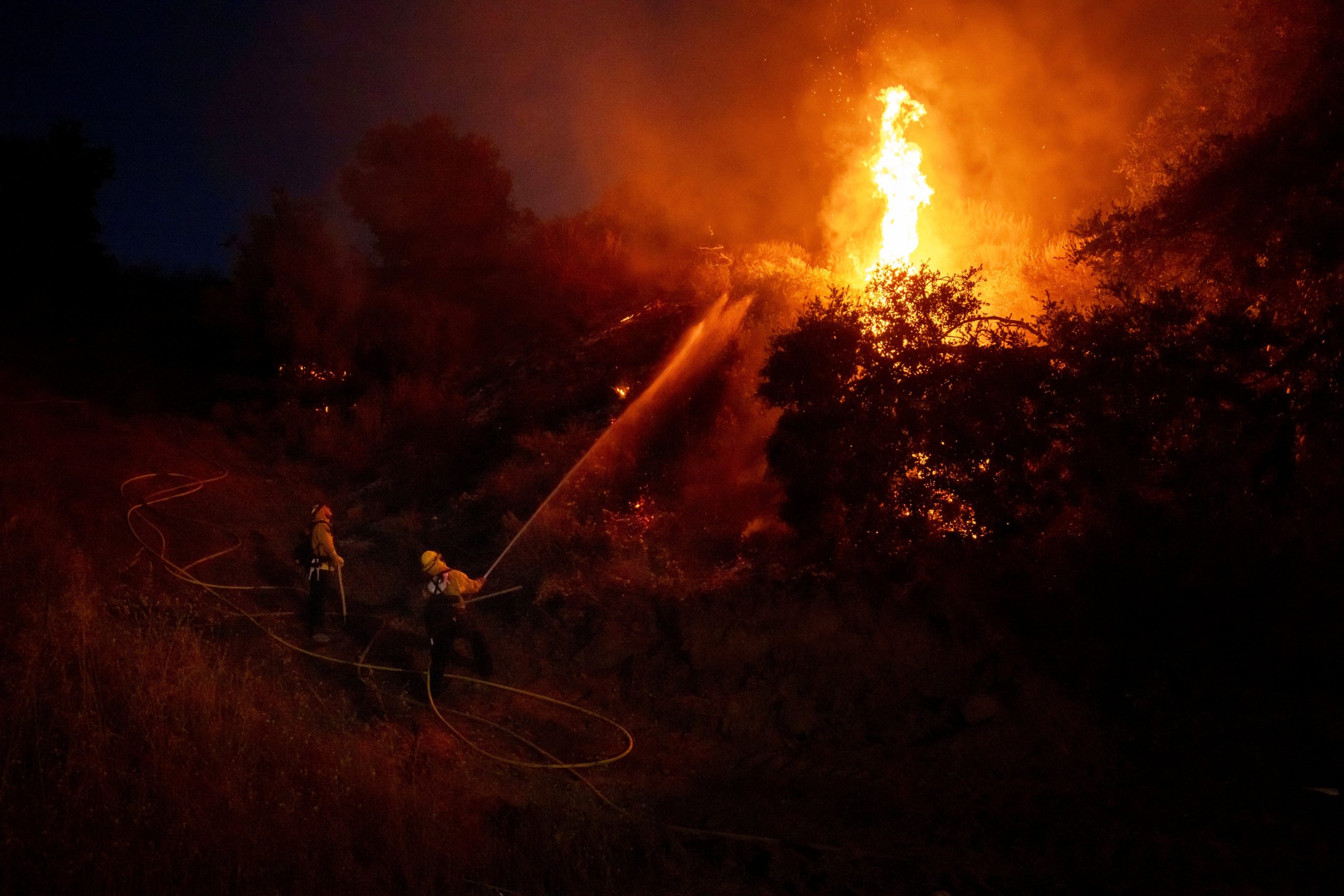
Wildfires fueled by extreme heat, drought, and strong winds have become a recurring emergency that California faces virtually every year. Now, the southern part of the state is grappling with a new wave of fires that has placed thousands of residents under evacuation orders and forced the deployment of emergency resources in several counties. The most critical fire so far is the Sandy Fire, fueled by strong winds, which continues to advance in Simi Valley, northwest of Los Angeles.
The fire began Monday morning in the Sandy Avenue area of Ventura County and quickly spread due to gusty winds and dry vegetation. Within minutes, the flames reached residential areas and destroyed at least one home along with vehicles parked near the property.
By early Wednesday morning, Sandy had consumed nearly 1,700 acres (6.88 square kilometers) and maintained a containment level of between 5% and 15%, according to various official reports released in recent hours.
Authorities noted that more than 17,000 people remained under evacuation orders, although at the height of the crisis the number had exceeded 43,000 residents. Several communities in Ventura County and areas bordering Los Angeles received evacuation orders and warnings.
Winds complicate firefighting efforts
Firefighters and aerial crews worked through the night on Tuesday trying to slow the fire’s advance before weather conditions worsened again. Ventura County Fire Department spokesperson Andrew Dowd explained that crews were able to make headway thanks to a temporary lull in the wind.
However, authorities warned that the change in wind direction continued to pose a significant risk. Cal Fire stated that firefighters remained strategically positioned in anticipation of possible changes in the fire’s behavior.
Furthermore, the mountainous terrain and dry vegetation have complicated the efforts. Andy VanSciver, a public information officer with the fire department, told the media that the steep slopes and dry grasslands are fueling the rapid spread of the flames.
More than 800 firefighters deployed
The operation to combat the Sandy Fire mobilized hundreds of personnel from various agencies. According to official reports, more than 869 firefighters were assigned to containment efforts after a new secondary fire forced the deployment of more than 100 additional personnel.
Efforts included aerial drops of water and retardant, nighttime operations, and the creation of containment lines to prevent the fire from reaching sensitive areas such as the Santa Susana Field Laboratory and the Box, Bell, and Woolsey canyons.
Los Angeles Mayor Karen Bass reported that the city deployed helicopters, crews, and specialized equipment to support Ventura County, though she clarified that, as of now, the fire was not expected to reach the city of Los Angeles.
School closures and poor air quality
The impact of the fire also forced the closure of all campuses in the Simi Valley Unified School District on Wednesday. Only essential staff were called in to work.
In addition, smoke from the Sandy fire and other nearby fires triggered air quality alerts in areas such as Calabasas, Malibu, and Pacific Palisades. Authorities urged residents to avoid outdoor activities and stay tuned for emergency updates.
Other active fires in California
The Sandy Fire isn’t the only one causing concern for authorities. On Santa Rosa Island, off the coast of Ventura and Santa Barbara, another fire has burned nearly 17,000 acres (68.8 square kilometers) and destroyed historic structures. The fire is approximately 26% contained.
Authorities believe the fire may have started after a shipwrecked sailor used flares to signal for help. The man was later rescued by the Coast Guard.
In Riverside County, the Bain and Verona fires also forced the evacuation of entire communities. The Bain fire has burned more than 1,300 acres, while the Verona fire has burned over 400 acres and remains uncontained.
Another fire, identified as the Tusil, spread rapidly in San Diego County and forced the partial closure of Interstate 8.
Critical fire season
Experts have warned that California is entering a particularly dangerous period for wildfires.
Meteorologist Ryan Kittell of the National Weather Service in Oxnard explained to the Los Angeles Times that moisture levels in vegetation are reaching a critical point. “Right now, the latest readings show we’re right on the cusp of when most of the plants are ready to burn,” he said. “It’s still kind of a mixed bag, but we’re getting real close.”
Sign up for our weekly newsletter to get more English-language news coverage from EL PAÍS USA Edition





















 Competiciones3 weeks ago
 Foreign demand2 weeks ago
 %4 weeks ago
 %4 weeks ago