
Housing politics
Spain’s ‘major landowner’ nonsense turns small players into cartoon villains


Spain has a housing crisis, so naturally some politicians have decided the answer is to make housing investment more confusing, less attractive, and morally suspect. Catalonia has turned this into something of an art form.
The legal battle over who qualifies as a “major landowner” in Spain has become one of the great absurdities of the rental market. Under the state Housing Law, the general threshold is more than ten residential properties, though this can fall to five in stressed housing markets. In Catalonia, where housing policy often appears to be written with a clenched fist, the concept has been pushed even further into farce.
In practice, depending on the rule, the authority, and the phase of the moon, someone with interests in five modest properties can be treated as a “gran tenedor” — a major landowner — with all the stigma, obligations, restrictions, fiscal punishment and reduced property rights that now come attached to the label.
This is where the policy becomes ridiculous. A person with four properties worth €10 million can remain an ordinary citizen. Someone else with minority interests in five modest homes worth a fraction of that can find themselves bundled into the same category as large landlords and investment funds. Not so much robber baron as unlucky aunt with inherited shares in flats in a family-owned building.
A policy built on suspicion
The phrase “major landowner” sounds as if it was designed to conjure up cigar-chomping speculators hoarding homes from the poor. In reality, the net can catch private individuals, families, accidental landlords, small investors and heirs who have done nothing more sinister than own, inherit, or invest in property.
Catalonia has also doubled down fiscally. Recent measures have raised the transfer tax burden on major landlords to 20% in certain cases, while rent controls, registration requirements, extended contract obligations and other interventions pile up around the same concept. The message is not subtle: own too much property — however that is defined this week — and the state will treat you as part of the problem.
Lawyers now warn that the state and Catalan definitions do not align, while questions over co-ownership, company holdings, cadastral records, land registry data and surface area create a fog of uncertainty. When professionals struggle to explain the rules, ordinary owners can hardly be expected to navigate them with confidence.
Less investment, less housing
This might be tolerable if the policy produced more homes. But Spain’s housing crisis is, above all, a shortage crisis. The country needs more rental supply, more renovation, more professional management, more private capital and more confidence. Public authorities do not have the money, speed, competence or land pipeline to replace the investment they are busy discouraging.
Instead, the system tells owners that putting homes on the rental market may mean longer contracts, tighter rent limits, more bureaucracy, higher tax, less control and greater political hostility. Then everyone acts surprised when supply falls, investment cools, and owners look for ways out of the long-term rental market.
The great irony is that policies aimed at punishing “major landowners” often hit the very people needed to increase supply: small and medium-sized investors willing to buy, renovate and rent homes. Treating them as villains may satisfy the politics of resentment, but it does not house anyone.






The IMF has praised Spain’s economic performance, but warned that the housing crisis will not be solved with more political tinkering, rent controls, and legal uncertainty.
Spain’s economy might be doing better than most in the eurozone, but the International Monetary Fund has put its finger on the country’s biggest domestic problem: housing affordability.
In its latest assessment, the IMF says the deterioration in housing affordability requires “more decisive measures to increase supply”, including faster urban development, less legal uncertainty, and quicker building-licence procedures.
In other words, Spain needs to make it easier, faster, and safer to build homes. Revolutionary stuff.
The supply problem Spain keeps dodging
The IMF’s criticism is politely phrased, but hard to miss. Spain’s housing problem is being made worse by a chronic shortage of supply, especially in the places where people most want or need to live.
Instead of focusing on supply, the Spanish government has spent much of this legislature tightening controls on the rental market, extending so-called stressed-market areas, and intervening in contracts. The latest forced extension of rental contracts has already opened a legal front, with challenges in the courts after the decree that introduced the measure expired without parliamentary approval.
That is the kind of “legal uncertainty” the IMF is talking about. Investors, landlords, developers and owners all make decisions based on rules. Keep changing the rules, or threatening to change them, and many will simply sit on their hands.
Rent controls are no substitute for homes
Spain also has a tiny stock of public and social housing by European standards. Just 2.5% of the housing stock is public or social, compared with an EU average of 9.3%, according to Spain’s Housing and Land Observatory.
Building more public housing takes time, money, land and administrative competence, so politicians prefer quicker gestures such as rent caps and emergency decrees. The trouble is that those gestures can reduce supply even further by discouraging landlords and investors.
The IMF is effectively warning Spain that affordability will not improve unless supply increases. You can regulate prices on paper, but people still need somewhere to live in the real world.
A strong economy, but housing remains the weak spot
On the broader economy, the IMF remains positive. It expects Spain to lead growth in the eurozone in 2026, with GDP expanding by 2.1%, helped by strong domestic demand, immigration, a dynamic labour market and a growing share of renewables in the energy mix.
But the housing market is flashing warning lights. The IMF also warns against lax mortgage lending standards as prices rise quickly, recommending borrower-based measures in the coming year to prevent financial risks from building up.
So Spain has two housing challenges at once: prices rising too fast for many households, and a policy environment that may be making supply worse rather than better.
Housing politics
Politics destroys Barcelona’s rental market—despite rents going nowhere for 20 years
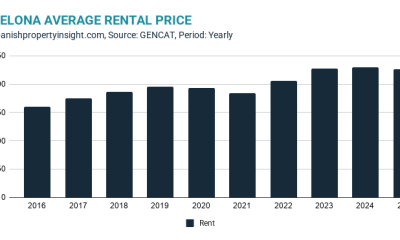
Barcelona’s latest rental data shows how politicians and housing activists have crippled the rental market with price controls, even though rents have barely risen in real terms for nearly two decades.
The latest figures from the Catalan government’s INCASÒL agency give us a full-year view of 2025, the first complete year under rent controls introduced in Q1 2024. And a clear pattern is emerging—one that goes far beyond the headline spin about “stable” or slightly falling rents.
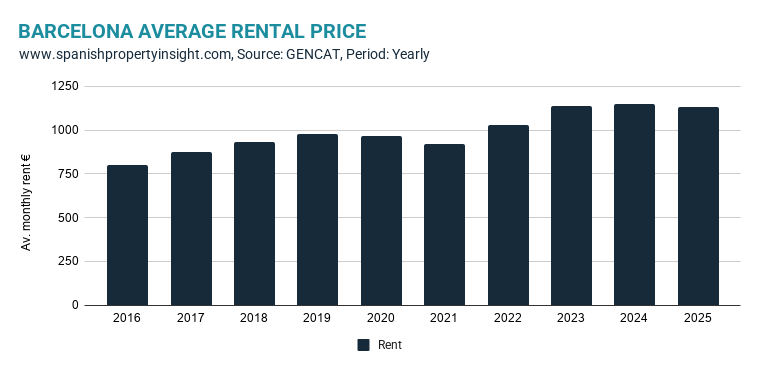
Officially, the average rent in Barcelona was €1,134 in 2025, down just 1.1% year-on-year. But adjusted for inflation, rents are barely higher than they were in 2008—up just 1.8% in real terms over nearly 20 years.
In €/sqm terms, rents actually rose 3.3% year-on-year to €16.67, while in real terms they are slightly below 2008 levels. So much for the narrative of runaway rents.
A market signal that no longer means anything
Of course official rents are stable. That’s what rent controls are designed to do. Prices in registered contracts are no longer a market signal—they are an administrative outcome, dictated by politicians, bureaucrats, and housing activists.
The problem is that the market itself is disappearing.
Just 30,789 new rental contracts were signed in 2025, down 6.4% year-on-year and dramatically below recent peaks. Compared to 2021 the market has shrunk by more than half.
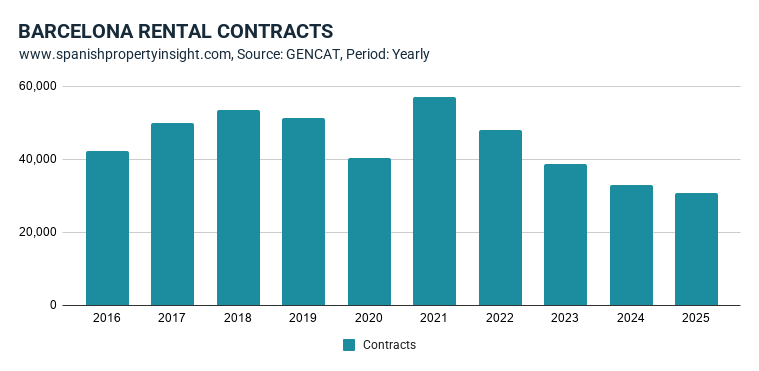
But the real divergence has happened since 2022. While asking prices have surged, contracts have collapsed. Supply is being choked off.
Rising asking prices and a widening gap
While official rents stagnate, asking prices continue to climb. In 2025, asking rents reached €23.75/sqm, up 8.6% year-on-year and nearly 58% above 2008 levels.
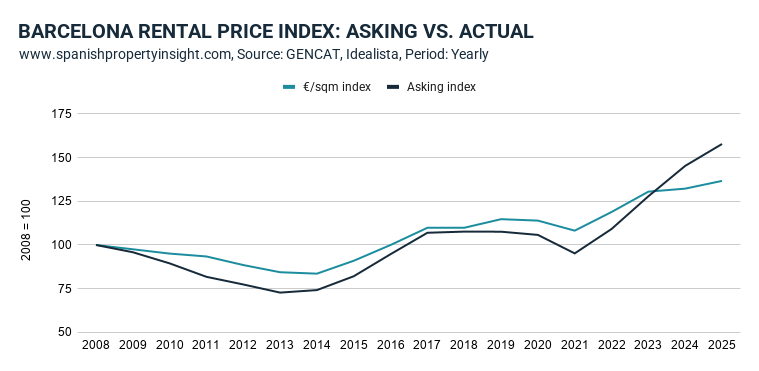
This growing gap between declared contract prices and asking prices is a clear warning sign. It suggests the official data is becoming less reliable as a reflection of real market conditions.
The most obvious explanation? A growing black economy, with tenants paying part of the rent under the table—off the books and invisible in the statistics.
Fewer homes, tougher access, worse outcomes
What’s happening on the ground is simple. There are fewer rental homes available, landlords are becoming more selective, and access to housing is getting harder.
A shrinking pool of “perfect” tenants—high-income, stable, low-risk—are benefiting from capped rents. They could afford market rates anyway, but now pay less.
Everyone else loses. Young families, migrants, the self-employed, and anyone without a flawless financial profile are increasingly shut out. If landlords are forced to rent below market rates, they minimise risk. They don’t take chances.
And many landlords are simply leaving the market altogether.
The myth of the rent crisis
What makes this policy particularly hard to justify is the longer-term context.
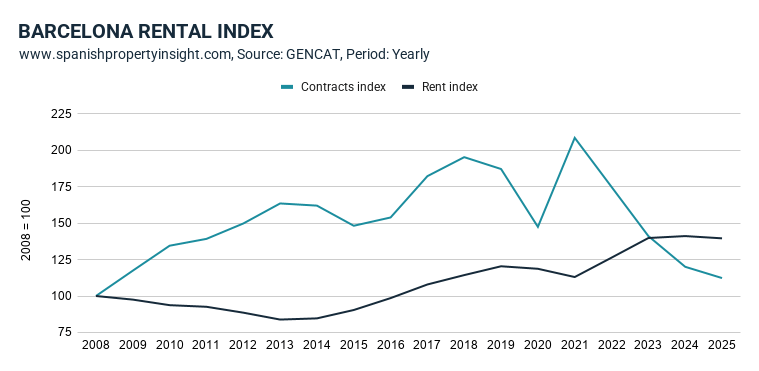
Rental prices in Barcelona fell by 16% between 2008 and 2013 as the financial crisis crushed demand. Supply exceeded demand, and prices adjusted—without any need for rent controls.
That part of the story is quietly ignored.
Instead, housing activists focus on the rebound from the 2013 trough, presenting it as evidence of runaway rents. But that “surge” was largely a return to normality after an extraordinary collapse.
Since then, prices have been driven by fundamentals: economic growth, tourism, and strong population increases fuelled by immigration—from affluent digital nomads to lower-income workers sharing accommodation.
Demand rose. Supply didn’t keep up. Prices responded accordingly. That’s how markets work.
From housing market to rationing system
Rent controls don’t change those fundamentals. They simply distort the outcome.
By capping rents, the government has turned Barcelona’s rental market into a rationing system—where access depends less on willingness to pay and more on luck, timing, and profile.
Some sitting tenants benefit. A small group of high-quality applicants win. But the market as a whole shrinks, and access collapses.
All pain, little gain
The bottom line is stark. After nearly 20 years of flat real rents, Barcelona didn’t need rent controls to “fix” a pricing problem. Yet politicians imposed them anyway—and in doing so have damaged the market they claim to protect.
Official rents may look stable. But supply is collapsing, asking prices are rising, and the gap between the two is widening fast.
Behind the headline numbers lies a simple reality: fewer homes, fewer contracts, and fewer chances to rent.
If you search for a rental in Barcelona today, the reality hits immediately. Idealista—the biggest portal—shows around 2,500 flats available, roughly half the 5,000 on offer at the end of last year before the latest round of housing intervention. And even that overstates the situation. Many listings are little more than bait to generate leads—enquire and you’ll be told it’s already gone, but you can join a waiting list. In practice, there are hardly any homes to rent. Finding a place to call home in Barcelona today feels less like a property search and more like an endurance test that punishes the least well-off the most.
Housing politics
Politics Destroys Barcelona’s Rental Market—despite Rents Going Nowhere For 20 Years

Barcelona’s latest rental data shows how politicians and housing activists have crippled the rental market with price controls, even though rents have barely risen in real terms for nearly two decades.
The latest figures from the Catalan government’s INCASÒL agency give us a full-year view of 2025, the first complete year under rent controls introduced in Q1 2024. And a clear pattern is emerging—one that goes far beyond the headline spin about “stable” or slightly falling rents.
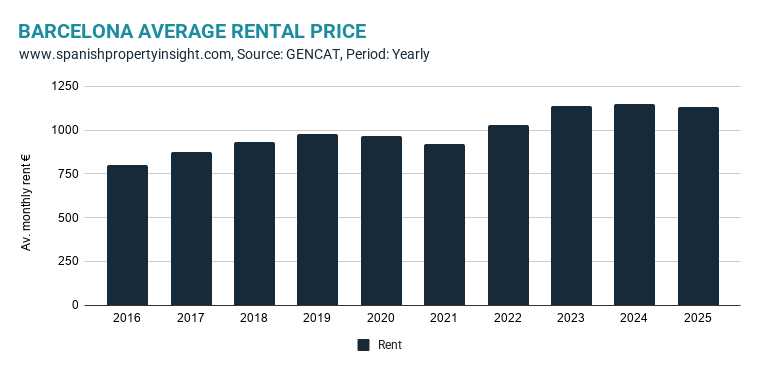
Officially, the average rent in Barcelona was €1,134 in 2025, down just 1.1% year-on-year. But adjusted for inflation, rents are barely higher than they were in 2008—up just 1.8% in real terms over nearly 20 years.
In €/sqm terms, rents actually rose 3.3% year-on-year to €16.67, while in real terms they are slightly below 2008 levels. So much for the narrative of runaway rents.
A market signal that no longer means anything
Of course official rents are stable. That’s what rent controls are designed to do. Prices in registered contracts are no longer a market signal—they are an administrative outcome, dictated by politicians, bureaucrats, and housing activists.
The problem is that the market itself is disappearing.
Just 30,789 new rental contracts were signed in 2025, down 6.4% year-on-year and dramatically below recent peaks. Compared to 2021 the market has shrunk by more than half.
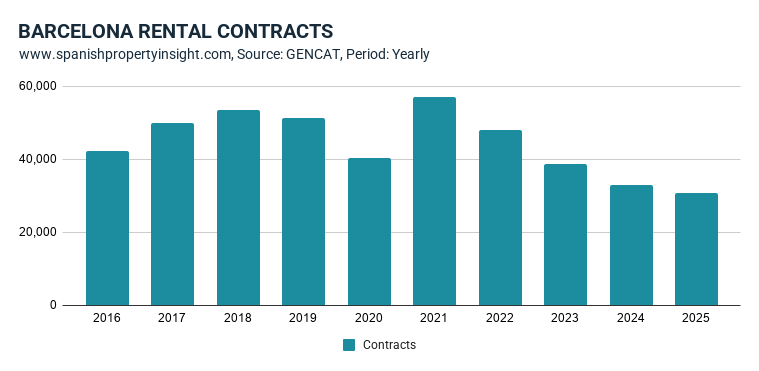
But the real divergence has happened since 2022. While asking prices have surged, contracts have collapsed. Supply is being choked off.
Rising asking prices and a widening gap
While official rents stagnate, asking prices continue to climb. In 2025, asking rents reached €23.75/sqm, up 8.6% year-on-year and nearly 58% above 2008 levels.
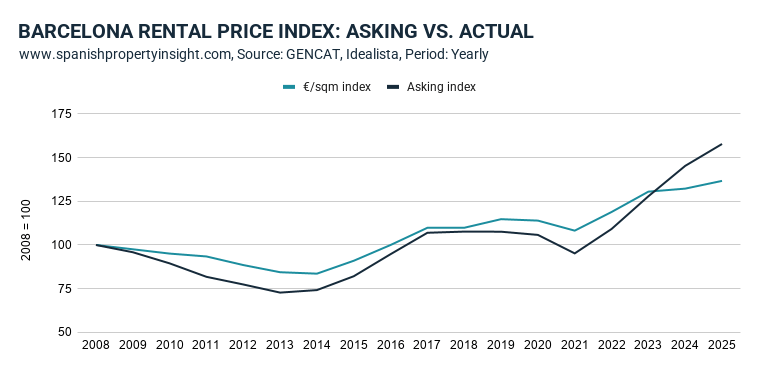
This growing gap between declared contract prices and asking prices is a clear warning sign. It suggests the official data is becoming less reliable as a reflection of real market conditions.
The most obvious explanation? A growing black economy, with tenants paying part of the rent under the table—off the books and invisible in the statistics.
Fewer homes, tougher access, worse outcomes
What’s happening on the ground is simple. There are fewer rental homes available, landlords are becoming more selective, and access to housing is getting harder.
A shrinking pool of “perfect” tenants—high-income, stable, low-risk—are benefiting from capped rents. They could afford market rates anyway, but now pay less.
Everyone else loses. Young families, migrants, the self-employed, and anyone without a flawless financial profile are increasingly shut out. If landlords are forced to rent below market rates, they minimise risk. They don’t take chances.
And many landlords are simply leaving the market altogether.
The myth of the rent crisis
What makes this policy particularly hard to justify is the longer-term context.
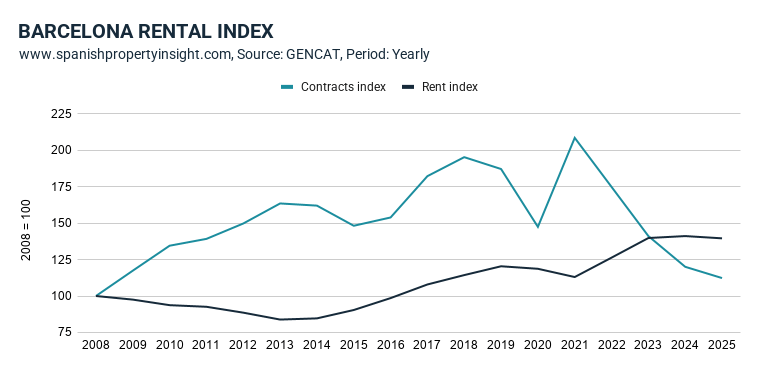
Rental prices in Barcelona fell by 16% between 2008 and 2013 as the financial crisis crushed demand. Supply exceeded demand, and prices adjusted—without any need for rent controls.
That part of the story is quietly ignored.
Instead, housing activists focus on the rebound from the 2013 trough, presenting it as evidence of runaway rents. But that “surge” was largely a return to normality after an extraordinary collapse.
Since then, prices have been driven by fundamentals: economic growth, tourism, and strong population increases fuelled by immigration—from affluent digital nomads to lower-income workers sharing accommodation.
Demand rose. Supply didn’t keep up. Prices responded accordingly. That’s how markets work.
From housing market to rationing system
Rent controls don’t change those fundamentals. They simply distort the outcome.
By capping rents, the government has turned Barcelona’s rental market into a rationing system—where access depends less on willingness to pay and more on luck, timing, and profile.
Some sitting tenants benefit. A small group of high-quality applicants win. But the market as a whole shrinks, and access collapses.
All pain, little gain
The bottom line is stark. After nearly 20 years of flat real rents, Barcelona didn’t need rent controls to “fix” a pricing problem. Yet politicians imposed them anyway—and in doing so have damaged the market they claim to protect.
Official rents may look stable. But supply is collapsing, asking prices are rising, and the gap between the two is widening fast.
Behind the headline numbers lies a simple reality: fewer homes, fewer contracts, and fewer chances to rent.
If you search for a rental in Barcelona today, the reality hits immediately. Idealista—the biggest portal—shows around 2,500 flats available, roughly half the 5,000 on offer at the end of last year before the latest round of housing intervention. And even that overstates the situation. Many listings are little more than bait to generate leads—enquire and you’ll be told it’s already gone, but you can join a waiting list. In practice, there are hardly any homes to rent. Finding a place to call home in Barcelona today feels less like a property search and more like an endurance test that punishes the least well-off the most.

Spanish Supermarket Giant Fined €30,000 Over Labelling That ‘misled Shoppers’
Spain’s ‘major landowner’ nonsense turns small players into cartoon villains

Spain Launches Its Third Quantum Supercomputer To Revolutionise AI And Medicine


-

 Competiciones4 weeks ago
E
-
blackout April 20253 weeks ago
Insurance company Mapfre decides to pay out €14 million compensation for 2025 blackout
-
 Foreign demand3 weeks ago
Who Bought Where In The Second Half Of 2025?
-

 New Developments4 weeks ago
Stylish 3-Bedroom Apartment With Panoramic Sea Views – Benalmádena
-

 New Developments3 weeks ago
Inside The Most LUXURIOUS Apartment Building In Spain!
-

 New Developments4 weeks ago
Luxury Villas For Sale, Estepona – ProjectL1
-
Costa Blanca South3 weeks ago
Alicante police chief to retire after 17 years of service
-

 New Developments3 weeks ago
🌅 Stunning Penthouse With Panoramic Sea & Mountain Views Benalmádena