
ElPais
Tamara Fernández Varela: Drugged, Raped And Filmed By Her Husband

She could hardly believe it. Sitting at home, Tamara Fernández Varela kept reading and re-reading the letter from the court in Carballo, in Spain’s northwestern Galicia region, notifying her that her ex-husband had drugged, raped and photographed her. It included six images. In some she appeared completely naked. “I kept looking at them and saying: it can’t be me. Such brutality doesn’t fit inside your head. A woman looking dead in a bed. And it’s me,” recalls the 43-year-old woman. Her mother and she both began to scream. They screamed so loudly that a frightened neighbor called an ambulance.
Tamara had just been told in writing that Alessandro Pompeo, who had been her partner for eight years and from whom she separated in 2018 — the same man who gave her roses every month on their anniversary — was being investigated as her aggressor. And the piece of news arrived in a notice as impersonal as a speeding ticket. This happened in 2022. Two years later the man fled. Since then he has been missing. The trial was put on hold. The Provincial Court of A Coruña has repeatedly rejected requests from the public prosecutor’s office, most recently in February, to activate an international warrant.
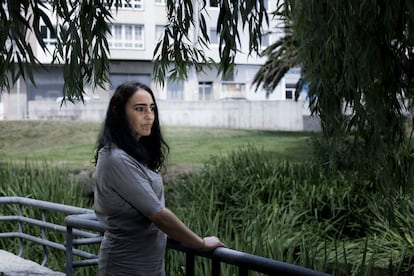
“Do you know how disappointed I was the day before the trial?,” the woman snaps, widening her dark, heavily lined eyes and thick eyebrows. When she gets angry, she switches to the Galician language without realizing it. Tamara drives around A Coruña, where flags and shirts are still being hung up after the local soccer club Deportivo’s promotion to First Division. The city is celebrating and life goes on, but not hers. She feels in limbo. “I wish I could be as strong as I used to be. To still have the vitality to say, ‘Mom, today we’ll go wherever the car takes us,’” she laments. Now she does not like driving anymore, nor does she enjoy the city.
After receiving the notice she went to the courthouse. There she learned there were more photos and eight videos. The National Police found the material after raiding Pompeo’s Carballo home in 2020 when they discovered he had downloaded 70 files of child pornography. Tamara recognized the furniture and bedding in the photos and recordings. She had to listen to herself snore. Some recordings dated from when they lived in Switzerland, where they met in 2009; others were from later, after they moved to Carballo, Tamara’s hometown. The accused admitted the facts, but “he said I had consented to everything. Not even the judge believed him,” she says. She says the magistrate apologized for the letter the court sent her, saying it had not been the proper way to summon her.
She loathes the photos, but they could serve as evidence that chemical submission occurred — something that, without images, is hard to prove. In the case of Gisele Pelicot, a 73-year-old Frenchwoman who was drugged and raped by her husband and at least 50 other men (those the police were able to identify), the fact the assaults were filmed proved crucial to uncovering the crime and proving it at trial.
Tamara says she was initially ashamed to leave the house because she thought someone might have seen the photos. Pompeo’s case is not unique: from time to time a new Telegram group or platform emerges where men send videos of their girlfriends or sisters, swap tips on how to drug women and on which substance and dose to use. Underwear and piercings can also be relevant evidence. “I have that filth stored at home because I had to take it to the judge, but since there was no trial…,” she laments.
In June 2022, Alessandro Pompeo was convicted for possession of child pornography — the reason police went to his house in the first place — and sentenced to eight months of supervised freedom, a fine of about €700 and disqualification from any work involving contact with minors for two years. In January 2023, according to the court documents EL PAÍS has obtained, the Provincial Court indicted him for “continued sexual abuse with abuse of superiority and carnal access” against Tamara Fernández Varela, for which the prosecution sought 14 years in prison.
Her lawyer requested pre-trial detention and that his passport be withdrawn, but the justice system issued only a protection order for her. The police have not found him in more than two years. He holds Italian and Swiss nationality; he lived in Zurich from childhood, where he had a son with another woman and where Tamara met him. They were married a year later.
“He was affectionate; if he’d been harsh, shouted at me… But he never did that kind of thing,” she notes. He was a blacksmith. She remembers him as a “very attentive” man who “wouldn’t break a plate.” They liked going to the pool, eating at the Chinese restaurant, walking in the woods and picking mushrooms. “Nothing seemed strange to me at the time. Now it does, everything adds up. We were at the table, we were on the sofa, and I would wake up in bed,” she recalls. He’d tell her she had fallen asleep. They lived with the daughter Tamara had with her first husband, who at the time was a minor. She is tormented by the thought that the accused may have done something to her as well and that she may never know.
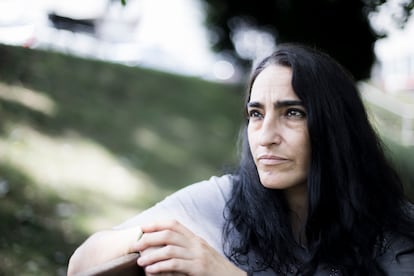
They decided to move to Galicia at the end of 2017 because Tamara’s father was very ill. They separated six months later. Tamara survives on state aid, although she has always worked as a waitress: “I loved to laugh, to have a good time with customers; many people now tell me I’ve become boring.” She suffers from depression and has attempted suicide more than once. “He has killed me while I’m still alive,” she says, the only time all day her voice breaks. She thinks of how he violated her most intimate security — the safety of being in her own home with someone who supposedly knew and loved her most. “I’m not capable of having a partner now because it scares me, it overwhelms me. I distrust everyone,” she adds.
The last time they spoke was at the gas station where he began to work after they separated. She, who already knew everything at that point, went to fill her tank and look him in the eye to see how he reacted. She relives it in horror: “He says to me, ‘How beautiful you look, long time no see, your short hair suits you so well.’ I didn’t even know how to answer. I gave him the money and left.” She was never able to locate him again; he changed phones and closed his social media accounts. Fernández Varela says the images that the police showed her included other women. She says she only recognized his first wife and tried to warn her via Facebook, but the woman blocked her. This newspaper has not been able to determine whether the ex-wife has been notified or is aware of the ongoing judicial process.
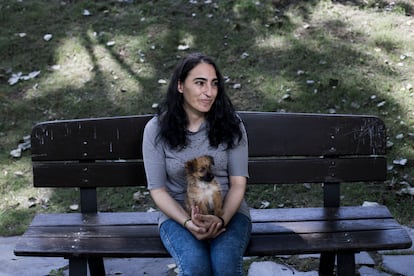
“I’d stake my life that he’s still doing it. One day in the future there will be news that he’s done this to others and it could have been avoided,” she laments. The Provincial Court rejected requests for an international arrest warrant because it felt that “there are no sufficient indicative elements, beyond the foreign nationality of the accused, that he is in a foreign country.” The crime he has been indicted for prescribes after 15 years.
“Until he shows up and pays for what he has done, I will not be at peace,” the woman repeats. Tamara never found the right words to talk about this violence with her daughter. A few weeks ago the latter turned 18 and told her she was proud of her, and that telling her story was what she had to do. The support from those around her gives her courage: “I felt guilty for not realizing what was happening, but we don’t have to hide.”
At the moment, Tamara Fernández Varela is moving house. While putting things away at home this past Thursday, she found the court notice that started the nightmare. The one she looked at and cried over so much. She had put it away so carefully that she had never come across it since. But something told her she would find it again.
Sign up for our weekly newsletter to get more English-language news coverage from EL PAÍS USA Edition











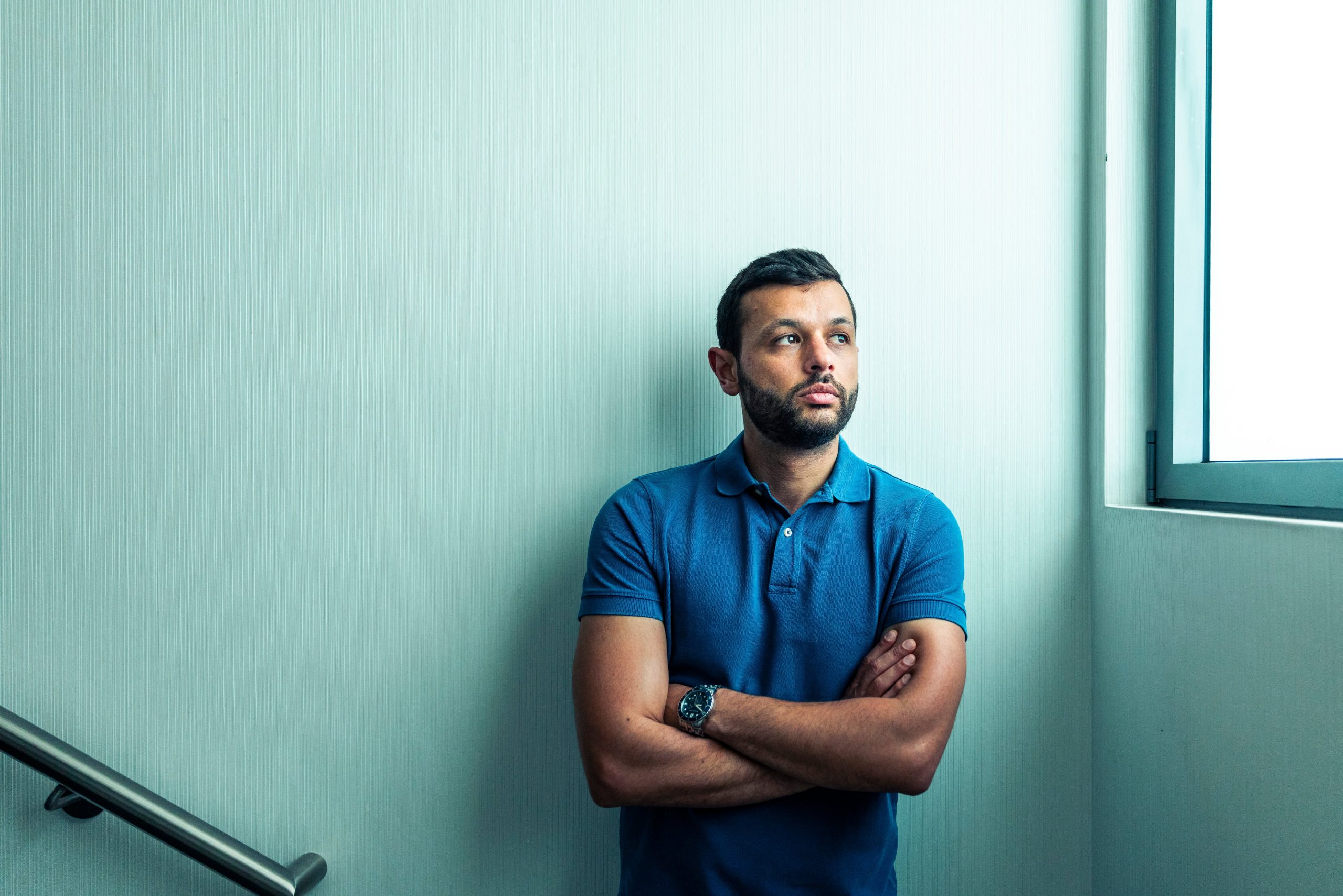
Arab Barghouti (Jerusalem, 35) says that “at the end of the day” he does not think of Marwan Barghouti as a politician, nor as the Palestinian leader of the Second Intifada (2000–2005), who was sentenced by Israel to five life terms in a trial full of irregularities 24 years ago. He thinks of himself as the son who wants his father “to come home.”
Marwan Barghouti (Kobar, 66) is the only Palestinian leader who commands consensus, even among Hamas fundamentalists. That “unified leadership,” his son argues, is “the reason” he believes Israel refuses to release the man known as “the Palestinian Mandela” (Nelson Mandela himself drew parallels between their experiences).
Arab Barghouti spoke with EL PAÍS on June 3 in Madrid. Among other events, in the Spanish capital he met with representatives from all parliamentary groups in Congress except those from the conservative PP, far-right Vox, and pro-independence Junts per Catalunya, as part of the “Free Marwan” campaign to call for his father’s release.
Question. Like you, many Palestinians grew up with parents in prison. What does the imprisonment of Palestinians represent for Israel?
Answer. It is collective punishment and an instrument of the occupation used to silence, oppress, and de-legitimize the Palestinian people’s right to self-defense. Over the past 58 years, more than 800,000 Palestinians have been imprisoned, one-third of them under administrative detention [without charges or trial], which is unlawful under international law. It affects every Palestinian family. As my mother [lawyer Fadwa Barghouti] noted, after October 7, 2023 [the day of the Hamas attacks and the start of the Israeli offensive in Gaza], mass incarceration has become a continuation of the genocide.
Q. You have denounced several assaults on your father in prison. How is he now?
A. His lawyer saw him a few weeks ago and said he was assaulted again at the end of April and also on May 12. Those attacks continue because Israel knows what my father represents. We are facing a deranged prison system that has killed more than 100 Palestinian political prisoners [since October 7, 2023]. That shows how desperate they are, because they fear a man behind bars, whom they lock in a cell and prevent from receiving medical treatment or [sufficient] food. My father has lost more than 10 kilos and has been held in solitary confinement for more than two and a half years, but he remains positive and very strong mentally.
Q. When Israel’s national security minister, Itamar Ben-Gvir, threatened your father on camera, you said that was the representation of the Palestinian struggle. Why?
A. Because there you had a bully, a fascist like Ben-Gvir, who tried to humiliate my father in front of the whole world just to show off. He is a convicted terrorist even in Israel. He is also a perfect reflection of what Israel is today. To me it makes no sense that world leaders do not speak out against Ben-Gvir and the horrific treatment he gives Palestinian political prisoners. That he is allowed to do whatever he wants demonstrates the state of the international community. My father, with his weakened body, represents the Palestinian people. When the Palestinian people starve, he starves; when a Palestinian is attacked, he is attacked. He is someone who embodies the Palestinian history and struggle.
Q. Israel has repeatedly refused to free him, most recently when Hamas demanded his release as part of the October ceasefire in Gaza.
A. My father supports coexistence and a political solution in Palestine. And that is why he remains in prison. In the past 15 years, Israel has released more than 800 Palestinians serving life sentences like his, in cases that, according to them, were more complicated than my father’s. Israel does not want peace with the Palestinians; it wants one of two options. The first is the ethnic cleansing of the Palestinian people, which occurs every day: in Gaza, where they already control more than 60% [of the territory] and where they have killed dozens, if not hundreds, of people; and in the West Bank, where settler terrorism has expelled 40,000 Palestinians. The second option is perpetual apartheid. They do not want a two-state solution or peace. That is why they refuse to release a unifying Palestinian leader who believes in international law, in coexistence and in peace, but who will never renounce the Palestinians’ right to achieve freedom, self-determination, and independence.
Q. How do you explain that Hamas, an Islamist faction, respects your father, who is a leader of the secular Fatah [the main PLO movement]?
A. My father was brave regarding the peace process, but also regarding the Palestinians’ right to defend themselves. He advocated for peace in the 1990s and met with Israelis in Tel Aviv, in Europe, in Palestine and elsewhere. He later understood that the Israelis had not committed to the Oslo Accords nor to the Palestinian people’s right to their own state. That was when he decided to tell the people what to do as a member of parliament during the Second Intifada. From then on, he became the face of that uprising. He is also a highly educated man who taught hundreds of Palestinian prisoners who, upon release, became ambassadors of his political vision and spread his message. Above all, he is a unifying figure.
Q. Does your father still see a two-state solution as possible?
A. My father understands that the Israelis are undermining that solution by building more and more illegal settlements and stealing more Palestinian land. But at the same time, he does not insist on the final form of the two-state solution. Our goal is freedom, dignity, and independence, whatever the ultimate shape of the solution may be.
Q. In 2015, Marwan Barghouti wrote that Israel used negotiations “to advance its colonial project.” Is that prophecy coming true?
A. My father understands what we’re up against, especially now that we’re dealing with an Israeli government as terrible as any we’ve ever seen before. However, the idea that peace in the Middle East can be achieved without addressing the Palestinian question is a myth. There will be no peace or stability in the Middle East without an answer to the Palestinian question. And I hope the international community understands that the only way to confront the Israeli regime, its apartheid, occupation, and war crimes is by sanctioning and isolating it.
Q. That is not the trend the EU is showing by maintaining its association agreement with Israel.
A. Some EU leaders are complicit in the shedding of our blood and the killing of our children, as are leaders of other countries, but we must focus on the future because we owe it to Palestinian children. I am here to build bridges with the EU, with all countries. Even with the governments of the United Kingdom and the United States.
Q. What role does the Palestinian Authority (PA) play in the current political paralysis?
A. I belong to a generation that is very critical of the PA for its inability to protect the Palestinian people, but what I blame them most for is not holding elections when political renewal is essential in Palestine. Right now we welcome all the measures President Mahmoud Abbas is taking, such as the local elections two months ago or the internal Fatah central committee vote a month ago, in which my father was re-elected with the highest number of votes among the candidates. We hope elections are held for the PLO’s Palestinian National Council, which would act as the parliament we do not have, making the whole system dysfunctional. We also trust that general elections will take place, which are essential for the Palestinian Authority to recover its legitimacy and indispensable to achieve political unity between Gaza, the West Bank, and East Jerusalem.
Sign up for our weekly newsletter to get more English-language news coverage from EL PAÍS USA Edition

Six people were stabbed at Penn Station, New York’s main intercity rail hub and its busiest station. The attack occurred on Sunday after 7.00 p.m. local time (1.00 a.m. CEST) between 33rd Street and Seventh Avenue, the New York Fire Department told local media. The incident comes as the city is on a high security alert ahead of a planned presidential visit on Monday by U.S. President Donald Trump, Game 3 of the NBA Finals, and the start of the FIFA World Cup.
Five of the six victims were taken to Bellevue Hospital. One suffered serious injuries, two sustained moderate injuries, and the remaining two were lightly injured. The sixth victim was admitted to NewYork-Presbyterian Hospital, the city’s emergency services said.
The suspect was arrested by police at the scene, but authorities have not released his identity or confirmed a possible motive. City comptroller Mark Levin suggested the assailant may have been experiencing a mental health crisis, and said the incident raises questions about the city’s psychiatric health network. The investigation, however, remains open.
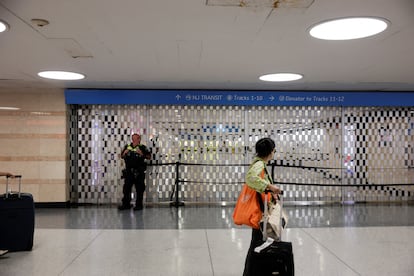
The incident came hours after the official watch party for Game 3 of the NBA Finals at Madison Square Garden, scheduled for Monday, was canceled. The game will pit the New York Knicks against the San Antonio Spurs. Officials said the cancellation was due to increased security measures related to the expected attendance of Trump and New York City Mayor Zohran Mamdani. “My heart is with everyone who was injured, their loved ones, and all those shaken by this unacceptable violence,” the mayor wrote on social media. “I’m wishing each of the victims a full and speedy recovery,” he added.
I’ve been briefed on the horrific stabbing at Penn Station. Based on the information available right now, six people were stabbed and the alleged perpetrator is in custody following a swift response from the Amtrak Police Department.
My heart is with everyone who was injured,…
— Mayor Zohran Kwame Mamdani (@NYCMayor) June 8, 2026
New York City Police Commissioner Jessica S. Tisch had recently warned about the huge workload facing the force, not only because of the decisive phase of the NBA Finals but also because of the imminent arrival of the FIFA World Cup.
Matches in the tournament, which kick off on June 13 in neighboring New Jersey, will make New York the base of operations for thousands of international fans.
Security at the World Cup in the United States regained international prominence this weekend after reports that nine people were wounded in a shooting near England’s national team base in Kansas City on Saturday.
Sign up for our weekly newsletter to get more English-language news coverage from EL PAÍS USA Edition

WATCH: Kim Kardashian steals F1 Monaco GP winner Antonelli

Los “doce Sucios”: Estos Son Los Grandes Bancos Que Disparan La Financiación Del Sector Fósil Espoleados Por Donald Trump

España Goza En Su Escala En México


-
 Argentina2 weeks ago
Trump Receives Flávio Bolsonaro In The Oval Office Three Weeks After Lula
-

 Uncategorized1 week ago
Montoya vs Brundle BEEF, Newey
-
 %2 weeks ago
Tourist Begs Police Not To Fine Her After Swimming In The Trevi Fountain During Heatwave
-

 Anthropic2 weeks ago
The IPOs Of SpaceX, OpenAI And Anthropic Threaten To Drive Wall Street To Bubble-Like Levels
-

 Foreign demand1 week ago
German Demand For Spanish Property Cools After A Strong Run
-

 %1 week ago
The Rising Cost Of Finding Love
-

 New Developments1 week ago
Luxury Villas For Sale, Estepona – ProjectL1
-
 %1 week ago
Major Strike In Portugal To Cause Widespread Disruption To Air And Rail Travel