
ElPais
Primary Elections In New York, Maryland, And Utah: Date And How To Vote







Aubrey Plaza
Aubrey Plaza Shows Off Pregnancy With Boyfriend One Year And Four Months After Husband’s Death: Social Judgment Remains Relentless


Aubrey Plaza posed with her partner, the actor Chris Abbott (who played Charlie, Marnie’s boyfriend, on the TV series Girls), at the Tony Awards wearing a dress from Chanel’s Coco Beach 2026 collection that showcased her pregnancy. People magazine broke the news that they were expecting a baby last April. That the actress (who rose to fame on the series Parks and Recreation and was one of the leads in the second season of The White Lotus) is pregnant has angered those who believe that she has moved on too quickly, since 15 months have passed since her husband, the screenwriter and filmmaker Jeff Baena, was found dead in his home. This is not the first time the actress has been singled out. After Baena’s death was ruled a suicide, reports emerged that the couple had been separated since September 2024. Some blamed her as if, in some way, she were responsible for his death.
Those who think she hasn’t taken enough time to grieve find their views reinforced by outlets such as Page Six and The New York Post. “Actress Aubrey Plaza pregnant with her first baby one year after her husband’s death,” both outlets headlined the pregnancy, emphasising how much time had passed since the tragic date.

If a widower had rebuilt his life that ‘quickly,’ would the reaction have been the same? Let us not forget that one of the most iconic romantic comedies in film history is Sleepless in Seattle (1993), in which Tom Hanks plays a widower whom people urge to find love again. Yet many viewers thought Carrie Bradshaw moved too quickly in And Just Like That when, after her husband’s death in the first episode of season one, she began dating again by the middle of season two. The editor of the book in which Bradshaw addresses grief told her she needed to start dating to “give readers a little hope.”
Mónica Lidón, an author who has written on the subject, says that culturally society still judges grief and new relationships differently depending on who experiences them. “It is often understood or accepted sooner when a man rebuilds his life after a loss, while when a woman does so there are more judgments, more questions and even external feelings of guilt. However, each grieving process is unique and should not be conditioned by social expectations or by the gender of the person going through it,” this grief expert said.

José González, author of La tristeza cura (or Sadness Heals), agrees: “When a woman starts a new relationship, judgments about loyalty, emotional fidelity or even guilt appear more frequently. We still carry certain cultural stereotypes. We expect women to take on the role of guardians of family memory and emotional bonds. When they rebuild their romantic lives, some people mistakenly interpret that they are abandoning that role.”
He believes one of the greatest mistakes society makes is trying to measure grief by a calendar. “Dates reassure us because they are objective, but grief is an emotional and relational phenomenon, not a chronological one. Some people need years to reorganize their lives after a loss, and others begin a new relationship relatively soon. None of those situations, by themselves, tell us how much they loved the deceased. Love is not measured by how long we remain alone,” he says.
He is concerned about the debate sparked by Aubrey Plaza’s pregnancy. “The truly relevant question is not how much time has passed, but how the person is experiencing the loss, what meaning the new relationship has for them and whether both experiences can coexist in a healthy way. The calendar tells us how much time has passed; it does not tell us how much emotional ground has been covered. In grief, emotional time does not align with social time,” he stresses.
Seven months after Jeff Baena’s suicide, Plaza appeared on Good Hang, the podcast hosted by her friend Amy Poehler. The comedian asked how she had been coping. “At all times, there’s, like, a giant ocean of just awfulness that’s just right there and I can see it,” she said. “Sometimes I just want to dive into it and be in it. And sometimes I look at it and sometimes I just try to get away from it, but it’s always there.”
Raquel Mascaraque, another researcher who has written ¿Me quieres o qué quieres? (or Do You Love Me or What Do You Want?) notes that no one knows what kind of grieving process the actress has experienced. “Perhaps she experienced it within the relationship. This is called anticipatory grief because it occurs before the loss actually happens. There is a moment when you realize the relationship has no future and you begin to process the loss while the person is still present. Often it is an unconscious process to protect ourselves, and you can experience sadness, guilt, anger, fear of uncertainty, even loneliness because no one around you knows what you’re living through, but at the same time it prepares you for the loss. That does not mean grief disappears completely once the loss is official, or, of course, that a new grief can’t emerge when, in this case, an ex-partner takes their own life even if you are no longer in a relationship,” she says.
Lidón notes something she frequently sees in her practice. “In addition to managing the pain of the loss and everything involved in rebuilding a life that has been completely devastated, they have to face judgment from others. There is a huge need to feel understood, but they often receive criticism about how they should be grieving. Many people end up questioning their own emotions and feeling forced to constantly justify themselves. And that is very frustrating, because it never seems to be enough,” she says. “If you move on, you are judged for doing so too quickly; if you don’t move on, you are judged for continuing to suffer. When a person is so vulnerable, these kinds of comments do not help healing; they add another burden to the process and increase the suffering. That is why it is so important to understand that there are no universal deadlines for grief. Each person has their own timing, their own resources and their own way of adapting to such a significant loss.”
And with that in mind, Mascaraque says that what matters is not that time passes, but what is done with it. “What we seek is evolution, growth and the development of new tools that help us manage and regulate our emotions, and that requires work. Perhaps it is not so much about thinking whether you are ready for a new relationship, but about asking whether you lose sight of your relationship with yourself when you share space and time with another person,” she says.
As Noelia Ramírez says, “on television it is not easy to free women from grief.” Apparently, off-screen life is no different.
Sign up for our weekly newsletter to get more English-language news coverage from EL PAÍS USA Edition

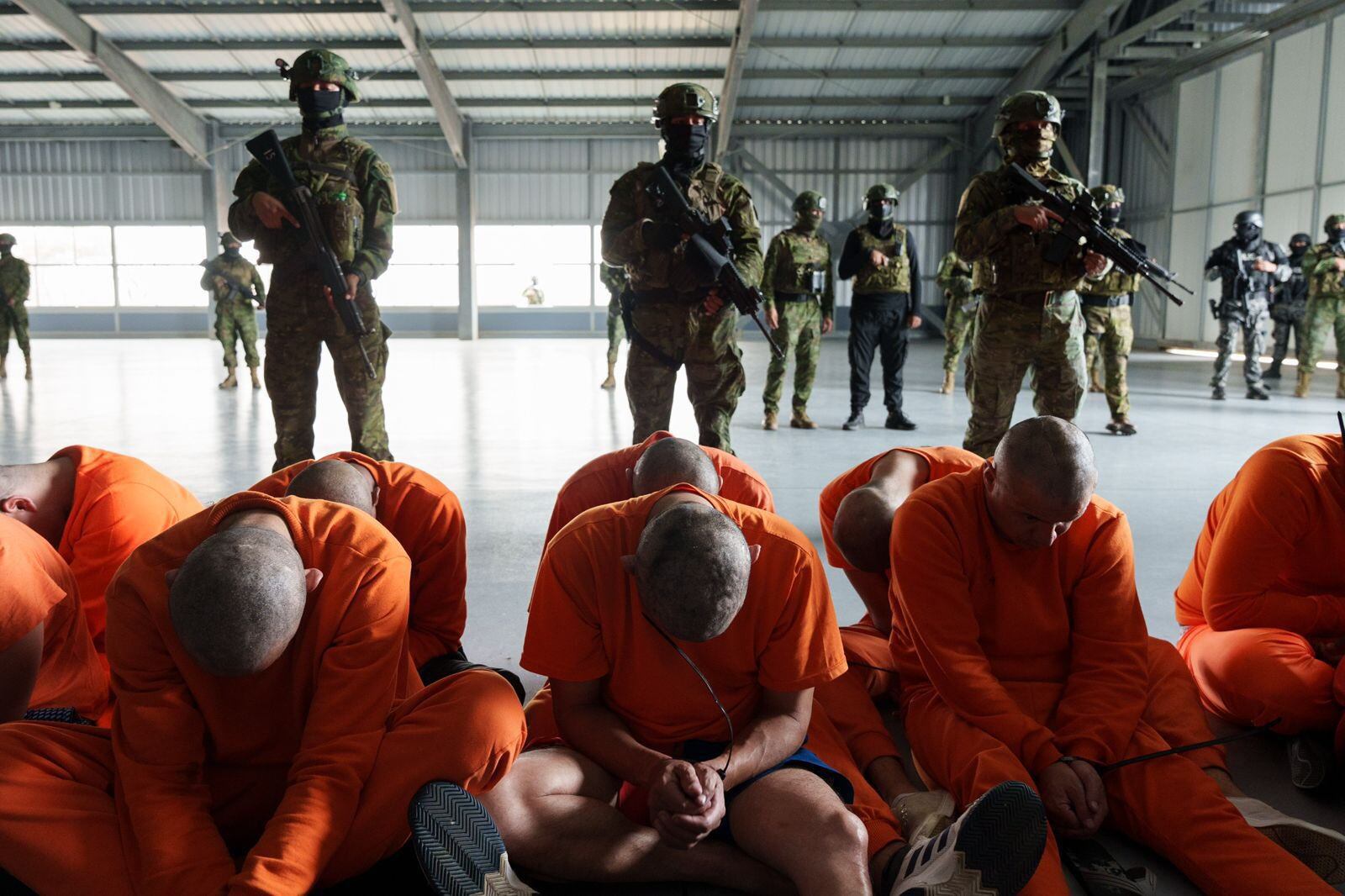
The last time Verónica saw her son was December 16, 2025. She had been working at the small food stand with which she supports her family — an improvised oven and some plastic tables and chairs alongside the highway that connects Quinindé with Esmeraldas on the northern coast of Ecuador. Starting early in the day, she had watched for the military convoy transferring her son to the maximum-security prison Encuentro, which was built in the middle of a forest, some 280 miles from her home. “It was as if God wanted us to see each other, because the vehicle stopped for a moment,” she remembers.
For a few seconds, Verónica managed to make out her 38-year-old son’s face, pressed against the glass of the window. “He looked at me and motioned for me to bless him. He couldn’t raise his hands because they were chained. I blessed him and then my daughter and I started to cry.” In her memory, that scene has become the worst day of her life. Ever since, she’s had no news of him.
For family members of prisoners, the name of Encuentro has become associated with fear. Inaugurated by the Daniel Noboa administration as an emblem of its war against organized crime, the prison was created following the maximum-security model that President Nayib Bukele turned into a symbol of his punitive policy in El Salvador. Part of the team that built Bukele’s Terrorism Confinement Center (CECOT) even advised on the construction of Encuentro.
The Ecuadorian penitentiary facility has been the subject of allegations of starvation, abuse and complaints connected to an outbreak of tuberculosis and a lack of medical attention. Fear as to prisoners’ safety has only increased due to the hermeticism with which authorities manage information about those behind its walls. Families go weeks or months without news of their relatives and on occasion, are only informed when they are transferred to another prison, or of their death.
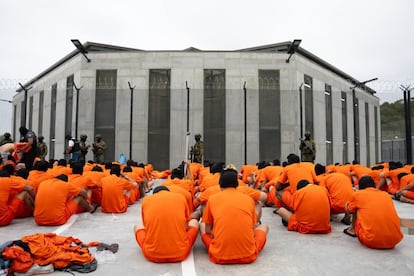
Three inmates died in May at the prison. Two of their deaths were attributed to tuberculosis, the other to pancreatitis. “No one dies from pancreatitis from one day to the next,” says Ana Morales, spokesperson for the Committee of Families for a Dignified Life In and Out of Prisons (COFAVID). “If someone dies from that cause, what happened was a lack of timely medical attention.”
A lack of information about those who are sent to Encuentro has also led to questions. The last person who died in the prison was a trans woman who had no criminal sentence in Ecuador, according to a complaint lodged by the Silueta X Association. “The United Nations’ Bangkok Rules are binding in Ecuador. A trans woman incarcerated in a maximum-security prison, with no clear sentence and with no documented gender-based protocol was not invisible, she was the responsibility of the state,” says Zackary Elías, deputy director of the organization, who is demanding an investigation under inter-American standards.
Most of what is known about the conditions inside Encuentro has come from the testimonies of prisoners who have been transferred to other facilities, and from information leaked by penitentiary officials. One of those leaks were photographs of the transfer of 11 out of 35 inmates diagnosed with tuberculosis to the Guayaquil regional prison, according to documentation provided by COFAVID.
The photos were taken during a nighttime transfer. Under spotlights, a line of prisoners moves slowly forward in the darkness. They are extremely thin, just skin and bones. Some can barely stand on their feet, and look for help from the equally fragile bodies walking next to them. One needs to be supported underneath both arms to stay upright. Another seems unable to lift his head.
There has been no comment on the images from the government. After a few days, Minister Nataly Morillo, in an interview with the media outlet Visionarias, confirmed that the transfer had taken place. “Every person deprived of their liberty in the Encuentro prison is in their space, their environment, they have the areas they need, there is no epidemic in the penitentiary system,” she said.
State negligence and torture
The allegations concerning Encuentro have arisen amid a silent transformation of the Ecuadorian prison crisis. An investigation by Tierra de Nadie and Connectas led by journalist Karol Noroña found that in 2025 there were a record 1,220 inmate deaths, or more than three a day, one every seven hours.
In contrast to the years of gang massacres, many of these deaths were documented by the state as “natural” or stemming from “indeterminate” causes. The finding points to a shift in the prison crisis: inmates are no longer dying from organized crime violence alone. Now, they also die from illness, negligence and a lack of medical attention.

Accusations also point to alleged systematic abuse. Morales says that former inmates have spoken of daily punishments and degrading conditions. “Torture is continuous. There is a select group who is tortured on a daily basis,” she says. Among these alleged practices are inmates being woken up at dawn and submitted to physical and psychological aggressions. “They wake you up at three in the morning, throw water on you and put a gas mask on you. This has caused heart attacks,” she says. Morales says that inmates have even left the prison with permanent injuries. “We have one person who came out disabled after being struck on the spine with a club,” she adds.
Several testimonies describe extreme physical deterioration that fits with the photographs that were made public. “There is dengue, malaria, tuberculosis, malnutrition, dehydration,” Morales says. According to her, a lack of water is one of the primary problems in the penitentiary facility. “There’s no water there. They give you a tiny amount of water and that water is very contaminated. It comes out completely black, like chocolate, and that is the water they drink,” she says.
The availability of basic services was on the list of criticisms and warnings received when it was announced that the prison would be built in the middle of a protected forest that belongs to an ancestral Indigenous community. Towns nearby the prison have always suffered from a lack of potable water. Residents rely on tanker trucks and the river for their water supply, and the latter has now been polluted by the prison’s runoff.
Isolation and military control
Isolation is one of the characteristics that distinguishes Encuentro from other Ecuadorian prisons. Members of the military monitor and restrict travel down the road that connects nearby towns. Only inhabitants who have proven they are from the area are permitted to pass a military checkpoint. Families are not allowed to approach the facility’s perimeter nor request information on inmates. In this prison, inmates have no right to visits.
One of the few exceptions to this rule is the mayor of Guayaquil, Aquiles Álvarez, who has been incarcerated in Encuentro since February, despite never having been convicted of a crime. After outcry was raised by his family and defense team, authorities authorized a weekly video call under the supervision of penitentiary officials. After nearly four months of imprisonment, those close to him say he has lost more than 50 pounds.
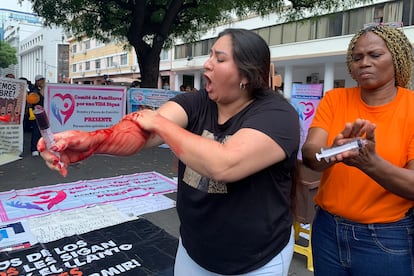
The government, which denies the existence of any prison crisis or tuberculosis outbreak, justified the mayor’s drastic physical deterioration by saying that he was “watching what he eats,” according to Minister of the Interior John Reimberg. Later, those statements were qualified: officials said the mayor was carrying out a legal strategy. “Since Aquiles’ defense has not managed to get him out of jail, what do they tell him? Don’t eat. And he doesn’t want to eat,” said Reimberg.
Former vice president Jorge Glas, who was sentenced on charges of corruption and was one of the first prisoners to be transferred to the facility that authorities have dedicated to the fight against terrorism, has made similar allegations. Glas says he has not received adequate food and is suffering systematic torture.
Vivian Idrovo, coordinator of the Alliance for Human Rights Ecuador, says that prisoners have been a population that the state is willing to sacrifice. “They commit serious human rights violations to justify these cruel measures,” she says. In her eyes, the militarization of the penitentiary system has not managed to contain the advance of organized crime. “They focus on this population to cover up the inaction of the state in the fight against criminal economies, like for example, money laundering,” she says. “It is a dehumanization. The cruelty is exhibited, as if cruelty were an antidote to organized crime.”
Sign up for our weekly newsletter to get more English-language news coverage from EL PAÍS USA Edition



The San Roque Club – Townhouses For Sale

Primary Elections In New York, Maryland, And Utah: Date And How To Vote

El Escándalo Del Banco Master En Brasil Golpea A Un Líder Del Partido De Los Trabajadores Cercano A Lula

Peru’s Roberto Sánchez And Keiko Fujimori Urge Caution As Vote Count Continues In Very Tight Presidential Election

Spain, A Country Of 50 Million People With Infrastructure For 40 Million: ‘The Cracks Are Starting To Show’
A Journey Through The Ages Of Soccer In The United States


-
 Alberto Fujimori1 week ago
Peru’s Roberto Sánchez And Keiko Fujimori Urge Caution As Vote Count Continues In Very Tight Presidential Election
-
 Barcelona2 weeks ago
Spain, A Country Of 50 Million People With Infrastructure For 40 Million: ‘The Cracks Are Starting To Show’
-
David Beckham2 weeks ago
A Journey Through The Ages Of Soccer In The United States
-

 Arthur Miller2 weeks ago
The Enduring Fascination With Marilyn Monroe: The Actress’s Lipsticks, Bras And Frying Pans Fetch $2 Million At Auction
-
Latest2 weeks ago
Today In Spain: A Roundup Of The Latest News On Friday
-
Costa del Sol2 weeks ago
Marbella releases full beach rules for Noche de San Juan bonfires in 2026
-
Latest2 weeks ago
Inside Spain: How Drinking Is Becoming An Old Man’s Game
-
Almeria2 weeks ago
Balerma ranks as Spain’s most exposed location to tsunami from Averroes fault