
ElPais
From Wallis Simpson To Pippa Middleton: The Long History Of Wedding Guests In White

Fortunately for Wallis Simpson, TikTok did not exist on August 3, 1950. Had it happened today, her arrival at that wedding would probably have become a viral video, followed by thousands of indignant comments and, who knows, perhaps even a glass of wine spilled not entirely by accident on a guest’s dress. Because yes: she arrived late, dressed in white, and stole all the attention.
That morning in Cannes, the U.S. millionaire Herman Livingston Rogers was marrying Lucy Fury Wann, the widow of British Air Commodore Archibald Herbert Wann. Rogers was no stranger to international high society. An engineer educated at Yale and MIT, he had inherited a substantial fortune and had for years been one of the Duke and Duchess of Windsor’s closest friends. He had taken Wallis Simpson in after the turbulent end of her first marriage, acted as an intermediary with the press during Edward VIII’s abdication, and even accompanied the couple through some of the most delicate moments of their exile in France. When Edward and Wallis married in 1937, it was Herman himself who gave the bride away at the Château de Candé. But Herman was more than just that.
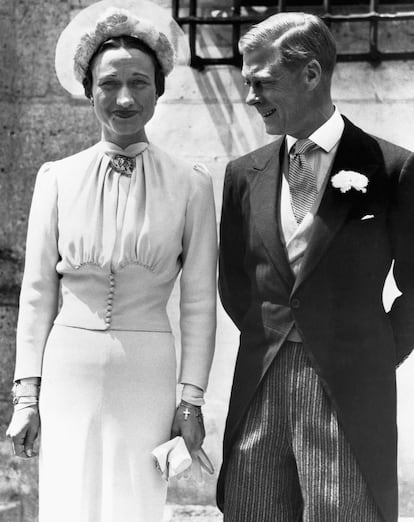
According to Andrew Morton in Wallis in Love, after the death of Katherine Moore, Herman’s first wife, Wallis believed the time had come to deepen her relationship with the man whom, she would later say, she considered the only one she had ever truly loved. While she was traveling in the United States, another Riviera regular, Lucy Wann, won over the millionaire. Upon learning of the engagement, Wallis sent Rogers a telegram bearing a line that today sounds as though it came straight out of a Hollywood script: “Do nothing until I return,” signed, “your guardian angel.” She did not arrive in time. Or perhaps she did, depending on how one looks at it. And she arrived dressed in white.
The ceremony was already over, but the reception was still underway. And then she appeared. Morton recounts that Wallis seemed determined to draw attention away from the newlyweds, making a late entrance in a white tulle gown that quickly became the focus of the room. Lucy’s retort was equally sharp: “You have got your king, but I have got your Herman,” she told Wallis.
Seen through the eyes of 2026, the episode seems tailor-made for social media: a former lover, a white dress, a theatrical entrance, and a bride forced to share the spotlight on her wedding day. Yet the reaction at the time was different. What scandalized people was not so much the color of the dress as the performance itself.
And that is the crucial nuance in this story. Although wearing white to someone else’s wedding is now considered one of the greatest breaches of etiquette, for much of the 20th century the rule was not nearly so strict. In international high society, overshadowing the bride was frowned upon, certainly, but it was more likely to happen through extravagant jewelry, a Balenciaga fresh from the atelier, or simply by being Wallis Simpson — the woman for whom a king had given up the British crown. The white dress was merely one element of that display.
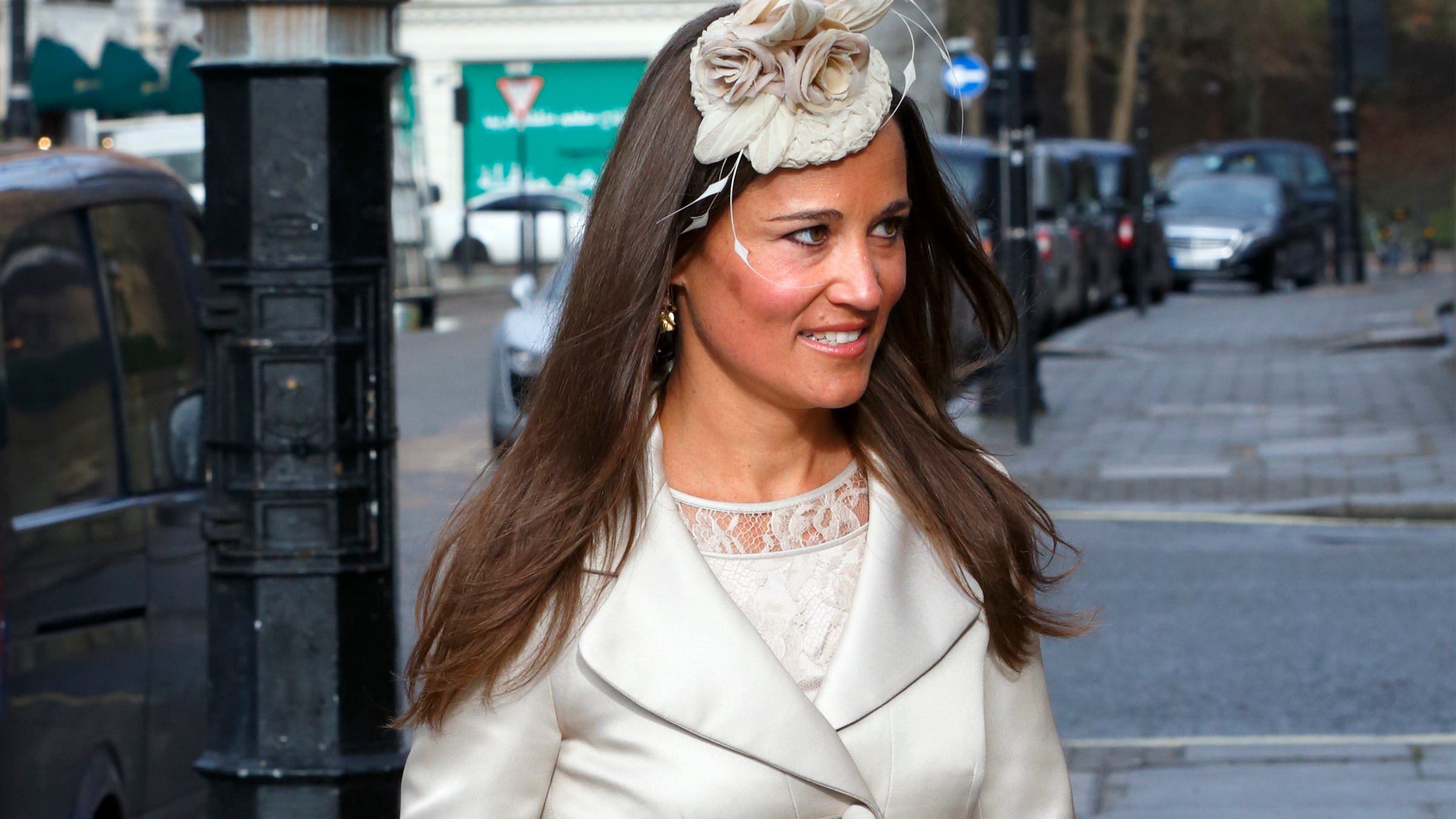
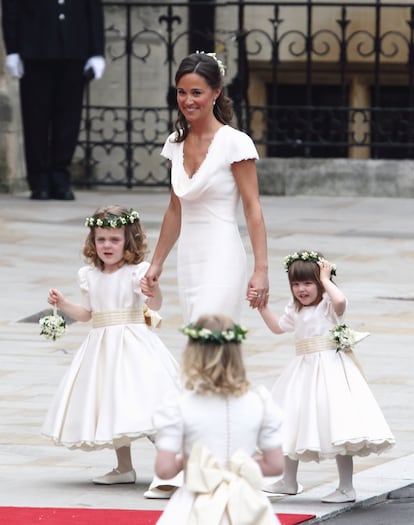
Another wedding that frequently resurfaces on social media whenever this debate is revived is that of Jacqueline Bouvier and John F. Kennedy in 1953. Lee Radziwill was her sister’s maid of honor and wore a dress of such a pale ivory shade that, in photographs, it appears almost white. At the time, no one interpreted it as disrespectful. On the contrary, it was common for U.S. bridesmaids to wear cream or ivory tones — a tradition that remains common today, for example, within the British royal family. Remember Pippa Middleton at the wedding of Kate Middleton and Prince William? Or when, as a guest at the wedding of Arabella Musgrave and George Galliers in 2014, she herself wore ivory-white to the ceremony? Would Lee be “cancelled” today? Would that be considered “worse” than looking as dazzling as the guests at Nate and Cassie’s wedding in Euphoria?
The explanation for the taboo goes back much further. Although it may now seem like an age-old tradition, the white wedding dress is a relatively recent custom. It was Queen Victoria who popularized the choice when she married Prince Albert in 1840 wearing a cream-colored silk gown trimmed with Honiton lace. Until then, even royal brides married in red, blue, silver, gold or simply in the finest dress they already owned. White could be among those options because it symbolized the height of luxury: it was difficult to keep clean and therefore a visible display of wealth.
The real revolution came after the Second World War. Growing economic prosperity meant that more and more women could afford a dress intended exclusively for their wedding day. Hollywood did the rest. Images of Grace Kelly marrying Prince Rainier of Monaco in 1956 cemented the ideal of the bride in white as a genuine fairy tale. Other weddings also left a lasting mark on the public imagination, such as that of Bianca Pérez-Mora Macías, better known as Bianca Jagger, who made headlines in 1971 when she married Mick Jagger in Saint-Tropez wearing a white Yves Saint Laurent jacket over her bare torso, paired with a long skirt and a wide-brimmed hat (a look that inspired Dua Lipa for her own wedding in 2026); and that of Diana Spencer and the then Prince Charles in 1981, watched by 750 million viewers around the world.
White had ceased to be merely an elegant color and had become a symbol: that of the undisputed star of the wedding. “I find it quite amusing that one of the most difficult colors in the palette is the one women traditionally choose to wear on one of the most significant days of their lives,” Lorenzo Caprile told EL PAÍS.
In his view, white is a difficult color “because of the way it reflects light. For white to suit you, you have to have very striking, dark coloring. On pale women it washes them out even more.”
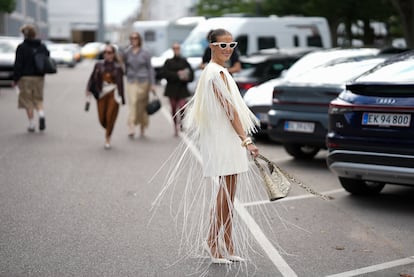
In any case, there is now a broad consensus — at least in the West — that guests should not wear white to a wedding when there is a bride.
“The simple answer is no,” declares the U.S. edition of Vogue. On TikTok, the debate remains lively: one of the platform’s most-viewed videos on the subject, with more than 28 million views, shows two wedding guests dressed in white and ends with a plea that captures the prevailing sentiment online: “Please never wear WHITE at someone’s wedding. It is sad and disrespectful.” The platform is full of videos calling out friends, guests, and even mothers of the bride who turned up in white, much to the collective disapproval of viewers.
Perhaps that is why the Wallis Simpson anecdote feels so fascinating today. It illustrates how changing social attitudes transformed the meaning of wearing white, and why something that would now provoke outrage was interpreted very differently 70 years ago.
Sign up for our weekly newsletter to get more English-language news coverage from EL PAÍS USA Edition


ElPais
Jeanette Serritzlev, Military Analyst: ‘Crises Are Already Here; It’s Not About Being Afraid, But About Being Prepared’

America
Woman Rescued In Brazil After Being Enslaved For 55 Years By Three Generations Of The Same Family

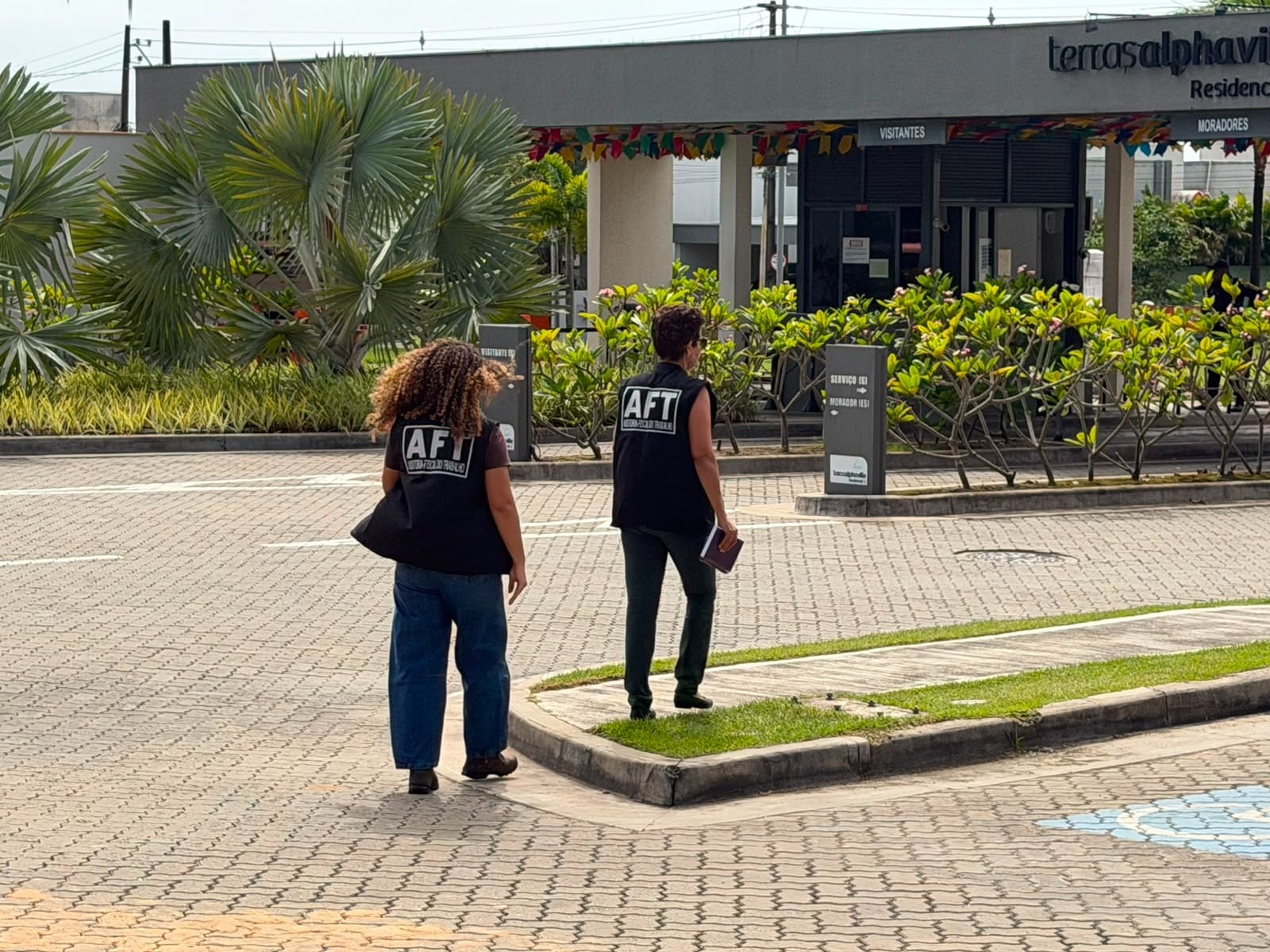
We’ll call her Maria, the most common female name in Brazil, because authorities have not disclosed her real name in order to protect her identity. Maria, who was sent to work as a live-in domestic servant for a family at the age of seven, has just been rescued at 62 in the northeastern city of Fortaleza by Brazil’s Labor Prosecutor’s Office after spending more than half a century in slave-like conditions — with no pay, no vacation and never having learned to read or write.
The domestic worker was exploited by three generations of the same family, an unusual but not unique case. She was still waking up at 4:30 a.m. to prepare breakfast and get children ready for school. Although the family has agreed to compensate her, Maria, who lived in near-total isolation and without contact with her relatives, will remain with her employers, while authorities try to locate her family.
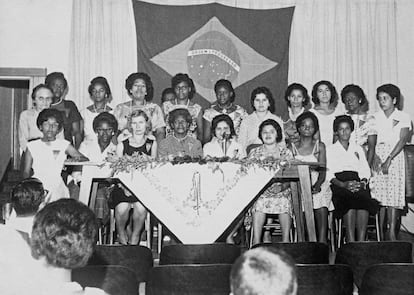
Statistics suggest that Maria was undoubtedly poor and, most likely, Black. That is the profile of the more than six million Brazilian women who care for children, cook, wash, iron, and clean in households other than their own. They only won full labor rights a little more than a decade ago.
Maria did not handle money, had no bank account, and no friends. She had never gone to the beach by herself. “She lived in a kind of prison,” Maria Neuzeli, a prosecutor specializing in the eradication of domestic slave labor, told local media. “She didn’t know how to get around the city, she was afraid of the violence outside. And because she was given clothes, food, and shelter, she felt she was being paid for her work.”
Specialists explain that because the exploitation begins in childhood, victims are often unaware of the seriousness of the abuse. Moreover, they know no world beyond that household. Maria’s mother had also worked for the same family.
The family accused of keeping her in conditions of slavery is white and has the surname Brasil — a detail loaded with symbolism for a form of exploitation that specialists regard as a legacy of slavery, which was abolished in Brazil in 1888.
The current employers, the third generation of the Brasil family, have reached an agreement with labor prosecutors under which they will purchase an apartment worth $30,000 for the victim, “fully furnished and equipped with household appliances,” according to a statement from the Labor Prosecutor’s Office. They will also pay her an additional $10,000 in compensation.
“The signing of this agreement does not rule out the possibility that the worker may pursue individual claims through the courts,” the statement added.
Maria was exploited for 55 years by three couples spanning three generations: first two retirees, then a lawyer and a civil servant, and finally a veterinarian and another civil servant. According to the news outlet G1, they are also suspected of fraud. Prosecutors believe that, in addition to denying her wages for her domestic work, they appropriated the roughly $115 a month that Maria received through Bolsa Família, Brazil’s flagship anti-poverty program.
The Brasil family “categorically denies the allegations, which do not reflect the relationship of coexistence, care, and affection built over decades with the woman involved,” according to a statement released through a law firm.
Maria entered their lives around 1971 — the year Henry Kissinger visited China, John Lennon wrote Imagine, and Mexico hosted the first Women’s World Cup.
The shock generated by the case has been compounded by controversy over the authorities’ decision to allow Maria, for now, to remain with the family that enslaved her for 55 years.
Luciano Aragão Santos, the national coordinator for the eradication of slave labor, says that rescues in domestic settings are “even more complex” because victims are often stripped of their autonomy, cut off from family ties, and denied access to healthcare and education. For that reason, leaving such situations “requires a genuine effort toward the victim’s social reintegration, the restoration of family connections, and the construction of an independent and dignified life,” he said.
The concern is that Maria’s dependence on the exploiting family is so extreme that removing her abruptly, without a structured support network, could do more harm than good.
Maria is now at an age when wealthier Brazilians are already retired and, whether rich or poor, enjoy priority treatment in queues and when boarding airplanes.
The traditional maid’s room is gradually disappearing in Brazil, but buildings with separate social and service elevators — for domestic workers, visiting technicians, neighbors with dogs, or residents carrying groceries — remain commonplace.
This case of severe human-rights violations came to light thanks to an anonymous tip, something that is becoming increasingly common as public awareness grows and witnesses become more willing to report abuses.
Every so often, Brazil is shaken by the rescue of a domestic worker who has spent decades in slavery-like conditions in the home of an outwardly respectable family. The stories follow a familiar pattern, differing mainly in the details.
The turning point was the case of Madalena Gordiano, whose rescue in 2021 attracted enormous attention. After receiving compensation from the affluent family that had enslaved her, she gained her independence. She started a new life, made new friends, enjoyed swims in the ocean, and took Zumba classes, sharing her newfound freedom on social media.
Sign up for our weekly newsletter to get more English-language news coverage from EL PAÍS USA Edition

Costa Del Sol Business Leaders Urge Junta To Add ‘reversible’ Third Lane To A-7 Motorway – And Boost Case For Long-Awaited Railway
Bystanders and paramedics save 77-year-old swimmer after cardiac arrest on Murcia beach

Bystanders And Paramedics Save 77-Year-Old Swimmer After Cardiac Arrest On Murcia Beach

Última Hora Del Terremoto En Venezuela, En Directo | Exteriores Eleva A 9 La Cifra De Españoles Fallecidos En El Doble Terremoto De Venezuela
Spain tourists renting cars this summer warned over deposits, damage and hidden fees
Spain’s driving licence delays spark anger as learner drivers face months-long waits


-
 America2 weeks ago
Última Hora Del Terremoto En Venezuela, En Directo | Exteriores Eleva A 9 La Cifra De Españoles Fallecidos En El Doble Terremoto De Venezuela
-
car hire2 weeks ago
Spain tourists renting cars this summer warned over deposits, damage and hidden fees
-
driving license2 weeks ago
Spain’s driving licence delays spark anger as learner drivers face months-long waits
-

 Uncategorized2 weeks ago
When is the next F1 race? British Grand Prix schedule and details for 2026
-

 Antoni Gaudi1 week ago
Los Aficionados Al Ciclismo En Barcelona: “Que Venga El Tour De Francia Es Como Ir Al Mundial De Fútbol”
-
kamik2 weeks ago
Granada ring road horror: Wrong-way driver video goes viral
-
Calahonda2 weeks ago
Lorry snags power cable on A-7 in Mijas, creating danger for drivers and residents
-
Latest2 weeks ago
More Than 1,300 Excess Deaths Recorded In Europe Heatwave: WHO