
airport queue delays
British families flying to Spain face no guaranteed escape from border queues this summer

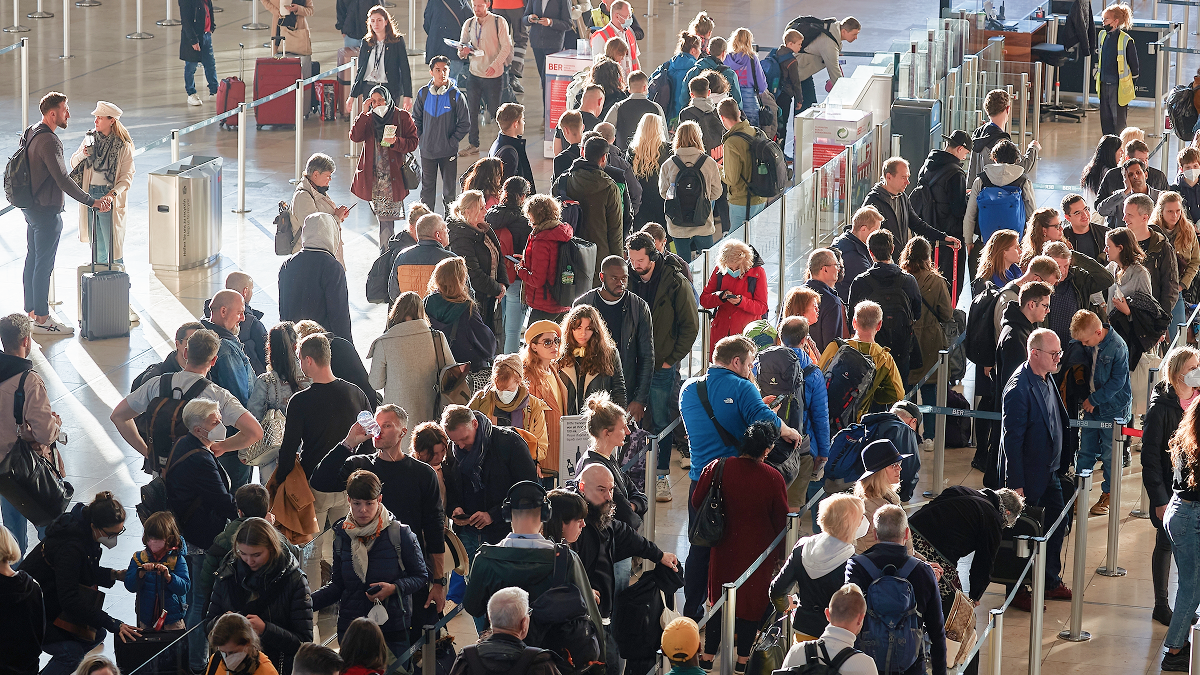
No blanket pause for border checks this summer. Credit: Desintegrator / Shutterstock
British travellers heading to Spain this July and August will not receive a blanket pause from the European Union’s biometric border checks. Brussels has rejected full suspension calls from airports and airlines, leaving travellers dependent on limited, airport-by-airport relief when queues become severe.
Border police can pause fingerprints but not passport checks
Families flying between Britain and Spain during the school holidays cannot rely on the European Union switching off its biometric border system if queues become unmanageable.
The European Commission has rejected urgent calls from airports and airlines for a full summer suspension of the Entry/Exit System (EES). EU officials said such a move was neither needed nor possible because border records must remain consistent across the Schengen area.
National border authorities can still temporarily stop collecting fingerprints and facial images when a particular crossing faces “exceptionally high pressure”. However, Commission spokesperson Markus Lammert stressed that this only applies to the initial collection of biometric information. Passports and travel records must of course still be checked.
EES digitally records the entry and departure of non-EU short-stay visitors, including most British tourists, replacing passport stamps with electronic travel records and biometric checks.
How queue relief may differ between European airports
The Commission’s position means there will be no single rule guaranteeing that biometric registration will be relaxed whenever queues build. The decision rests with the national border authority responsible for each crossing and can be taken on an ad hoc basis. One airport may temporarily stop taking fingerprints from first-time users, while another continues the complete process during a busy period.
EU officials have acknowledged difficulties at 20 of approximately 1,500 border crossing points. They argue that problems should be dealt with locally through additional staff, equipment and temporary flexibility rather than by suspending EES across Europe.
For passengers, this means that a journey through one airport in Italy may run relatively smoothly, yet another airport in southern Spain serving a similar number of British visitors could apply the checks differently depending on staffing, available kiosks and passenger numbers.
Families and tight connections remain the most exposed
Airports Council International Europe and airline groups told European Commission President Ursula von der Leyen that border waits had reached up to five hours during peak periods at some European airports.
Their open letter said the disruption was affecting families travelling with young children, elderly passengers and people with reduced mobility. It also described missed connections, delayed departures and aircraft reaching gate-closing time while passengers remained trapped at border control.
The five-hour figure applies across the entirety of European airports and should not be interpreted as a recorded waiting time at every Spanish airport. However, Ryanair has separately highlighted Alicante-Elche, Málaga-Costa del Sol, Palma de Mallorca and Tenerife South among the holiday airports where it believes staffing, kiosks and border capacity could come under pressure.
The aviation industry expects European airports to handle around 40 million more passengers during July and August than during the previous two months. This increases the risk of several flights arriving around the same time and overwhelming border facilities built for a much more steady passenger flow.
Brussels says border security gains justify keeping EES running
The European Commission says EES has already recorded approximately 110 million entry and exit movements and resulted in around 44,500 refusals of entry.
More than 1,000 people considered a security risk were reportedly stopped, while others were refused because they lacked an appropriate justification for their stay, had exceeded the 90-day visitor allowance or were using false travel documents.
EU officials have also warned that switching EES off in some countries but not others could leave incomplete travel records. A visitor registered on entry but not correctly recorded on departure could later appear to have overstayed.
For a British non-resident, that could become far more than a technical error. On a later trip, they may be stopped, questioned and required to prove that they left within the 90-day limit. Until the record is corrected, someone returning to Spain to see children, parents or grandchildren could face lengthy delays or even a refusal at the border, despite having left on time.
British residents in Spain should present their TIE immediately
British citizens legally resident in Spain with a valid foreigner’s identity card, known as a Tarjeta de Identidad de Extranjero (TIE), are exempt from EES registration.
UK government guidance says residents should actively present the TIE alongside their passport at Spanish border control rather than entering the biometric registration process as tourists.
The remaining flexibility allowing border authorities to ease biometric collection is due to end in September. As of July 7, no EU member state had formally requested that the measure continue beyond that point.
That September deadline will now be the next test for the tedious EES system. After the long summer rush, unless the rules are extended or the system becomes quicker, airports could lose their main emergency tool for reducing queues just as autumn travel and the October half-term period approach.








Sunset Symphony: Vera hosts weekly concerts beneath the summer sky

Tracy-Ann Oberman Refused Spain Flight
TUI’s new alcohol rule could change the traditional holiday warm-up


-

 Uncategorized2 weeks ago
F1 Qualifying Results: 2026 Austrian Grand Prix times and grid positions
-
 %2 weeks ago
Spain’s Heat Reaches Highest Level In 76 Years
-

 %2 weeks ago
Terminal Patients In Poland Ask For The Right To Say Goodbye To Their Pets
-

 America2 weeks ago
Última Hora Del Terremoto En Venezuela, En Directo | Exteriores Eleva A 9 La Cifra De Españoles Fallecidos En El Doble Terremoto De Venezuela
-
Latest2 weeks ago
EU Worries Jet Fuel Supply Situation To Worsen
-

 America2 weeks ago
DHS Inspector General To Investigate The Rise In Deaths And The Use Of Force At ICE Detention Centers
-
airport liquids2 weeks ago
Malaga Airport to end liquids and electronics removal at security
-
car hire2 weeks ago
Spain tourists renting cars this summer warned over deposits, damage and hidden fees