
China
Kim Jong-Un, The Leader Trump Seeks Out, Putin Relies On And Xi Doesn’t Want To Lose

Donald Trump wants to meet with him again. Vladimir Putin needs him to sustain his war in Ukraine. And Xi Jinping chose a visit to Pyongyang as his first, and so far only, foreign trip of 2026. Kim Jong-un, the supreme leader of secretive North Korea, has managed to make the United States, Russia and China compete for his attention. Despite leading a nuclear-armed regime long subjected to international sanctions and presiding over a tiny economy, Kim appears to have found a formula for exerting influence over Washington, Moscow and Beijing: offering each of them something different, and something none wants left in the hands of the others.
“Kim has deliberately sought to increase North Korea’s strategic value to several major powers, rather than return to the kind of dependence and isolation it faced years ago,” Rachel Minyoung Lee, senior researcher in the Korea program at the U.S. think tank Stimson, explains by email.
The outcome is less the result of a grand strategy than of a series of opportunities skillfully exploited. Kim could not have foreseen Russia’s invasion of Ukraine or that ties with Moscow would evolve into a military alliance, Lee notes. But he has proved “adept” at turning the needs of others into strategic leverage, she argues.
The latest opportunity emerged last Monday, just hours before U.S. and South Korean forces began their main joint summer military exercises. Trump unexpectedly ordered the Pentagon to “substantially” reduce U.S. participation, citing the high cost of the drills and his dissatisfaction with Seoul’s level of support during the war with Iran.
Trump justified the decision in a post on Truth Social, where he also emphasized that the exercises make North Korea uncomfortable, despite the fact that, he said, the country had been “unthreatening and respectful” since his return to the White House. The Ulchi Freedom Shield exercises ended on Friday, six days ahead of schedule. There is no precedent for military drills of this scale being cut short at Washington’s request once they have already begun.
For Pyongyang, which sees the exercises as rehearsals for an invasion, the reduction amounts to a concession secured before negotiations have even begun, Ramón Pacheco Pardo, professor of international relations at King’s College London, says by phone.
A pivotal player
Trump is turning his attention back to Pyongyang at a time of mounting domestic pressure and frustration over his inability to achieve the results he had hoped for in the Middle East. The images of his three meetings with Kim between 2018 and 2019, the only meetings ever held between a sitting U.S. president and a North Korean leader, made headlines around the world. Although the process ultimately ended without an agreement, the Republican still portrays it as one of the major achievements of his first term. In recent days, he has highlighted his “great relationship” with Kim and said he is considering another meeting, perhaps in the fall, when he travels to Shenzhen, China, for the Asia-Pacific Economic Cooperation (APEC) leaders’ summit.
Seven years after their last handshake, however, that photo opportunity comes at a higher price. Kim Yo-jong, the North Korean leader’s sister and one of his closest aides, has denied that the two sides are engaged in negotiations, though she has left the door ajar to dialogue if Washington changes its policy toward Pyongyang. The personal relationship between her brother and the U.S. president, she noted, “remains excellent.”
Still, Jenny Town, director of the publication 38 North, stresses in a phone interview that Pyongyang should not be underestimated. “North Korea has options,” Town says, noting that cooperation with Russia is designed to outlast the war and that North Korea has recently expanded ties with other countries at odds with the West. Relations with China, meanwhile, have entered what Chinese and North Korean state media in June described as a “new historic stage.”
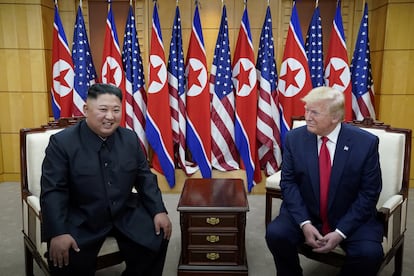
Although sanctions continue to weigh on the country and China’s economic support remains indispensable, there is “no longer any urgency” for Pyongyang to sit down and talk with the United States, Town stresses. That gives Kim room to wait, raise his demands and decide when it suits him to turn back toward Washington. “He believes he is a key player in reshaping the world order” and “on equal footing with his partners,” Town says.
The war in Ukraine has made clear that this ambition extends far beyond rhetoric. North Korea has become a crucial supplier for Russia’s war of attrition in a conflict that has now stretched into its fifth year. The U.K.-based Open Source Centre estimates that, since mid-2023, Pyongyang has shipped between eight million and 11 million artillery shells and rockets, while Ukrainian intelligence believes North Korean supplies have at times accounted for nearly half of the ammunition used by Russian artillery on the front lines.
Weapons have been accompanied by manpower. Since 2024, some 15,000 North Korean troops have fought in Russia’s Kursk region. Kyiv estimates that around 8,500 North Korean personnel are currently deployed in Russia, including engineers, sappers and drone operators. “North Korea can now present itself as a country that contributes to the security of another major power,” Lee notes.
It is a significant reversal of roles: a state long treated as a problem to be contained by others is now providing ammunition and troops to a permanent member of the U.N. Security Council. The relationship has continued to deepen since Putin and Kim signed a strategic partnership treaty in 2024 committing the two countries to assist one another in the event of an attack.
China steps up its diplomacy
The exchange has also reduced Pyongyang’s isolation. In return for its military support, North Korea has obtained revenue, oil, economic cooperation, combat experience for its troops and, possibly, military technology transfers. Russia has also helped weaken one of the main instruments of pressure on North Korea: despite U.N. sanctions, it openly imports North Korean weapons and, in 2024, vetoed the renewal of the panel of experts responsible for monitoring those sanctions. The sanctions remain in force, but they have lost their main independent oversight mechanism.
The burgeoning Russia-North Korea partnership has also altered the balance with Beijing. A European diplomat based in the Chinese capital argues that North Korea’s involvement in Ukraine has forced China’s leadership to reassess its calculations. Although China remains by far North Korea’s main economic partner and traditional ally, the existence of a Russian alternative has reduced Beijing’s ability to impose conditions. That added room for maneuver has unsettled Chinese policymakers, who in recent months have accelerated high-level diplomatic engagement with Pyongyang.
Kim returned to China in September 2025 after six years without meeting Xi, and stood alongside the Chinese leader and Putin during the grand military parade in Tiananmen Square marking the 80th anniversary of Japan’s surrender in the Second Sino-Japanese War (1937-1945) and the end of World War II.
Xi traveled to Pyongyang in June for the first time since 2019, in what remains his only foreign trip this year. For China, keeping North Korea within its orbit means preserving a partner against the U.S. military presence on the Korean Peninsula, preventing instability along its border and ensuring a central role in any crisis that could upset the regional balance. During his visit, Xi reaffirmed a friendship “forged in blood” and a bond of comradeship and mutual trust that, he said, has withstood both the passage of time and a changing international landscape.
The official accounts of the meeting also contained a notable omission. There was no mention of denuclearization, which for years had been one of Beijing’s stated objectives on the Korean Peninsula. Although China has not formally abandoned that goal, it has avoided raising it publicly in the face of an emboldened Kim, who insists that North Korea’s nuclear arsenal is not up for negotiation.
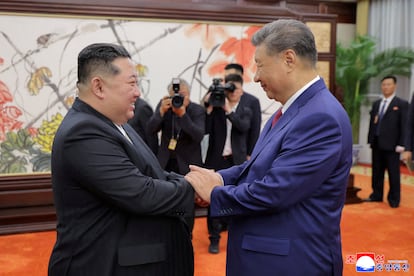
“Kim is trying to make North Korea impossible for the United States to ignore,” Lee says. The researcher argues that Kim’s nuclear arsenal is no longer merely a guarantee of the regime’s survival. It has also become a source of power, autonomy and international status. “He wants to be treated as a normal actor,” Town says, “and to engage with the international community on his own terms.”
And Trump, with his appetite for attention and recognition, may be particularly receptive to that ambition. While previous administrations maintained the complete denuclearization of North Korea as their objective, the U.S. president has gone so far as to refer to the country as a “nuclear power.” That does not amount to formally recognizing North Korea as a nuclear-armed state, his administration still officially calls for denuclearization, but it breaks with the caution of previous governments and raises the possibility that any future negotiations may not begin with demands for the dismantling of Pyongyang’s arsenal.
Pacheco Pardo believes the U.S. president has made it quite clear that his priority is to deal directly with Kim and secure an outcome “he can sell as a victory.”
For now, Kim does not appear to be in any hurry. But a future opening from Washington, and above all any easing of sanctions, would help him continue to diversify North Korea’s international relationships. “North Korea does not want to depend on anyone,” explains Pacheco Pardo.
Having strengthened its ties with Russia and repaired its relationship with China, Pyongyang can afford to wait and assess what it might be able to extract from Trump.
Sign up for our weekly newsletter to get more English-language news coverage from EL PAÍS USA Edition










Ataque contra Irán
Trump Apuesta Por Un Acercamiento A Kim Jong-Un Para Olvidar El Callejón Sin Salida De Irán

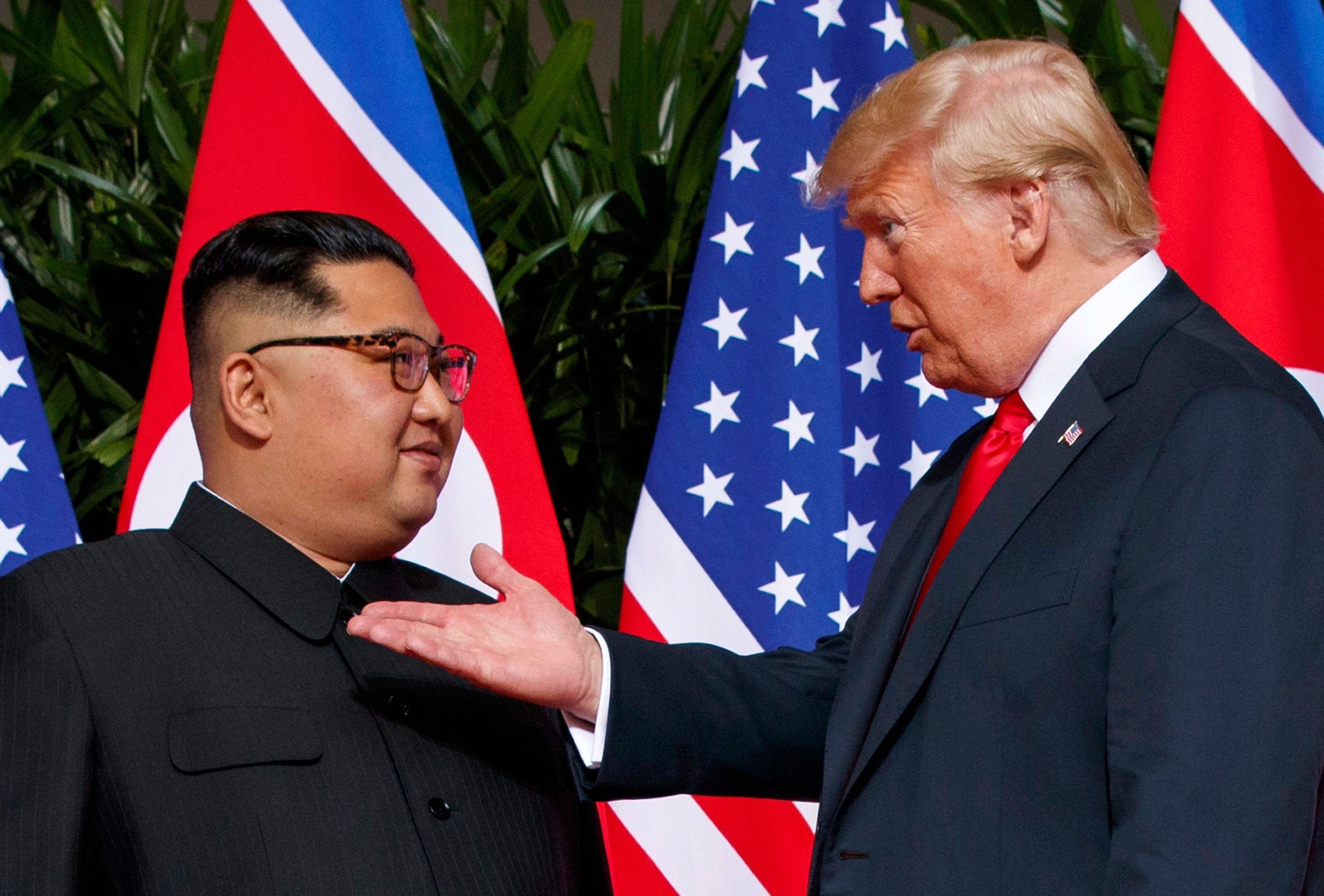
Frustrado ante una guerra contra Irán estancada y que le aburre, y deseoso de castigar a los aliados, el presidente de Estados Unidos, Donald Trump, vuelve a mirar cada vez más a lo que él considera que fue el momento de gloria de su política exterior durante su primer mandato: las negociaciones nucleares —fallidas— con el líder norcoreano, Kim Jong-un. Enfadado con un Gobierno surcoreano al que acusa de no ayudar a resolver el bloqueo en el estrecho de Ormuz, ahora amenaza con un nuevo acercamiento al régimen autoritario de Pyongyang que puede sacudir los delicados equilibrios geopolíticos en Asia-Pacífico y, con ellos, los del mundo.
Aquella primera campaña de Trump para lograr la desnuclearización de Corea del Norte incluyó tres reuniones entre el republicano y el vástago de la dinastía Kim entre 2018 y 2019. Las únicas de la historia entre un presidente estadounidense y un máximo líder norcoreano. No arrojaron ningún resultado del que Washington pudiera jactarse, más allá de alguna vaga promesa. Al contrario. Pyongyang se reforzó en el convencimiento de que su programa nuclear es la tabla de salvación que le protege de ataques enemigos y ha multiplicado su producción de estas armas: los expertos calculan que hoy día cuenta con unas 60, tres o cuatro veces más que hace una década, y posee material suficiente para llegar a las 90. El propio Trump ha asegurado este martes, en declaraciones desde la Casa Blanca, que las bombas son 57.
Pero el mandatario republicano recuerda con nostalgia los fastos y la atención mediática que rodearon aquellas cumbres, aquella sensación de estar haciendo historia y que cada vez se antoja más improbable que se repita en la guerra contra Irán. En los pasillos de la residencia presidencial es posible ver la foto de su apretón de manos con Kim en Singapur en 2018, pero no parece que vaya a haber jamás una similar con el líder espiritual en Teherán, Mojtaba Jameneí, colgada en el Despacho Oval.
Trump sacó a relucir la posibilidad de un nuevo acercamiento con Kim el pasado domingo, cuando anunció su deseo de recortar las maniobras militares anuales con Corea del Sur, que concluirán precipitadamente este viernes, seis días antes de lo previsto. El presidente mencionaba en términos elogiosos su “amistad” con el líder al que hace casi diez años apodaba “hombre cohete”, por las constantes pruebas de misiles norcoreanas. También ha alegado descontento con Seúl por no apoyarle lo suficiente en la guerra en Irán. Ahora se plantea celebrar una nueva cumbre con “el brillante camarada” cuando viaje a Asia este otoño.
“Sí, lo creo”, ha confirmado, cuando este martes la prensa le ha preguntado si creía que los dos líderes podrían reunirse entonces. Trump ha confirmado así las informaciones del periódico Wall Street Journal que adelantaban esos planes.
Una posibilidad es que la reunión cara a cara ocurra en noviembre, aprovechando la cumbre de líderes del Foro de Cooperación Económica Asia-Pacífico (APEC) que se celebrará en la ciudad china de Shenzhen. Aunque oficialmente no hay ningún plan en marcha para un encuentro con Kim —Corea del Norte no es miembro de la APEC—, el deseo de Trump de que ocurra “apunta a que el presidente busca afanosamente un logro del que presumir en política exterior, dado que la victoria en Irán sigue siendo esquiva”, señala el Journal. También recuerda que “la mayoría de los presidentes [estadounidenses] han rechazado reunirse con Kim sin condiciones previas”.
No es la primera vez en este mandato que Trump expresa su interés en un nuevo acercamiento con el autócrata norcoreano. El año pasado, durante otra gira por Asia, ya instó a la prensa que le acompañaba a bordo del avión Air Force One a que “hiciera circular” sus esperanzas de una nueva cumbre. Quedó en nada: el propio presidente comentó después que esa reunión hubiera oscurecido la que ya estaba programada —y era fundamental para enderezar la relación bilateral clave entre Washington y Pekín— con el presidente chino, Xi Jinping, en Corea del Sur.
En declaraciones desde el Despacho Oval el lunes, el mandatario aseguró que el líder norcoreano sí ha respondido a los mensajes y que los intercambios entre ambos son “muy positivos”. No aportó más detalles.
Tras un silencio inicial, Corea del Norte ha respondido para subrayar que no tiene tanto interés en un encuentro como Trump. La hermana y mano derecha del líder norcoreano, Kim Yo Jong, ha asegurado que desconoce que exista ningún tipo de contacto entre el estadounidense y Kim Jong Un para relanzar una relación en la que, según llegó a contar el presidente estadounidense, Kim le escribió “cartas bellísimas”. “Nos enamoramos”, había afirmado por aquel entonces el republicano.
“Está muy claro que (Trump) está de nuevo comunicando su deseo de reunirse con Kim, de desarrollar contacto con Corea del Norte. Pero esta vez es diferente, porque ha dicho que reducirá las maniobras militares con Corea del Sur, que se perciben como extremadamente importantes”, apuntó el lunes Andrew Yeo, de la Catholic University of America de Washington, en una charla organizada por el think tank CSIS. El mandatario volvió sobre esa cuestión el lunes en el Despacho Oval: recordó que Estados Unidos protege a Corea del Sur frente a su vecino del norte y preguntó por qué su aliado no quería ayudarlo en lo que calificó de una “operación militar muy sencilla”.
La orden de recortar las maniobras ha causado una enorme sorpresa. Corea del Norte, que desde el fracaso de las negociaciones con Estados Unidos se ha acercado cada vez más a su gran patrocinador, China, y a Rusia, ha enviado soldados a la guerra en Ucrania, donde ha aprendido nuevas tácticas y ha tenido acceso a nueva tecnología. Los ejercicios militares conjuntos se percibían como claves para la coordinación entre las fuerzas surcoreanas y las estadounidenses ante la nueva realidad militar norcoreana.
Presión sobre Seúl
“El mensaje del presidente Trump agrega presión sobre varios asuntos pendientes relacionados con el Gobierno de Corea del Sur”, ha afirmado este miércoles el ministro de Exteriores surcoreano, Cho Hyun, ante una comisión parlamentaria. El diplomático considera que la orden persigue tres objetivos: forzar a Seúl a atender las reclamaciones de Washington, enviar una señal a Pyongyang y ayudar a Estados Unidos a romper el estancamiento en el conflicto iraní.
Trump aseguró que hay 39.000 militares estadounidenses desplegados en Corea del Sur, aunque la cifra oficial ronda los 28.500. Tampoco precisó qué clase de participación había solicitado a su homólogo surcoreano, Lee Jae-myung. La presidencia surcoreana sostiene, no obstante, que ha participado en los esfuerzos internacionales para alcanzar un alto el fuego y restablecer la libre circulación en el estrecho de Ormuz y afirma que negocia con Washington posibles contribuciones prácticas y militares.
A esa fricción se añade el compromiso surcoreano de invertir 350.000 millones de dólares (300.000 millones de euros) en Estados Unidos como parte del acuerdo comercial firmado el año pasado. De ese total, 150.000 millones se destinarán a la cooperación en la industria naval, pero ambos gobiernos continúan negociando cómo ejecutar los 200.000 millones restantes, según la agencia surcoreana Yonhap. Cho ha defendido la demora por la necesidad de estudiar la viabilidad comercial de las inversiones, cumplir los trámites legales y resolver imprevistos que no ha especificado. El ministro de Finanzas surcoreano, Koo Yun-cheol, ha negado que su país esté retrasando deliberadamente el proceso.
Las pruebas castrenses, que comenzaron el 17 de agosto y debían prolongarse hasta el día 27, concluirán finalmente el 21. Es la primera vez que unas maniobras conjuntas de esta magnitud se acortan por petición estadounidense una vez iniciadas, recoge Yonhap. Los aliados completarán solamente la fase defensiva, en la que ensayarán cómo responder a un ataque norcoreano, pero dejarán sin realizar la parte centrada en una contraofensiva. Seúl y Washington negocian todavía qué hacer con los 14 ejercicios conjuntos previstos sobre el terreno, pero el Pentágono sostiene que esos cambios no afectarán a sus objetivos de entrenamiento.
El régimen norcoreano condena sistemáticamente estas maniobras, que se celebran bajo distintas denominaciones y formatos desde 1976. El régimen norcoreano las considera ensayos para una invasión, mientras Estados Unidos y Corea del Sur insisten en su carácter defensivo. En un comentario difundido este miércoles por la agencia estatal norcoreana KCNA, Corea del Norte califica a ambos países de “belicistas” y asegura que seguirá ejerciendo su derecho a la “autodefensa” mientras persista la amenaza militar.
Mientras Pyongyang se deja querer —y analiza qué ventajas puede obtener del deseo de Trump de una aproximación—, y Corea del Sur trata de contemporizar, el resto de potencias en Asia contempla la situación con interés. Un Japón ya preocupado por la errática política de Trump en la región busca reconfigurar sus alianzas y reforzar sus lazos militares con Australia.
China mueve sus fichas: el anuncio de la reducción de las maniobras coincide con la llegada a Seúl del ministro chino de Exteriores, Wang Yi, en su primera visita bilateral a Corea del Sur en cinco años. Wang se ha reunido este miércoles con su homólogo Cho y será recibido el jueves por el presidente Lee, así como por su consejero de Seguridad Nacional, Wi Aung-lac. La situación en la península figurará entre los principales asuntos de las conversaciones.
Pekín, el principal socio económico y aliado tradicional de Corea del Norte, conserva gran capacidad de influencia sobre cualquier intento de reactivar el diálogo regional. El estrechamiento de la alianza militar con Rusia, a la que Pyongyang ha enviado tropas y armamento para la guerra de Ucrania, ha ampliado además el margen de maniobra de Kim.


Última Hora De La Entrada De Inmigrantes A Ceuta, En Directo | Sánchez Convoca Al Consejo De Seguridad Nacional 26 Días Después Del Inicio De La Crisis Migratoria De Ceuta
Kim Jong-Un, The Leader Trump Seeks Out, Putin Relies On And Xi Doesn’t Want To Lose
6,000 Lost Bags And 270 Flights Cancelled: Barcelona Airport Strike Rages On
Flames force Spanish troops to evacuate 1,000-year-old kings’ bones from burning monastery

Última Hora Del Terremoto En Colombia, En Directo | Al Menos 132 Muertos Y 570 Heridos Por El Seísmo De Magnitud 7,4

Attaoui Saca Un Bronce En 800m De La Casi Nada


-
aragon wildfire1 week ago
Flames force Spanish troops to evacuate 1,000-year-old kings’ bones from burning monastery
-
 Bogotá2 weeks ago
Última Hora Del Terremoto En Colombia, En Directo | Al Menos 132 Muertos Y 570 Heridos Por El Seísmo De Magnitud 7,4
-
 800 metros lisos2 weeks ago
Attaoui Saca Un Bronce En 800m De La Casi Nada
-
Latest2 weeks ago
Ceuta Leader Wants Detention Centre As Spain’s Migrant Crisis Deepens
-
Mallorca2 weeks ago
Qatar Royal Family’s £300m ‘Palace in the Sky’ lands in Mallorca ahead of historic eclipse
-
Benalmadena pueblo2 weeks ago
Five days that turn Benalmadena pueblo into a giant street party and everyone’s invited
-
Latest2 weeks ago
EU Curbs On ‘forever Chemicals’ In Food Packaging Kick In
-

 Cupón ONCE2 weeks ago
Cupón Diario De La ONCE: Comprobar Sorteo Del Lunes 10 De Agosto