Connect with us

%

Tim Curry Dies At 80: Rocky Horror Legend Who Redefined British Stage Flair

Published

on

tim-curry-dies-at-80:-rocky-horror-legend-who-redefined-british-stage-flair

RIP the great Tim Curry. Credit: Jaguar PS – Shutterstock

British actor Tim Curry has passed away at the age of 80, leaving behind a career packed with unforgettable turns that mixed camp, menace and pure theatrical cheek. Reports confirm he passed away on Tuesday night at his Los Angeles home after years of health struggles following a major stroke in 2012.

Born Timothy James Curry in Cheshire in 1946, he grew up as the son of a Royal Navy chaplain and a school secretary. His father died when he was 12, an early blow that shaped a childhood spent partly in Plymouth and at boarding school. Watching Judi Dench in Cabaret later fired his determination to act. He trained in drama and English at Birmingham University before landing early West End work, including a stint in Hair where he first crossed paths with Richard O’Brien.

That meeting changed everything. O’Brien’s new musical needed a larger-than-life mad scientist. Curry stepped up as Dr Frank-N-Furter in the original 1973 London production of The Rocky Horror Show at the Royal Court Theatre’s tiny upstairs space. What began as a modest run exploded into a phenomenon that crossed the Atlantic, hit Broadway and became the 1975 cult film classic. Audiences still pack midnight screenings decades later, shouting back lines and doing the Time Warp in fishnets.

How a bus conversation created an icon

Curry once admitted the famous Frank-N-Furter voice came from an upper-class woman he overheard on a London bus, determined to sound like the Queen. He shopped for the most comfortable women’s black heels he could find (later turned into platforms) and reused a Victorian corset from an earlier stage role in The Maids. He liked risky choices and often said that approach suited him best. Princess Diana later told him the show “quite completed my education”, delivering the line with a wicked smile that left him chuckling for years.

One particularly funny episode saw him thrown out of a New York midnight screening of his own film. Staff dismissed his phone booking as another prank caller and later accused the real Curry of being an imposter, claiming he did not even look like himself. He produced his passport, then walked out with friends rather than stay.

From corset to clown and the Devil’s horns

Stage work remained central throughout his career. He earned Tony nominations for Amadeus and My Favorite Year, plus Olivier nods for The Pirates of Penzance (as the Pirate King) and Spamalot (as King Arthur). On film he brought sly humour to Rooster Hannigan in Annie, the butler Wadsworth in Clue, Captain Hook in Muppet Treasure Island and the suspicious Mr Hector in Home Alone 2. Voice roles kept him busy too, from Nigel Thornberry in The Wild Thornberrys to countless cartoons and games.

Pennywise the Clown in the 1990 IT miniseries terrified a generation, even though Curry himself suffered from a lifelong fear of clowns. Contracts banned reflective surfaces near him during makeup, and a young co-star once stopped a scene to say the performance was genuinely frightening. Curry apologised politely while saying that was rather the point.

Filming Legend proved another physical ordeal. Full-body prosthetics for the Lord of Darkness took up to eight hours to apply. Removing them meant a long soak in a bath; impatience once caused him to tear skin, forcing a week of workarounds. He later joked about the whole process with typical dry wit.

Career built on contradiction and charm

Many faces of Tim Curry.
Credit: Prof. Frank McDonough x

Curry rarely courted the spotlight off-stage and protected his private life carefully. Friends and colleagues often spoke of his sharp humour and refusal to take himself too seriously. After the 2012 stroke left him partially paralysed and reliant on a wheelchair, he still appeared at Rocky Horror anniversary events, cracking jokes about being “legless” and continuing to engage with fans. His 2025 memoir Vagabond captured that same mischievous tone, recounting everything from Studio 54 nights to an awkward chat with Donald Trump on the Home Alone 2 set.

British acting has long thrived on performers who can switch from high drama to pure mischief without missing a beat. Curry embodied that tradition. Whether in a West End musical, a Hollywood comedy or a late-night cult screening, he brought precision, mischief and a refusal to play it safe. His work gave generations permission to be different, to laugh loudly and to lean into the ridiculous.

Fans will keep doing the Time Warp. Stage and screen both feel a little less colourful without him.


%

Ceuta Crisis Reaches Mainland Spain As Rallies Are Called Across The Country

Published

on

ceuta-crisis-reaches-mainland-spain-as-rallies-are-called-across-the-country

Demonstrators wave Spanish flags outside Madrid’s Moroccan embassy on August 2, an earlier show of support for Ceuta. Credit: David Raw / Shutterstock

Ceuta’s regional day usually passes with a quiet medal ceremony and general celebration throughout the city, but this year it is drawing rallies to town halls and city squares in more than 30 places across Spain. The gatherings directly follow the migration crisis that disrupted the city at the end of July. 

Local councils asked to support Ceuta from 8pm on September 2

The Spanish Federation of Municipalities and Provinces (FEMP), which represents town halls and provincial councils nationwide, has called for gatherings outside town halls at 8pm on Wednesday September 2, Ceuta’s regional day. The invitation covers all 8,132 Spanish municipalities, though FEMP has confirmed only that several councils have agreed to take part rather than claiming universal participation.

FEMP President María José García-Pelayo said Ceuta was “in intensive care” and needed the government to act “in a proportionate way”, describing the aftermath of the crisis as the most difficult moment in the city’s recent history.

García-Pelayo has also given up her seat on the EU’s Committee of the Regions so that Ceuta’s president, Juan Vivas, can represent the city directly in Brussels, and FEMP’s next governing board meeting, on September 29, will be held in Ceuta itself.

Fuengirola and Torremolinos on the Costa del Sol are among the councils that have already confirmed events.

A separate citizen movement has spread to far more than 30 cities

Alongside the official FEMP call, a decentralised citizen campaign called Por Ceuta has organised its own concentrations for the same evening, under messages including “Toda España por Ceuta” (All of Spain for Ceuta) and “Ceuta no está sola. España está con Ceuta” (Ceuta is not alone. Spain is with Ceuta).

🇪🇸 TODA ESPAÑA POR CEUTA 🇪🇸

El próximo 2 de septiembre, Día de Ceuta, nos manifestamos en toda España.

🗓️ 2 de septiembre
🕗 20:00 h
📍 Frente a los ayuntamientos de toda España

Por Ceuta. Por nuestras fronteras. Por España.

Que se escuche en cada rincón del país: CEUTA NO… pic.twitter.com/BDRmQGQKcP

— Muy.Mona/🇪🇸💚 (@Capitana_espana) August 19, 2026

Unlike the FEMP appeal, this strand carries no formal municipal backing. It began on social media and has since spread all over Spain, including cities like Madrid, Barcelona, Valencia, Sevilla, Málaga, Zaragoza and Bilbao, according to organisers’ own published lists. 

The overlap between the two calls means turnout in some places could combine both official and grassroot participants. An expected attendance figure has not yet been published.

“Ceuta is not for sale, Ceuta defends itself”

In Ceuta itself, the Neighbourhood Associations Federation (FPAV) has called a separate march under the slogan “Ceuta no se vende, Ceuta se defiende” (Ceuta is not for sale, Ceuta defends itself).

The march sets off at 7pm from the Patio de Armas at the Murallas Reales, the city’s fortified walls, and follows a route through the old town before ending outside the Government Delegation. Organisers have asked participants to leave political and ideological banners at home and to bring Spanish or Ceuta flags instead.

A month on, the government sets up a single command

The gatherings come a month after the crisis at the border that dominated headlines through late July and into August, as Spain shifts from emergency response to a longer-term plan for the city.

On Wednesday, the Spanish government announced a new single command structure for the crisis, led by Territorial Policy Minister Ángel Víctor Torres and including Vivas, the government’s Ceuta delegate and national security officials, alongside an expanded socioeconomic plan for the city worth more than €180 million.

Whether the show of support on September 2 changes anything about that response is, for now, the open question hanging over what should have been the regular annual celebration day for the city.

Continue Reading

%

‘It Could Kill Them’: Experts Warn Beachgoers Against Pushing Stranded Dolphins Into Sea

Published

on

‘it-could-kill-them’:-experts-warn-beachgoers-against-pushing-stranded-dolphins-into-sea

A stranded cetacean has not simply ended up on the sand because it took a wrong turn. Photo credit: Alexander Sánchez

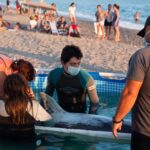
A group of well-meaning beachgoers recently helped a stranded dolphin back into the sea on Spain’s Costa Tropical, however several marine biologist are warning that what looks like a rescue can actually put the animal’s life at greater risk. Dolphins are extremely sensitive animals, and the stress of being surrounded, handled and moved by people can itself have serious consequences. 

A dolphin that reaches the beach is often already sick, injured, exhausted or otherwise compromised, meaning simply getting it back into the water does not necessarily save it. The warning comes after bathers on Castell de Ferro beach in Granada helped a striped dolphin return to the sea after it washed ashore on August 19. The people who intervened were trying to help. Alexander Sánchez, a marine biologist for Pelagics Conservation, based in Almerimar, says members of the public should not attempt to reintroduce stranded cetaceans themselves.

Why pushing a stranded dolphin back can be dangerous

Talking to Euro Weekly News Sánchez explains that it is unusual for a striped dolphin to come so close to shore and that the species normally travels in groups. From the footage of the Castell de Ferro incident, he says it was quite possible that the dolphin had some sort of underlying problem.

That is the crucial point for anyone who finds a dolphin on the beach. A stranded cetacean has not simply ended up on the sand because it took a wrong turn. The reason for the stranding needs to be established before anyone decides whether the animal can safely return to the water.

They are already struggling 

Sánchez says that in the majority of the cases, a stranded dolphin is either old, sick or injured. Returning it to the sea without veterinary assessment can mean that it simply becomes stranded again somewhere else, continues to suffer or drowns.

Dolphins are also highly sensitive to stress. Being surrounded by crowds, touched repeatedly, dragged across the sand or forced back into the water can place an already compromised animal under enormous physiological strain. In severe cases, that stress can contribute to its death.

Andalucía’s own marine environment service specifically warns that a live stranded cetacean should be reported to 112, with members of the public then following the instructions given by the veterinary team. The regional authority says that releasing an animal without a prior health assessment can result in its death.

A dolphin on the beach needs help, not a push

The risks are not theoretical, In July 2025, a common dolphin stranded at Roquetas de Mar in Almería up to three times. When specialists from the local stranding network assessed the adult male, it had head injuries and signs of respiratory failure. The veterinary team ultimately decided that euthanasia was the most humane option because the animal was already agonising.

Another case in Mijas, Málaga, in May this year ended with a stranded dolphin dying shortly after reaching the beach. Marine conservation teams again advised the public not to handle the animal or attempt to return it to the sea, explaining that stranded dolphins can be injured, disorientated or severely weakened.

There are occasions when a stranded dolphin can be returned to the sea, but that decision only belongs to trained professionals after the animal has been assessed. In La Línea de la Concepción, for example, specialists examined a stranded striped dolphin in 2023 and determined that its condition was apparently good. Its swimming and buoyancy were assessed before it was eventually released.

What beachgoers should do

If a dolphin or another cetacean is found stranded on a Spanish beach, the correct response is straightforward: call 112 and wait for instructions. People should not attempt to drag the animal into the water, push it offshore or surround it in an effort to help. Apart from potentially worsening its condition, unnecessary handling can interfere with the assessment needed to determine why it stranded in the first place.

Andalucía’s official guidance also points out that intervention by untrained members of the public can put people at risk. The bathers at Castell de Ferro were clearly trying to do the right thing. But for marine mammals, the most compassionate response is not always the most obvious one. If a dolphin is stranded, leave the rescue to the people trained to decide whether it can be saved. Call 112, keep your distance and follow the instructions given by the emergency team.

Continue Reading

%

UK Prepares Emergency Campaign Urging Households To Keep Food And Water At Home

Published

on

uk-prepares-emergency-campaign-urging-households-to-keep-food-and-water-at-home

The campaign will encourage households to take simple steps to prepare for risks. Photo credit: David Pereiras/Shutterstock

In recent hours major UK news outlets including The Guardian and The Independent have reported that ministers are preparing to launch a public campaign encouraging households to keep basic emergency supplies, including bottled water and tinned food, at home.

The reports are likely to draw the attention of British residents in Spain who have family, property or other close ties in the UK. However, there is no need to panic, yet. There is currently no warning of an immediate emergency and no instruction to panic buy. The government’s message is about helping households cope for a few days if essential services are disrupted.

The government has confirmed a campaign is coming

The reports follow an official Cabinet Office announcement published on July 14, confirming that a national resilience campaign will launch later this year. It will encourage the public to take simple steps to prepare for risks including severe weather, flooding, cyber attacks and other incidents. Ministers say that better-prepared households can help emergency services concentrate on people who are most vulnerable during a crisis.

The Cabinet Office has also said that government crisis plans are being updated as part of its Home Defence Programme. That work covers a range of possible threats, but it is not a prediction that an attack or national disaster is about to happen.

Food and water advice is already available

The guidance asks households to consider what they would need if a power cut, water outage, flooding or another emergency lasted for several days. Suggested supplies include bottled water, food that does not need cooking, a manual tin opener, a torch, candles, spare batteries, a phone power bank, a battery or wind-up radio and basic first aid supplies. 

It also recommends allowing for at least 2.5 to 3 litres of drinking water per person each day. People should also make sure they have enough regular medication to last several days. Importantly, the advice is not to rush out and buy everything at once and definitely no need to panic-buy toilet paper. Households are encouraged to build up their supplies little by little but when possible.

A quick check worth making from Spain

If you have an older parent or vulnerable relative in UK, it may be worth checking that they have their medication, a torch, enough food and water for a short disruption, and important telephone numbers written somewhere other than on their mobile phone. It is also worth asking whether they know a neighbour who could check on them if phone networks or transport were affected. Having someone nearby who can make contact could be particularly useful for people who live alone or have mobility problems.

Families separated between the UK and Spain may also want to agree on a simple contact plan. People who are older, disabled or medically dependent may be eligible for extra support through their supplier’s Priority Services Register. This allows energy, gas and water providers to identify customers who may need additional assistance during an interruption. Anyone with a second home in Britain should also make sure a trusted neighbour, friend or property manager has up-to-date contact details and knows how to reach the owner if there is a problem at the property.

Prepare calmly, not fearfully

The government has confirmed that the national resilience campaign is coming, but its detailed launch material has not yet been published. The recent reports indicate that advice about keeping basic supplies at home is likely to form part of it.

For Britons living in Spain, there is no reason to panic or start stockpiling food and water. What is advised however is that we check on relatives in the UK, make sure they could manage for a few days if essential services were interrupted, and agree how you would stay in contact if normal communications were affected.

Continue Reading

Trending

Copyright © 2017 Spanish Property & News