Connect with us

Berlin

Maricarmen, Elderly Woman Evicted From Home In Spain, Becomes A Global Symbol For Housing Activists

Published

on

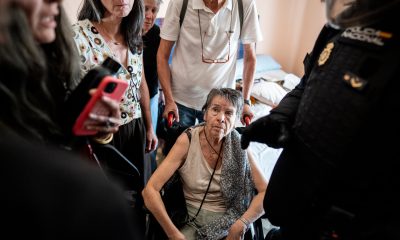
They came to Madrid to counterprogram one of Europe’s largest real estate fairs, The District. What they found was an 87-year-old woman who was about to be evicted from their home — and was, before their eyes. Around 200 housing activists from more than 20 countries across Europe decided to join the demonstrations against the eviction, and later joined a spontaneous encampment in front of the Madrid regional government headquarters at the historic Puerta del Sol plaza.

They are activists from Ireland, Germany, Portugal, France, England, Greece, Romania and Switzerland, among others, who see Maricarmen’s case as a turning point and hope the Spanish movement will spread to cities around the world, including their own.

“We are witnessing a historic moment. I’d never seen an eviction in Spain make the news in England. And now everyone is talking about it,” says Nadz Vogel, 29, a member of the London Renters’ Union. He landed in Madrid last Wednesday afternoon and, before boarding the plane, saw images on social media of police removing Maricarmen from her home and taking her out on a stretcher to the hospital. The image reminded him of an eviction he had tried to stop two weeks earlier, of a 71-year-old woman in a neighborhood of the English capital. They couldn’t stop that one, either. “They dragged us, they shoved us. It’s a form of violence that tenants around the world know well,” says the 29-year-old activist.

Maricarmen reminds Vogel of dozens of people that he knows — “she’s our grandmother, our siblings, ourselves” — and he finds many parallels between the demands he has been hearing for a day and a half in Sol and their own back in the U.K.: “Raising a tenant’s rent with no controls; vulture funds promoting new luxury housing that isn’t meant for any of us; social housing sold to private companies; people being pushed out of their homes.”

Vogel says that five months ago he witnessed a historic day in England and hopes that on Tuesday, when a housing decree is due to reach the Spanish Cabinet for a vote, Spain will also experience a historic day. He is referring to the May 1 entry into force of a permanent ban on no-fault evictions (the right to repossess a property at short notice without needing to give a specific reason), a measure that is part of the Renters’ Rights Act, passed in the fall of 2025. “We need a massive tenants’ movement because, in reality, there are far more of us than them [the real estate companies and investment funds]. The only thing we need is to become aware of that power.”

Vogel’s union is one of the organizations that belong to the European Action Coalition for the Right to Housing and the City, the network that coordinates social movements across the continent and which this week was holding its summit in Madrid. Several of its members camped out in Sol, and on Sunday afternoon they debated whether to extend their trip for a couple more days to see how far the protest would go. They were feeling inspired and stronger than when they arrived. Some of them were there the day Maricarmen was evicted, part of in the human barricade at the doorway.

One of them was Teresa Mamede, a lawyer and member of the Lisbon Renters’ Union. “We were furious about what happened. And the beautiful, powerful thing is that we organized that rage, we channeled it,” notes the 31-year-old activist with tears in her eyes. “It’s not just about Maricarmen. We are all going through this, in every country. And to see people united here, willing to spend the night on the street, in a tent, together, without sleeping… It’s a great demonstration of the power we have.” Mamede says that she wants to take “what happened in Sol” to Lisbon.

This summer, the Portuguese government pushed through a reform of the rental market that, among other changes, removes limits on the prices of new contracts. “It will take even more of our rights away, make things even more precarious. I’m going to bring Maricarmen’s case to my city so it can be an inspiration. We should pay attention to what’s happening here so that it gives us strength and shows us that it’s possible [in Portugal] too,” says Mamede.
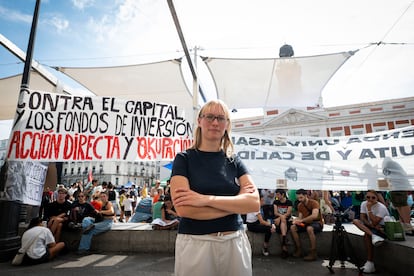
In Berlin the outlook is a little more hopeful, says Ronja Senkpiel, 31. Although renting an apartment in the German capital has become almost 70% more expensive over the past 10 years, the alternation between conservatives and social democrats in power has been broken and Die Linke (The Left) has emerged as the most voted party in the city with a campaign focused above all on fighting high housing prices. The party leader, Elif Eralp, could become the first mayor of Berlin from the leftist political group if she managed to reach a coalition agreement with the Greens and the social democrats.

“We’re very happy she won, because she also campaigned for our demand to expropriate large real estate companies in Berlin. Now everything depends on how the negotiations end and whether our demand will be implemented,” Senkpiel says from Puerta del Sol. She is talking about the post‑communist party’s promise to expropriate more than 200,000 apartments owned by large real estate companies and place them under public management.

The hundreds of people camping out in Madrid give her hope. Maricarmen is a symbol of shared problems, she says, and therefore the struggle must be a joint one.

The words of Senkpiel, Mamede and Vogel are echoed by the rest of the European activists gathered in Sol. There is excitement, a sense that this time things are different, and a desire to replicate the movement elsewhere. The feeling is summed up by Federico Tomasone, a political analyst at the Rosa Luxemburg Foundation.

“What is happening here is a signal for all of Europe. People are truly fed up. There is a huge mismatch between what the market offers and the real needs of the population. And you can’t treat an elderly woman as if she were a bicho [literally a bug, and the word used by the real estate market to describe a tenant who is still living in a house for sale]. This transcends borders. There are many Maricarmens everywhere.”

Sign up for our weekly newsletter to get more English-language news coverage from EL PAÍS USA Edition


Berlin

Helen DeWitt: ‘Publishers Treat Authors Like Outcasts Until It’s Time To Go Out And Sell Books’ 

Published

on

helen-dewitt:-‘publishers-treat-authors-like-outcasts-until-it’s-time-to-go-out-and-sell-books’ 

The warning arrives in the form of an email, just a couple of days before the interview. Helen DeWitt, author of The Last Samurai, one of the most acclaimed novels of the century, has requested, as a prelude to the conversation with EL PAÍS, that her latest blog post be read. According to the mediator from Random House (her Spanish-language publisher) in the post, she “talks a bit about how, sometimes, the promotion imposed on her by publishers or awards prevents her from doing what she’s dedicated to: writing books.”

The text in question is a rather lengthy manifesto against obligatory interviews. It discusses the ineptitude of various literary agents when it comes to understanding writers, while also listing the reasons for her recent rejection of one of the 2026 Windham-Campbell prizes, worth $175,000. She declined because she was unable to fulfill the award’s promotional obligations.

DeWitt cordially and charmingly answers the video call from her home in Berlin. Her speech pattern is sharp. And it’s marked — as in her novels — by a relentless sense of humor. She speaks in English, but could just as easily do so in French or German. She can also read Greek and Latin. In fact, she understands nearly a dozen languages, with varying degrees of fluency. Spanish, however, eludes her, despite having lived in Colombia and Mexico at different points during her childhood.

“It’s embarrassing. I can only remember the lyrics to [the song from a Colombian talcum powder commercial],” she laughs. She stops herself just before beginning to sing it: “No, it’s not good for conversation… maybe I’ll sing it at the end.”

“You don’t really like giving interviews.”

“And yet, here I am, doing this one with you.”

“Why?”

“Look, I know Penguin Random House has millions [of dollars] and all that… but they’ve taken a risk. And I want to help the publisher.”

Last month, the Spanish publishing house released a translation of the author’s book of short stories, Some Trick (2018), and her novella, The English Understand Wool (2022), as part of a single collection.

“Don’t ask me how the stories were selected,” she shrugs. “I don’t know. I wasn’t part of that decision. When I sent them to the American publisher to see if they would buy them, they made a list that perhaps didn’t make much sense… but I didn’t have the strength to nitpick and argue.”

DeWitt, now 69, began her literary career in 2000, at the age of 44, with the publication of The Last Samurai (unrelated to the film starring Tom Cruise). The novel almost immediately established her as one of the most unique and disruptive voices in American literature. It was an unexpected success, selling over 100,000 copies in English alone and becoming a classic. It was crowned “the best book of the century” by New York magazine and appeared on The New York Times’ list of the 100 best books of the 21st century.

The novel is about a single mother in London raising a brilliant boy named Ludo, who quickly masters ancient Greek, Arabic and Japanese. He then sets out to discover his father’s identity, in a story that’s filled with both humor and structural complexities. There are linguistic fragmentations, the use of multiple typefaces, foreign languages (ancient Greek, Japanese, hieratic script), as well as discontinuous blocks of text, which the author designed to reflect her characters’ chaotic minds.

Upon publication, she entered into her first clashes with an industry that still frustrates the Maryland-born author to this day. She spent months at odds with her copy editor, who — according to DeWitt — imposed her own changes aimed at standardizing the text. It was, she recalls, as if the publishing house wanted to “kill the mind that wrote the book.” This led to a nervous breakdown: she attempted suicide before disappearing. When the police found her in upstate New York, she was admitted to a psychiatric unit. When remembering this period in her life, Dewitt notes that she felt “alienated by intellectual mediocrity.”

Shortly after the release of The Last Samurai, the publishing house that introduced it to the world — Talk Miramax Books — disappeared. The book subsequently went out of print, before being reissued in 2016.

“When I was younger, I imagined that one of the things that people in the publishing world would enjoy most was interacting with brilliant writers. I didn’t realize that people went to great lengths to avoid discussing texts with an author,” she sighs. This is something that still happens to her: “You know, it’s as if these people get contaminated if they interact with the author, as if we’re outcasts. And then, ‘okay, now we’re going to publish the book… and yes, it’s great that you have all these opinions, [so now you can] go out and share them with the public.’”

She had already attempted suicide before, when she was a student suffering from depression. She survived and decided to go to Oxford University, to study Classics and Philosophy. “If I could go to Oxford, where intellectual life is taken seriously, life would be worthwhile,” is how she describes her thought process at the time. However, she left academia after nine years, frustrated with an education system that she continues to criticize today, especially for its failure to teach languages. “It’s like that [Colombian] commercial — I’m not going to sing it to you — which I heard when I was 13. I still know it by heart. There are people whose job it is to drill something into your head; there are people who are good at that. But those aren’t the people we have teaching classes,” she argues.

DeWitt’s books have been published inconsistently. It took her 11 years to sell her second novel (which she wrote before her debut), titled Lightning Rods (2011), a satire about a company that tries to prevent sexual harassment by allowing employees to have sex through a hole in the bathroom wall. And, last year, she published Your Name Here (2025), co-written with journalist Ilya Gridneff. DeWitt thought that they “could [put out the novel] in a few weeks, sell it and make some money,” so that she could then focus on her writing. But it ultimately took 20 years for her and her co-author to get it published.

“Something always interferes with the writing,” she laments. Her mind seems as complex as those of the characters she depicts: she doesn’t keep track of the number of books she’s writing simultaneously, nor of the drafts that she’s abandoned. “What happens,” she explains, as she lays out her creative method, “is that not only do voices come to you, but it’s almost like looking at a wall and seeing a movie playing on it; you know, you see everything at once… and the voices pop into your head.”

It would be better, she admits, “if I worked on one thing at a time.” She finds this to be very difficult, “because there’ll always be so many different voices and so many different storylines.”

“I might not know if the different voices belong to the same book, or if maybe they belong to another. Maybe a story doesn’t need a whole book: maybe it would have more power if you simply put these voices side by side. And that’s one of those decisions that requires a lot of thought,” she continues.

DeWitt is constantly striving to write “a masterpiece.” In a 2011 interview with The Los Angeles Review of Books, she recalled an interaction: “[A psychologist] asked me why dealing with my publishers had led to a suicide attempt. And I said, ‘well, if a book is technically challenging, it’s hard to get it through the machine, but if you want to write a work of genius it is necessary to take risks.’ He said: ‘Your sanity is more important than writing a work of genius.’ I thought: ‘Nobody who thinks that will ever write a work of genius.’ I thought: ‘We all die sooner or later.’”

Does she still prioritize literary success over her mental health? “It’s not exactly like I say, ‘I’m going to write a masterpiece and I don’t care if I lose my mind.’ But for certain kinds of books, you need to work with committed people. So, if [they’re] not interested in solving the technical challenges, it’s not possible. A masterpiece requires technical support that I can’t get,” she replies.

Her writing often contains strong autobiographical elements. “I think there [definitely] are. It’s scary,” she laughs. For instance, The English Understand Wool is a kind of satire of the publishing industry, in which a brilliant young woman has to defend herself against editors, agents and lawyers, who are just interested in making a sale. And, in the recent Spanish translation, the novella is followed by a series of short stories — two of them previously unpublished in any language — featuring writers, artists, musicians, agents, as well as businessmen who are disguised as patrons of the arts. My Heart Belongs to Bertie, for example, is about a children’s author whose book of “robot stories” has been an unexpected success, bringing him big royalties. However, irritated by the limitations imposed by his publisher, Peter looks for a new company and a new editor for his next book.

The stories possess the same sharp satire, as well as the sometimes absurd humor, as her first novel. And the classics that she studied at Oxford have also had a clear influence on her. “If something is truly awful, sometimes humor is the way to fight back. The more awful it is, the more you want to laugh,” the author explains. Much of the focus of her writing is on the publishing industry, but she also satirizes things like the art world, snobbery, cultural prestige and the commodification of talent.

Back in April, just a few days after declining the prize, DeWitt received a $175,000 grant (the same amount she gave up) from the Mercatus Center, a think tank affiliated with George Mason University, in Virginia, with no strings attached. “Today, there’s enormous pressure on writers to be publicly available all the time. That’s difficult for writers, artists, [or] anyone who creates works in various fields. I think we all need to accept that, sometimes, we just need to step away, be quiet and not be asked to do anything,” she affirms, noting that the donation will help her as she tries to do this. Perhaps it will even allow her to self-publish her next masterpiece.

“I should write the book myself and not try to convince a publisher to do what I want. [This may] seem like a defeatist attitude… I have the feeling that it is. But yes, that possibility exists.”

Sign up for our weekly newsletter to get more English-language news coverage from EL PAÍS USA Edition

Continue Reading

Alemania

La Izquierda Rompe La Alternancia En Berlín Y Acaricia La Alcaldía Con La Promesa De Abaratar La Vivienda

Published

on

Desde la reunificación alemana, los conservadores y socialdemócratas se han alternado siempre en el poder como los partidos más votados en Berlín. Hasta el pasado domingo. El partido de Die Linke (La Izquierda) ha dejado de estar limitado tradicionalmente a los barrios del este para alzarse como el partido más votado de Berlín impulsado por una campaña centrada, principalmente, en la lucha contra la escasez y los precios de la vivienda. La germano-turca Elif Eralp puede convertirse así en la primera alcaldesa de Berlín de la formación izquierdista, aunque para lograrlo necesitará un acuerdo de coalición con ecologistas y socialdemócratas.

Seguir leyendo

Continue Reading

AFD

La Extrema Derecha Se Dispara En Las Elecciones Regionales Alemanas Y Agrava La Crisis De La CDU

Published

on

la-extrema-derecha-se-dispara-en-las-elecciones-regionales-alemanas-y-agrava-la-crisis-de-la-cdu

“Un desastre”. Así ha calificado este domingo Friedrich Merz los resultados de su partido, la CDU, en las elecciones de este domingo en el Estado de Mecklemburgo-Pomerania Occidental. El escrutinio, finalizado a medianoche, da a los democristianos un 4,9% de los votos, por debajo del 5% mínimo para entrar en el Parlamento del land. Es la primera vez en la historia que la CDU no obtiene representación parlamentaria en un Estado alemán.

Seguir leyendo

Continue Reading

Trending

Copyright © 2017 Spanish Property & News