%
Aldi Mandarin South African Fruit Label
Shopping and eating local produce has become a priority for many people, a fresh vegetable that hasn’t travelled across the world to get to your plate is far less preferable to something grown and harvested just on your doorstep. One customer has now challenged the well known supermarket over an apparent labelling discrepancy in Spain, raising questions about food origins and shoppers’ right to know where their fresh produce comes from.
Mandarins from thousands of miles away
Aldi is facing questions after a shopper reportedly discovered that mandarins displayed as Spanish at one of its Spanish supermarkets were delivered in boxes identifying South Africa as their country of origin. The complaint concerns an Aldi store in Oropesa del Mar, in Castellon province, and was reported by Spanish publication Merca2 on November 3, 2026.
According to the report, the customer shared an image on X, formerly Twitter, showing the delivery-box label along with the supermarket’s fruit display. The shopper claimed that the store was advertising the mandarins as Spanish, despite the packaging stating that they came from South Africa. The apparent contradiction prompted the customer to challenge Aldi publicly and demand that the information be corrected.

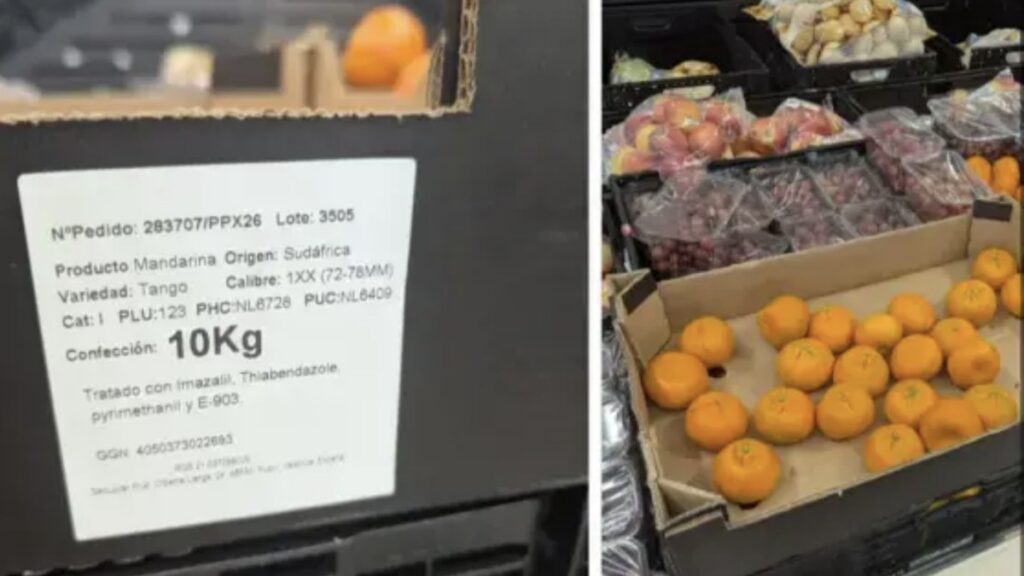
Credit: RRSS/XTwitter
What did Aldi say about the mandarin complaint?
Merca2 reports that Aldi asked the customer to provide further details so that the matter could be investigated internally. No outcome has been reported, and is still unclear whether the discrepancy resulted from an incorrect shelf label, a stock change or another administrative mistake. There is also no evidence that Aldi deliberately misled shoppers, but it raises a question of do we really always know where our food comes from.
What do EU rules say about fruit origins?
Supermarkets in Spain must provide customers with accurate information about the origins of fresh fruit and vegetables.
Under EU Delegated Regulation 2023/2429, which applies to fruit marketing standards, country-of-origin information must be clearly displayed and must not mislead consumers. Article 7 requires retailers to show this information prominently and legibly next to the produce. If mandarins grown in South Africa are presented as Spanish, this could breach the applicable consumer information rules..
Why the origin matters to shoppers
Spain has a long-established citrus industry, particularly in Valencia, Andalucia and Murcia, where oranges and mandarins are important agricultural products. Imported citrus is perfectly legitimate, and South African mandarins are regularly sold in European supermarkets. The important issue is that customers should be told accurately where their fruit was grown.
For shoppers who prefer to support Spanish farmers and local producers, clear labelling makes it easier to choose home-grown produce. British residents living in Spain may also find it useful to check the country-of-origin information on supermarket shelf labels rather than relying on the fruit variety or packaging. A mandarin variety such as Tango does not necessarily indicate where it was grown.
Shoppers should be able to trust the information provided by their supermarket and be able to confidently source produce grown close to home.