Connect with us

%

Christmas Is Coming! 100s Of Santas In Denmark

Published

on

christmas-is-coming!-100s-of-santas-in-denmark

Santas meet in Denmark. . . in July! Credit: Irina Korshunova – Shutterstock

Christmas is almost here, and to prove it, Spain is already selling tickets for its Christmas El Gordo lottery! Also, in Denmark, dozens of professional Santas, Mrs Clauses and elves from across the globe have descended on Aalborg for their annual World Congress, transforming the Danish city into a hub of christmassy cheer during the intense peak summer heat.

Global Santas gather for joyful pre-festive reunion

Participants numbered between 45 and 50, hailing from Denmark, Norway, Japan, Canada and Sweden. These festive figures paraded through Aalborg city centre on July 6, delighting locals with their red suits and flowing beards under bright sunshine. Organisers shifted the event to Aalborg after previous years at Bakken, creating fresh partnerships with Aalborg Zoo for family-orientated experiences.

City centre buzzes with Christmas fun

Monday, July 6, featured a packed schedule across Aalborg. Visitors watched the Christmas films; children joined Nisseskole, completing six playful tasks scattered around the city to earn diplomas. Tasks included reindeer riding, butterscotch throwing (it’s a thing in Denmark), feeling the wrapped gifts and guessing what they are, peppernut eating, gift wrapping and memory games for Santas.

Christmas concerts rang out through pedestrian zones at multiple spots from midday onwards. Crowds sang carols and danced around a tree during the afternoon party, and a grand parade at 4pm capped the day, with Santas marching through the streets to get everyone in the Christmas spirit as early as possible.

Aalborg zoo hosts festive takeover

Events continued on July 10 at Aalborg Zoo. Animal feedings and Safari Simon shows entertained families, while Santas mingled with visitors. Children wrote wish lists (they hope they won’t forget by December), got balloon animals and joined Santa Academy activities. The Zoofari stage hosted elf competitions, carol singing, fashion shows and even a crowning ceremony for new Santas. Attendees voted for Christmas 2025 highlights and watched Santa inspect reindeer readiness for the big night.

Rich tradition continues strong

The congress traces its roots to 1957 at Dyrehavsbakken, founded by Professor Tribini. International delegates have met annually every year since then to share experiences, set Christmas Eve dates and discuss ways to promote festive joy globally. Aalborg now provides a welcoming new home, mixing parades, zoo fun and cultural exchange into memorable days. This wholesome event increases community spirit and reminds everyone that Christmas magic knows no season.

Happy Christmas, everyone!

%

Spain’s Road Rules Are Changing

Published

on

spain’s-road-rules-are-changing

Spain’s updated traffic rules will introduce new measures to improve safety for pedestrians and cyclists from 1 October 2026. Credit : daily_creativity, Euro Weekly News

If you drive in Spain, there are new road rules coming into force on 1 October 2026 that could affect your daily journeys. The changes are designed to make urban streets safer, particularly for pedestrians and cyclists, but they also introduce new responsibilities for motorists and professional drivers.

From traffic lights to overtaking cyclists and seat belt requirements, several long standing rules are being updated. While many of the changes are aimed at improving safety rather than introducing tougher penalties, failing to follow the new regulations could still lead to fines.

Here’s what will change and why it matters.

Spain updates traffic rules to make city streets safer

The Spanish government has approved a reform of the General Traffic Regulations (Reglamento General de Circulación), introducing a new section dedicated entirely to driving in urban areas.

Cities have changed dramatically over the past decade, with more bicycles, electric scooters and pedestrians sharing the same streets. The updated rules are intended to reduce conflicts between different road users and create clearer priorities at junctions and crossings.

One of the biggest changes concerns traffic lights at pedestrian crossings.

From 1 October, flashing amber lights for vehicles will no longer be allowed to operate at the same time as a green signal for pedestrians at the same crossing.

Although the previous arrangement was legal in certain situations, it often caused uncertainty. Drivers could interpret the flashing amber light as permission to continue with caution, while pedestrians assumed they had clear priority because their signal was green.

The new rule removes that overlap entirely, making crossings easier to understand for everyone.

For pedestrians, the change should make crossing the road more predictable. For drivers, it means paying closer attention to updated traffic light sequences in towns and cities across Spain.

Drivers will have new responsibilities around cyclists

Cyclists are also given greater protection under the revised regulations.

The new rules state that cyclists should ride in the centre of their lane whenever appropriate, rather than staying close to the kerb as many currently do.

For motorists, that position must now be respected.

Drivers will also be required to maintain at least five metres of separation from a cyclist travelling ahead in the same lane. The measure is intended to discourage drivers from following bicycles too closely, particularly on busy urban streets where cyclists may need extra room to avoid parked cars, potholes or opening vehicle doors.

Another change could surprise some motorists.

On single lane urban roads with speed limits of 30km/h or less, local councils will be able to authorise cyclists to travel in both directions, even on streets that normally operate as one way systems.

This will only apply where the appropriate road signs are installed, so drivers should pay close attention to new signage introduced by their local authority.

The reform reflects a broader effort to encourage cycling while making interactions between cyclists and motorists more predictable.

Seat belt rules change for professional drivers

Another important change affects professional drivers who work in towns and cities.

Until now, certain professional drivers were exempt from wearing a seat belt while driving in urban areas under specific circumstances.

From 1 October 2026, that exemption will largely disappear.

Professional drivers will be expected to wear their seat belt in the same way as other motorists. Only a small number of exceptions will remain, including cases supported by certified medical reasons and certain reversing or parking manoeuvres.

The government believes the change reflects modern vehicle safety standards and removes an exception that no longer aligns with current road safety policy.

Some new requirements will not apply until 2027

Although the main reforms take effect on 1 October 2026, not every measure will begin immediately.

The government has allowed extra time for manufacturers, retailers and public authorities to prepare for two additional changes.

From 1 October 2027, personal mobility vehicles, including electric scooters covered by the regulation, will be required to have built in lighting.

The same date will also mark the introduction of a stricter rule for moped helmets. Riders will need to wear approved helmets, replacing the current requirement for helmets that are simply certified.

The staggered timetable is intended to give manufacturers and users enough time to adapt before the new technical requirements become mandatory.

For anyone living or driving in Spain, these changes are worth knowing before they take effect. Whether you drive every day, cycle to work or simply cross busy streets on foot, the updated regulations are designed to make urban roads clearer and safer for everyone. Spending a few minutes familiarising yourself with the new rules now could help you avoid confusion and unnecessary fines once they come into force in October.

Continue Reading

%

Search For Missing Neighbour Ends With Bizarre Underground Rubbish Bin Rescue

Published

on

search-for-missing-neighbour-ends-with-bizarre-underground-rubbish-bin-rescue

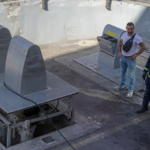
what had started as a two-minute mission to rescue a set of keys became an unexpected prison. Photo credit: Policía Arganda del Rey on Facebook

We’ve all done it, dropped our keys somewhere awkward, stared at them for a moment and wondered whether it’s worth trying to get them back. For one man in Madrid, that split-second decision turned into a 45-minute ordeal inside an underground rubbish container, complete with desperate cries for help and a rescue by firefighters. It sounds like something from a comedy sketch, but for the man involved it was anything but funny at the time.

The incident happened in Arganda del Rey, on the outskirts of Madrid, after the man accidentally dropped his house keys into an underground rubbish container. Rather than accepting defeat and arranging a replacement set, he decided to climb inside to retrieve them. It seemed like a quick solution, unfortunately, it wasn’t.

A simple plan that quickly went wrong

After climbing into the container, the man managed to get inside but soon discovered there was one major problem. The safety system designed to stop people falling into the underground bin also made it almost impossible for him to climb back out. Suddenly, what had started as a two-minute mission to rescue a set of keys became an unexpected prison.

For around 45 minutes, , unable to free himself. Realising nobody knew where he was, he began shouting: “Please, help!” It was a plea that fortunately didn’t go unheard.

His cries for help attracted attention

A nearby neighbour, identified as Gustavo, heard someone shouting from the street and initially struggled to work out where the voice was coming from. It wasn’t every day someone called for help from inside a rubbish container.

After locating the trapped man, Gustavo contacted the emergency services and stayed nearby to reassure him while firefighters made their way to the scene. As more neighbours realised what had happened, a small crowd gathered around the container, hoping the rescue would be straightforward.

Firefighters came to the rescue

Getting the man out wasn’t as simple as opening a lid, the underground waste containers use a counterweighted mechanism designed to make them safe and secure, meaning firefighters had to lift part of the system before they could reach him.

After around three-quarters of an hour trapped inside, the man was finally pulled to safety. Witnesses said he emerged covered in sweat, visibly shaken, with cuts to his hands after repeatedly trying to climb back out and an unpleasant odour that could make cats cry. Neighbours quickly handed him water while he recovered from the ordeal. Fortunately, despite the uncomfortable experience, he did not suffer any serious injuries.

An embarrassing story with a happy ending

Looking back, it’s easy to imagine the man wishing he’d simply called a locksmith. Replacing a set of keys is rarely cheap, but it’s probably preferable to spending 45 minutes inside a rubbish container waiting for firefighters to arrive.

The incident has attracted plenty of attention because it’s exactly the kind of situation many people can imagine themselves getting into. Faced with the choice between losing something valuable and trying to retrieve it, plenty of us might think, “I’ll just be a second.” Sometimes, however, those “quick jobs” have a habit of lasting much longer than expected.

A reminder to think twice

While the story has raised a few smiles, it also carries an important message. Underground rubbish containers are designed with safety features that prevent people from easily entering or falling inside. Those same features can make it extremely difficult to get back out without assistance.

Trying to recover dropped belongings may seem harmless, but climbing into these containers can quickly become dangerous, particularly in hot weather or if nobody knows where you are. This time, the man’s calls for help were heard by someone passing nearby. Had the street been quieter, the outcome could have been very different.

So, the next time your keys, phone or wallet disappear somewhere awkward, it might be worth taking a moment before climbing in after them. After all, a call to a locksmith is probably less memorable than becoming the neighbourhood’s most unexpected rescue story.

Continue Reading

%

Marbella Goes To War With Graffiti

Published

on

marbella-goes-to-war-with-graffiti

Marbella local police catch grafitti artist red-handed. Credit: PLM

Marbella has launched a serious crackdown on graffiti that mars public spaces across this popular destination. Local police and the council are combining efforts from works, parks, gardens and cleaning departments with support from the police to tackle vandalism and nip it in the bud.

Coordinated response targets immediate removal

Everyone involved hopes to erase fresh graffiti without delay and restore affected surfaces. Mayor Angeles Munoz met with works councillor Javier Garcia, cleaning councillor Diego Lopez and local police chief Javier Martin to coordinate actions. Their message is clear: everyone must support keeping Marbella free from such defacement, Munoz stressed.

Recent incidents reveal high financial costs

Police statistics and recent events have led to this decisive move. One case involving acid spray on glass resulted in damages worth €11,000. Authorities submitted a formal complaint, and officers already identified the suspected perpetrators for severe judicial proceedings.

December shock plan clears visible damage

A first rapid-response initiative arrives in December with a €21,000 budget through a minor contract. Crews will clear paint from walls, fences and urban furniture spotted by police patrols. In-house services will handle only part of the workload, so speed remains essential.

A longer-term strategy deters future acts

From next year, Marbella plans a specific contract for organised and systematic interventions. Graffiti artists will see their fleeting notoriety vanish quickly. Contacts with judges and prosecutors explore replacing fines with community service, especially for the four minors among nine identified taggers this year.

Hotspots receive extra police attention

Avenida Ricardo Soriano and public parks suffer most because perpetrators are looking for visibility and notoriety. Local police will reinforce surveillance through a dedicated administrative unit and encourage residents to report incidents. Unauthorised graffiti violates the municipal citizen coexistence ordinance, which imposes fines up to €1,500.

Shared responsibility protects public spaces

Preserving clean streets, facades and urban furniture benefits the entire community, according to the mayor. Police messages call on citizens to respect common heritage and maintain Marbella’s attractive appearance for everyone.

Continue Reading
Advertisement
Advertisement

Spanish Real Estate Agents

Tags

Trending

Copyright © 2017 Spanish Property & News