Abelardo de la Espriella
Colombia Breathes A Sigh Of Relief After Weeks Of Election Turmoil

This Wednesday, June 24, Colombia began to breathe easier. In the morning, the ruling party’s presidential candidate, Iván Cepeda, accepted the victory of his rival in last Sunday’s runoff. “Abelardo de la Espriella is the new president,” he stated plainly at a press conference convened for the occasion.
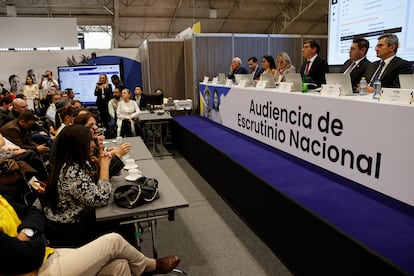
Just a few hours later, the National Electoral Council (CNE) announced the completion of the official count — the process that both Cepeda and outgoing President Gustavo Petro had said they would await before recognizing the result. As expected, the CNE reported only minimal differences from the figures released by the National Registry on Sunday, which, while only provisional, have shaped the country’s political landscape election after election.
With these two developments and the formal certification of De la Espriella as president-elect — scheduled for this Thursday at 9 a.m. — the country takes a breather after weeks of a hard-fought and polarized campaign. This comes just as the men’s national football team, one of the few unifying forces among Colombians, advanced to the second round of the FIFA World Cup — another welcome moment of relief for much of the country’s 52 million residents.
Cepeda’s announcement carried a measure of surprise and an even greater sense of calm. The surprise lies in the fact that he made the statement before the CNE had issued its decision — the moment he had said would be decisive for him. That is precisely where the calm lies: the timing shows he chose not to push his doubts about the vote too far and instead set aside his objections. Indeed, shortly afterward, his party, Historic Pact for Colombia, announced that it was withdrawing its pending challenges. The die was cast. “We will exercise a democratic, vigilant, and constructive opposition,” the senator said.
That does not mean Cepeda has backed down. In the speech he delivered from his party’s headquarters in downtown Bogotá, he reiterated his claim that his rival had carried out a “massive vote-buying operation.” He also laid out a series of red lines that will serve as an initial outline of his opposition: no to U.S. interference — led by Donald Trump’s administration, which backed De la Espriella; no to homophobic or misogynistic policies or rhetoric such as those that marked the winning candidate’s campaign; and no to any erosion of social rights, which were at the core of Cepeda’s platform and of the efforts of modern Colombia’s first left-wing president.
“No fiscal austerity policy can involve dismantling the gains achieved by the Colombian people,” he said.
In general, Cepeda’s speech stayed well clear of the more heated moments of his campaign appearances, such as when he called the traditional right-wing movement — known as Uribismo after former president Álvaro Uribe — “fascist,” or when, between the first and second rounds, he announced on two separate occasions that he would file criminal complaints against De la Espriella.
“We are the calm force of social change,” he stressed on Wednesday, signaling the steady but firm stance he seeks to bring to the political debate ahead.

In much the same way that Cepeda moderated his tone, De la Espriella on Wednesday showed a side consistent with the message he struck in his victory speech last Sunday, when he refrained from calling Cepeda or Petro “criminals” or “drug traffickers” and instead said he would govern for all Colombians. In a brief press release, he responded to Cepeda’s announcement just a few hours after it was made.
“It is positive that former candidate Iván Cepeda acknowledges the defeat of his political project and the sovereign decision adopted by Colombians,” reads a statement from the communications office of the president-elect, who took the opportunity to repeat his message to citizens: “The incoming government’s commitment, as expressed by the president-elect in his victory speech, will be to fully guarantee the right to political opposition and to peaceful protest, within the framework of the Constitution, the law and respect for democratic institutions.”
These messages from two contenders who never shared a stage throughout months of campaigning — who did not agree to a single debate that would have allowed voters to compare their proposals, personalities, or visions, and who at times criminalized each other — have been a balm for a country that, according to many analysts, emerged divided and fragmented from the campaign.
That sense of relief offers the first clues about the two major questions Colombia faced in these elections. The first concerns the endurance of its reformist tendency, which has long competed with a more conservative current. Cepeda has addressed this by proposing a strong opposition aimed at preserving recent social gains.
To that end, one key factor remains uncertain: how power will be distributed in the legislature. Cepeda’s party holds the largest bloc in both chambers, though far from a majority — 26 of the Senate’s 102 seats, if Cepeda takes the seat he is entitled to by law, and 42 of the House’s 182 seats, if his running mate and outgoing Indigenous senator, Aida Quilcué, assumes hers.
By contrast, De la Espriella has only his small party, Salvación Nacional, which has four Senate seats and one in the House. Joining them, as of Tuesday, are all 17 senators and 30 representatives from the Uribista Democratic Center. The remaining blocs in the fragmented Congress have yet to define their alignment, though they often tend to fall in line — at least at the beginning of each administration — with the government’s interests, as a way of securing appointments and other support from the powerful executive branch.
The second question appears to have at least a partial answer. The institutional strength of a country that has avoided hyperinflation, coups, debt defaults, and the suspension or alteration of elections for more than 70 years seems to have been reaffirmed. Although President Gustavo Petro continues to question the vote count on his X account (“There was no proper count when 90% of our challenges were not processed,” he wrote on Wednesday afternoon), he has also begun preparations for the transition to hand over power to De la Espriella.
The National Electoral Council has carried out its work with the backing of the heads of the high courts and oversight bodies, and its results have been recognized by all political parties. Most media outlets, as well as labor and business organizations, have accepted the outcome — whether with satisfaction or resignation.
Colombia exhales and enters a new phase, with the immediate question of how Abelardo de la Espriella will shape his cabinet and deliver on the priorities he has set for his four-year term and for his first hundred days in office.
Sign up for our weekly newsletter to get more English-language news coverage from EL PAÍS USA Edition