Connect with us

%

Early Morning Blaze Guts Estepona Apartment

Published

on

early-morning-blaze-guts-estepona-apartment

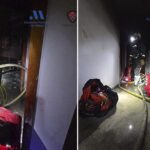
Blackened shell of flat left after blaze. Credit: CPB Malaga X

Emergency teams rushed to a residential block in Estepona after reports of a serious fire broke out in the early hours of Sunday, May 24.

Rapid response follows multiple distress calls

Operators at the 112 emergency line received several alerts shortly after 2am about flames visible from inside a property. Crews from the fire service, local police, and national police arrived rapidly at the scene on Avenida San Lorenzo.

Personnel focused efforts on the fourth floor of the Raimundo Building, where the blaze originated. Firefighters brought the fire under control before moving on to ventilate the premises and check surrounding flats for any lingering smoke or gases.

One flat left completely destroyed by intense heat

Authorities confirmed that the original flat suffered total destruction from the fire. Residents who left their homes during the incident later returned safely once operations concluded.

Multiple casualties reported during nighttime operation

Rescuers helped evacuate one individual from a fifth-floor property as a precaution while tackling the main fire. Overall four people experienced effects from the event.

Medical staff examined everyone involved at the location. A 64-year-old woman received transport to the primary care centre in Estepona for further assessment. Two men aged 38 and 40 plus a 72-year-old woman gained treatment directly in the area.

Separately, another woman received assistance after suffering what appeared to be an anxiety attack connected to the disturbance.

Quick action limits damage in busy coastal area

This incident created considerable work for emergency services throughout the small hours in Estepona. Efficient coordination between different agencies helped contain the situation and allowed checks on nearby properties. No further casualties were found other than those initially reported.

Local officials continue to examine the cause of the fire as standard procedure. Residents in the affected block expressed relief that the response prevented wider consequences in the multi-storey building.

Such events remind everyone of the importance of working smoke alarms and clear escape routes in apartment complexes across Andalucia. The fire brigade encourages regular safety checks to reduce risks in similar residential settings.

%

Barcelona Police Drama: Three Lorry Thieves Ram Police Car

Published

on

barcelona-police-drama:-three-lorry-thieves-ram-police-car

Thieves car rams Catalan police amid gunfire. Credit: Hercules X

Mossos d’Esquadra, the Catalan police, faced a violent escape attempt late on Friday night in Badalona, near Barcelona, when suspects linked to truck cargo thefts rammed an unmarked police vehicle.

Authorities confirm one individual now remains in custody while three others continue at large.

Violent clash at petrol station

Events took place shortly after 11.30pm at the Esclat petrol station on Avenida de Conflent. Officers spotted a stolen BMW M235 that they suspected formed part of operations targeting lorry loads in the area.

🇪🇸 | Tres agentes de paisano a bordo de un vehículo camuflado intentaron detener a cinco miembros de una banda de origen magrebí acusados de haber atracado a mano armada una gasolinera en Barcelona. pic.twitter.com/vBlspKrRM7

— ʜᴇʀQʟᴇs (@herqles_es) May 23, 2026

Four occupants were sat inside the vehicle upon police approach. Three individuals immediately fled on foot. The driver responded by accelerating hard and deliberately ramming the police car to break free.

Catalan police returned fire with regulation weapons during the chaotic moment to stop the threat. Despite the exchange, the driver managed to speed away from the scene in the stolen car.

Operation leads to arrest

Coordinated efforts between the Mossos d’Esquadra and Badalona local police resulted in the recovery of the abandoned BMW hours later. Officers detained one suspect during this follow-up action, although details about whether this person drove the vehicle remain unclear at present.

No gunshot injuries have been reported so far according to official sources. Police stress that checks continue to establish full facts around the confrontation.

Heightened alerts for night patrols

Mossos d’Esquadra issued an internal warning to officers following this incident urging extra vigilance during night shifts due to increased activity from these organised groups known locally as “teloneros”.

Investigations stay active across multiple units as detectives work to identify and apprehend the remaining three fugitives who escaped initial contact on foot.

This episode adds to concerns over vehicle thefts and cargo crimes affecting the Barcelona metropolitan region. Police resources focus on disrupting such networks that operate in industrial

Continue Reading

%

Music Petition In Port Duquesa

Published

on

music-petition-in-port-duquesa

A growing backlash has erupted in Puerto de la Duquesa after claims that bars and restaurants could face strict limits on live music performances during the summer months. 

An online petition titled “Save Summer Entertainment in Manilva” has begun attracting support from residents, tourists, musicians and hospitality businesses concerned about proposed entertainment restrictions in the marina area.

The petition claims venues may be limited to just 12 live music events between June 1 and September 30, subject to licence approval. At the time of writing, Manilva Town Hall has not publicly confirmed a blanket rule applying to all venues.

The campaign warns the measures could have a “devastating impact” on local businesses, jobs, entertainers, tourism and “the atmosphere that makes Duquesa special.”

According to the petition organisers, Puerto de la Duquesa’s live music scene is a key part of the marina’s identity during the busy summer months.

The petition states: “Visitors come to Duquesa because of its vibrant, friendly and welcoming atmosphere. Live music is part of what keeps the port alive during the summer months.”

Residents divide over nightlife noise in Duquesa

The issue has created debate across local social media groups over recent days, with opinions sharply divided between residents calling for stronger noise controls and others defending the marina’s nightlife atmosphere.

One widely shared community post questioned whether the current administration was reintroducing restrictions similar to those imposed during previous years in office.

The post stated: “Tourists, locals and the artists giving their time to make these things special [are] all affected.”

Others supported tighter regulation, pointing to long-running complaints linked to amplified music, shouting and late-night disturbance in apartments surrounding the marina.

Manilva reviewing licences and opening hours ahead of summer

Manilva Town Hall recently confirmed that opening hours, licences and security measures in Puerto de la Duquesa are currently under review ahead of the 2026 summer season.

Local Police patrols have also been increased during evening and overnight hours following meetings between authorities, businesses and residents concerning activity levels in the port area.

Supporters of live music insist they are not opposed to reasonable noise controls but want a compromise that balances residents’ quality of life with the needs of tourism and hospitality businesses.

At present there is still uncertainty over exactly what restrictions may be introduced this summer. You can see the details of the “Save Summer Entertainment in Manilva” on the change website. 

Continue Reading

%

Spain’s Nightlife Terraces Face Stricter Regulation As Cities Consider Mandatory Noise Sensors

Published

on

spain’s-nightlife-terraces-face-stricter-regulation-as-cities-consider-mandatory-noise-sensors

Complaints tend to increase during warmer months when terrace use intensifies and windows remain open. Photo credit: Alex Segre/Shutterstock

Spain is moving towards stricter control of noise in outdoor hospitality spaces, with proposals and existing municipal rules that may include real-time monitoring of sound levels using sensors on bar and restaurant terraces in certain areas. The changes are not being introduced as a single nationwide law. Instead, they fall under Spain’s established system of municipal and regional environmental regulation, meaning each city council decides how and when to apply stricter noise controls.

The most common framework used across Spain is the designation of acoustically saturated zones, areas where repeated noise complaints and measured sound levels exceed permitted thresholds. In these zones, authorities can restrict terrace capacity, reduce opening hours, limit new licences, or increase enforcement measures.

Cities already applying or expanding strict noise controls

Several major Spanish cities already operate or are developing tighter systems for controlling terrace noise, although the use of sensors is not uniformly mandated.

In Madrid, the city’s noise control system includes Zonas de Protección Acústica Especial (ZPAE), where terraces face reduced hours, stricter licensing conditions, and stronger enforcement. These zones are used in high-density districts where residential complaints are frequent.

In Barcelona, the city has long applied some of the strictest terrace regulations in Spain. Certain neighbourhoods, including parts of the city centre such as Ciutat Vella, Gràcia and L’Eixample, have previously seen earlier closing times, reduced terrace capacity, and enforcement based on sound measurements, including the use of monitoring data to justify restrictions.

In Valencia, local authorities have introduced pilot schemes exploring “smart terrace” concepts in some districts. These include acoustic monitoring tools and environmental adjustments designed to reduce noise impact in busy nightlife areas.

In the Balearic Islands (notably Palma de Mallorca), strict noise enforcement is already well established due to heavy tourism pressure. Regulations in entertainment zones often include tight limits on outdoor noise, operating hours, and licensing conditions.

In Málaga, municipal regulations have also been tightened in central and coastal districts where tourism and residential areas overlap, with restrictions on terraces and enforcement linked to noise complaints and measured thresholds.

These cities do not operate under a single shared system. Instead, they apply similar principles independently based on local demand, tourism intensity and residential pressure.

Why noise is a persistent issue in Spanish cities

Noise from terraces remains one of the most common urban complaints in Spain’s major cities, particularly in high-tourism and nightlife districts. Residents in these areas often report that the issue is not limited to individual incidents, but rather a continuous background level of sound during evening and night-time hours. This includes conversations from outdoor seating, movement of furniture, delivery activity, and general street congestion.

Complaints tend to increase during warmer months when terrace use intensifies and windows remain open. In densely populated districts, sound can travel easily between streets and residential buildings, contributing to ongoing disputes between residents and hospitality venues. Local authorities already use a range of enforcement tools, including inspections, fines, and acoustic measurements, to manage these conflicts. However, enforcement often depends on location-specific rules rather than a uniform national standard.

What the measures mean for residents

For people living in central or tourist-heavy districts, stricter controls are intended to improve consistency in how noise limits are enforced.

Residents’ associations in affected areas argue that current systems often rely on complaints rather than continuous monitoring. Where noise limits are exceeded, enforcement can vary depending on timing and available inspection resources.

More structured monitoring in some cities is intended to provide clearer evidence of breaches and reduce reliance on subjective reporting. This is particularly relevant in districts where hospitality activity is concentrated in narrow streets and mixed-use buildings.

What it means for bars, restaurants and tourists

For hospitality businesses, terraces are a major part of revenue, particularly in cities where outdoor dining is central to local culture and tourism. Any tightening of rules can affect seating capacity, opening hours, and compliance costs. Operators may face additional administrative requirements depending on the municipality, especially in areas designated as acoustically saturated zones. However, most cities continue to prioritise maintaining terrace activity while managing its impact on nearby residents.

For tourists, changes are likely to be gradual rather than immediately noticeable. Spain’s terrace culture remains a key part of its hospitality identity, and outdoor dining is not expected to be reduced nationwide. In some districts, visitors may experience more regulated environments, including earlier closing times or quieter seating areas. In others, especially outside high-density zones, there may be little visible change.

No nationwide uniform system

Despite the attention around noise sensors and stricter terrace controls, Spain does not currently have a unified national policy requiring all municipalities to adopt the same system. Instead, regulation remains fragmented. Cities such as Madrid, Barcelona, Valencia, Palma de Mallorca and Málaga apply their own rules based on local conditions, legal frameworks and environmental assessments.

The overall direction is consistent: increased attention to managing terrace noise in densely populated or tourist-heavy areas. However, the tools used, including whether sensors are deployed, remain entirely dependent on local government decisions rather than national legislation.

Continue Reading

Trending

Copyright © 2017 Spanish Property & News