Bruce Willis
Emma Heming, Wife And Caregiver For Bruce Willis: ‘I Thought I Had To Take It All On Myself And That I Was A Failure Because I Needed Support’

When Emma Heming Willis walked into a neurologist’s office nearly four years ago, she left with a whirlwind of emotions. Fear, surprise, anxiety, disorientation. But to cope with them, she left with just one thing: a piece of paper. A single brochure, a single printed sheet, was all the former model — who turns 48 on June 18 — took with her from that medical center. She was drowning in medical jargon and technical terms but was lost as to how to proceed. Because she had just been told that her husband, superstar Bruce Willis, the kind-hearted action hero admired around the world, not only had aphasia — as they had known for months — but also frontotemporal dementia, an incurable and irreversible condition. And there she was, a small piece of paper in her hand, the world crumbling beneath her feet. Perhaps that was the spark that led Heming to become, in addition to a wife, mother, caregiver, and patient advocate, an author.
In September, Emma Heming Willis published The Unexpected Journey, a guide to caring for the caregiver. Specifically, it’s aimed at caregivers of people with dementia, but it’s also for anyone who cares for a dependent person. A gentle yet thorough book, featuring insights from doctors, therapists, specialists, and people who have walked that path, it has just been published in Spanish under the title Un viaje inesperado. In fact, there are already more than a dozen editions in different languages, which she searches for on the shelves of her home library in Los Angeles. “I think it shows that this is a universal problem,” she says about the warm welcome the book has received globally. “There are so many caregivers out there without any guidance or roadmap. And we’re all figuring it out as we go. I’m so excited that this book is now available in Spain.”
From that room, she speaks with EL PAÍS early on a Tuesday morning. She’s an early riser; she was up at four in the morning. She has no shortage of work. She cares for her husband of more than 17 years, as well as her two daughters, Mabel, 14, and Evelyn, 12. She manages her foundation, her literary projects, and, above all, raises awareness about the importance of caregivers receiving help without feeling guilty. “And it’s not just my story, right? It’s so many people’s. This is the issue: walking out of there with nothing was really hard. And then realizing that, okay, I have to figure this out. I have to understand what support now is needed for Bruce, for our two young children,” she recalls. So she used the most logical, yet also the worst, method: searching on the internet. “And you know what the internet is like; when you look up any kind of disease, it’s a horrible place to go, and leaving that appointment, I just realized how unsupported caregivers are. We walk out with no support, and we’re asked to do so much where it’s not humane,” she reflects.
And yet Heming knows exactly where she stands: she is a young, healthy woman in a stable family, with access to support, financial resources, an education, and good connections. She doesn’t deny these advantages. In fact, she uses them precisely to reach a wider audience. “I know I’m in a privileged position because I have access, I have resources that many people don’t have,” she acknowledges. “And I knew I had all this important information and couldn’t keep it to myself. I wanted to be able to put it into a book.”
When a neurologist shared statistics with her about caregivers “who sometimes die before their loved ones,” it had a profound impact on her. “That book is probably 25% my story, but I really feel like the beauty of it are the experts and the specialists that share what they know. It’s not just me saying, ‘Oh, go get support, go get help.’ It’s the experts and specialists that say it; they give the caregiver permission to care for themselves, to ask for support, and to know that they’re not a failure if they need the help and support. I thought I had to take it all on myself and that I was a failure because I needed to ask for support.”

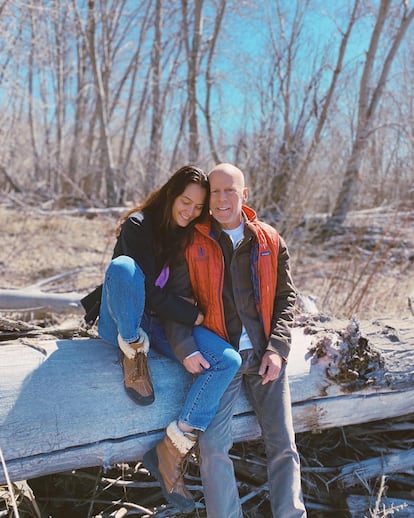
Before reaching that point, the Heming-Willis family went through the ordeal of getting a diagnosis. At first the model found the actor acting strangely; she couldn’t quite put her finger on it, but he wasn’t himself. She even began to think that maybe he no longer loved her, that he wanted to leave his family behind — she couldn’t make sense of any of it. After a long journey, in early 2022, they were told he was suffering from aphasia, a speech disorder. It was in late 2022 that the actor was diagnosed with frontotemporal dementia, which has caused his comprehension and memory to gradually fade. You can see it, for example, in how Heming refers to him in the book and in the interview: she speaks in a painful past tense. Because she knows her husband is no longer the man he once was.
A few months later, in February 2023, the family decided to go public with the diagnosis. Heming says that, in doing so, they also wanted to change the way this disease — and so many other neurological conditions, such as Alzheimer’s — are viewed by the general public. “I think that our family knew that by showing what we were going through with Bruce and this disease, we would see a change in how people look at dementia, how people talk about it. Moving away from the shame and the stigma that surrounds it, I wanted our two young children to not have to think that they have to talk about their dad’s disease in a hushed home like this was some dark family secret.”
“Bruce is so beloved and he has such a global reach. And I knew that this announcement could hopefully change what people perceive dementia to be. So I was really happy that we were able to get the support that our family needed. I am happy that we were able to share and make this conversation normalized,” she says.
All of this has led Heming — with the support of Willis’s ex-wife, Demi Moore, and the three older daughters from the couple’s previous marriage — to become an advocate for neurodegenerative diseases. Her insights have been featured in magazines and on television shows and have helped millions of people understand what it’s like to live with someone who is ill — even if that person is famous. In fact, she publicly asked the paparazzi not to chase and photograph Willis, because it affected him and them as a family. “I just wanted to protect my husband; I just wanted him to be able to navigate the world safely. I just wanted to be able to protect his space,” she recalls. “At People magazine there was an editor that when I came out with that statement, they made a conscious decision that they would never photograph anyone who was sick and publish it. And I felt like that was right.”

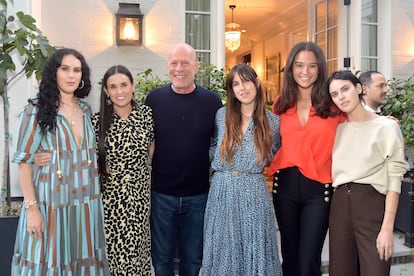
In her nearly 300-page guide, she helps caregivers manage the situation and, above all, take care of themselves. She speaks from experience, because when she felt overwhelmed, she isolated herself from her friends and loved ones, living in “a little bubble,” as she calls it, until she realized what she was doing and how “unhealthy” it was. That’s why she reaches out to another group: those who, though close by, don’t know how to help.
“People don’t know what to do; they don’t want to overstep. The message that I would get is that ‘if there’s anything you need, please let me know.’ That’s very well-meaning, and you know that’s a beautiful gesture, but it just puts another added stress on the caregivers to figure out, well, what can I ask? And it gets very complicated.” She encourages caregivers to raise their voice. “Caregivers need to understand that this is not a solo mission, and we’re not a failure because we are asking for support. We really need to learn to bring back our communities in our lives. We need to be able to depend on our neighbors. We live in this world that is so disconnected, and we need to get back to the sense of community and support and the idea that if parenting takes a village, so does caregiving.”
When they discovered the illness, the couple had two young daughters, who are now teenagers. “Bruce has three adult daughters, so I had to learn how to communicate with them about something that I was even still trying to come to terms with as well. We always feel like we make the world and everything be rainbows and unicorns for our children. But that’s not our world. And what we’re going through as a family with their father and his disease, that’s not that world. So it’s been really important for me to learn how to communicate with them in an age-appropriate way. When I give them the information, I wait for them to sort of ask me questions. And when they ask me the questions, I give them truthful answers. Which isn’t always easy, but I think that helps them feel a little bit more safe in that, knowing that I’m never going to tell them something that’s not true. And that if anything changes, I’m going to let you know.” Although not everything is ideal: “I’m not saying I do it perfectly all the time. I’m not a perfect caregiver. I’m not a perfect person. I’m not a perfect mom, of course. I think as caregivers and parents, we’re just trying to do the best that we can. And my daughters know that.”
Faced with this lack of awareness, Heming is also creating a guide to help family members of patients with frontotemporal dementia know what to do in the early stages. Shouldn’t that be the healthcare system’s job? Exactly, she says. “We need to understand as a society that we will need care or give care in our lives. No one is exempt from being a caregiver. It might not be happening to some now, but it will, and I think we don’t have a healthcare system that even sees the caregiver. They are unsupported. So we need to figure out a better system. We have to use our voices to be able to make the changes that we need.”
Still, she feels proud of herself. “That’s what I want caregivers to know, that in the beginning, it’s really hard. You’re learning new things. You have to come to terms with your person and this disease, and you’re dealing with the grief and the pain of that. For me, it was about really understanding that there is nothing that I can do to change the outcome of this disease. And I’ve tried; I’ve tried everything that I possibly can, but there is no treatment, there is no cure for this disease, so I’ve been able to educate myself, surround myself with people that are way smarter than me and that have been on this journey longer than me. I am really proud of where I am today and how far I’ve come. I know our support system will be prepared, and that really helps settle the anxiety a little bit. Not a lot, but at least it brings it down to know that I’ll be prepared, you know?”
The disease has also brought her something: “I think there’s one thing that’s beautiful about dementia. It gives you the gift of time. We can get so busy in life and be juggling a million things, but I think learning how to be present and be with the people that we love is so important. It’s allowed me to slow down in certain respects to really be able to appreciate the people and the love and the support that we have within our lives, so that we can continue to provide for Bruce and my family.”