Connect with us

%

Guiris Go Home? Look At The Numbers

Published

on

guiris-go-home?-look-at-the-numbers

Graffiti appearing around Malaga following recent housing protests. Credit: EWN

If you live in Spain and have seen the words “Guiris go home” appearing on walls, banners or social media, it is hard not to take them personally. The housing debate in Spain has seen expats scapegoated for the problems of affordable housing.

(“Guiri” is a colloquial Spanish term commonly used for a foreign visitor or foreigner, particularly someone from northern Europe or an English-speaking country. It is often used for British, German or Scandinavian tourists and residents. The term can be neutral, affectionate, humorous or mildly derogatory, depending on who says it, the context and the tone. In everyday Spain, many foreigners also use guiri about themselves without intending offence.)

For many British residents, and French, Dutch, Polish and German, etc., Spain is not somewhere they simply come for two weeks in August. It is home. There are perfectly legitimate arguments to be had about tourism, house prices, second homes and the pressure on local communities. But before ‘expats’ are scapegoated into the problem, it is worth looking at what they actually bring to the Spanish economy.

What do expats actually contribute?

It is not simply about buying a café con leche or spending money in a supermarket. Foreign residents and visitors generate economic activity in a number of ways:

  • They bring money into Spain. Foreign pensions, salaries, savings and tourist spending all put money into the Spanish economy.
  • They create jobs. Foreign residents need builders, plumbers, electricians, gardeners, cleaners, lawyers, accountants, estate agents, restaurants and countless other services.
  • They spend throughout the year. Unlike some holidaymakers, permanent residents are buying food, filling cars, paying utility bills and using local businesses in January as well as July.
  • They support Spanish businesses. A foreign homeowner renovating a property can mean work for several local tradespeople and suppliers.
  • They work and pay taxes. Foreign workers are part of Spain’s labour force and contribute directly to economic output.
  • They invest. Foreign money goes into property, businesses and other parts of the economy.
  • They support tourism. International visitors spent €126.3 billion in Spain in 2024. British visitors alone accounted for €22.6 billion of that total, according to Spain’s National Statistics Institute.
  • They help sustain whole communities. In the Balearic Islands, tourism generated €13.956 billion of direct and indirect economic activity in 2019, equivalent to 41.3 per cent of regional GDP and 41.6 per cent of employment.

That does not mean every consequence of foreign demand is positive. It clearly is not. But it does mean the picture is rather more complicated than “foreigners take things from Spaniards”.

Spain and its expats: a two-way street

There is another point that can easily get lost in the argument. Spain is not a country whose people have always stayed at home while foreigners moved in. The distinction between an expat and an immigrant is itself debated, but millions of Spanish nationals live abroad too.
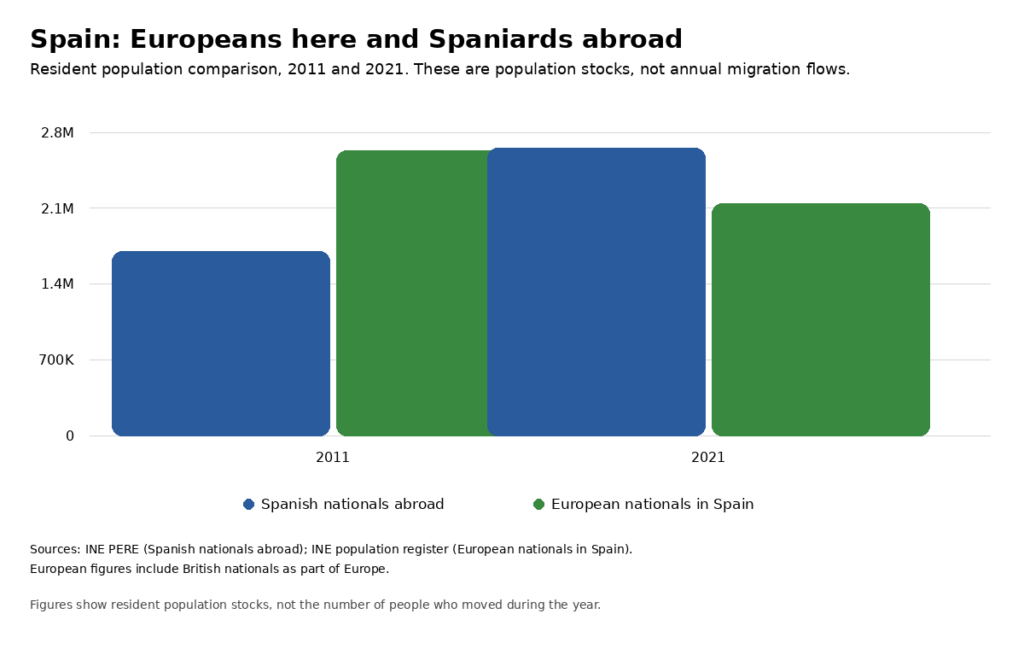
graph showing the amount of Europeans residing in Spain contrasted again Spaniards living abroad

Figures are resident populations, not annual migration flows.

Spain’s official PERE statistics count Spanish nationals habitually resident abroad. There were around 1.7 million in 2011 and 2.65 million by 2021. In other words, movement between countries works both ways.

A Spanish person living in Britain, Germany or France does not suddenly stop being Spanish because they have built a life somewhere else. They become part of another country’s economy. The same principle applies to the British, Germans, French, Dutch and other Europeans who have built lives in Spain.

Yes, but… None of this means Spain should ignore its housing problems.

Foreign demand can add pressure to house prices in places where supply is already restricted. Tourism can put pressure on infrastructure and local communities. Governments have every right to debate how many homes should be holiday lets, how development should be managed and what sort of tourism individual towns want. Those are legitimate arguments. But there is a difference between questioning the impact of foreign demand and deciding that foreigners themselves are the problem. That distinction is important.

Spain’s central bank recently estimated that the foreign population made a direct contribution of between 0.4 and 0.7 percentage points to Spain’s annual per-capita GDP growth between 2022 and 2024, when total per-capita GDP growth averaged 2.9 per cent a year. So the next time somebody sees “Guiris go home”, there is another question worth asking. Go where?

‘Go home’? Where?

Back to Britain? Back to Germany? Back to France? And what happens to the businesses, jobs, rents, mortgages, renovations, restaurants, shops and services that those people currently support?

You do not have to pretend Spain has no housing problem. You do not have to defend every aspect of mass tourism. And you certainly do not have to believe every foreign resident is automatically good for every community.

But there is a difference between having an argument about what Spain needs and telling millions of people who have made Spain their home that they simply do not belong. For many of those people, Spain is not somewhere they have merely visited. It is where they chose to build their lives.

And the numbers show that they have become a big part of Spain’s economy too.

And, before the expat vs immigrant argument fires up again, an ‘expat’ is basically an ‘immigrant’ who can easily take an easyJet flight and be back to the land of their passport in a couple of hours, whereas some other categorised as ‘immigrant’ cannot.


%

Tied-Up Bull In Fuengirola Shocks Locals

Published

on

tied-up-bull-in-fuengirola-shocks-locals

The strangest sights are everyday business in Fuengirola. Credit: FsQ

A clip of a bull lashed to a flat’s railing has set local social media on fire in Fuengirola, hours after the town’s Romeria in honour of the Virgin of the Rosario left the parish church.

Fuengirolasequeja posted the footage. Viewers saw a working ox standing by a metal fence, looking lonely, and comment threads filled with complaints about how the animal was being treated.

Town hall and police call it a planned stop (honestly)

Fuengirola Town Hall and Local Police sources told 101TV nothing irregular had happened. That stretch, running parallel to Calle Cordoba, is the agreed dawn meeting point where oxen are usually hitched to the floats before the pilgrimage leaves town. The trouble is, no one was with it.

Officers were close by, those sources said, so no incident and no risk developed. What the camera caught, they added, was a brief, scheduled pause: “a matter of minutes.”

Sunday’s route is the usual one. After the 10am pilgrims’ mass at the Rosario parish, a replica of the Virgin travels on an ox-drawn cart from Plaza de la Constitucion toward Parque El Esparragal in Mijas. Riders, decorated waggons and walkers follow. Return is due from about 7pm.

Why the clip travelled so fast

Ox carts still open this romeria every year. Many locals treat that as an ordinary Andalucian custom. Others see a huge animal with horns parked against a residential fence and want it gone from busy streets. Spanish pet rules often leave working oxen in a different legal box, which is why these videos spark heat even when councils say the stop was brief and watched.

This row is not quite in the August carriage crash category in Plaza de la Constitucion, when a horse bolted in high heat and two women were hurt. That smash reopened the Costa del Sol argument over tourist calesas.  Fuengirola’s big week, the Feria del Rosario, runs 6 to 12 October. EWN’s 2026 feria guide has concerts and street times. Last weekend’s Fuengirola a Caballo already put horses back in the same central streets.

No injury, no fine and no PACMA filing has been published for this ox. And no tipsy tourists stumbled upon it, thankfully. Officials say the animal was where it was meant to be. Online, plenty of people still want working beasts kept off railings in a packed resort town. Where the owners of the animal were at the time is up for debate.

Continue Reading

%

Racehorse Forced To Change Its Name After Officials Spot A Very Unfortunate Problem

Published

on

racehorse-forced-to-change-its-name-after-officials-spot-a-very-unfortunate-problem

The horse had already made her racing debut when officials decided that her name was a problem. Photo credit: gabriel12/Shutterstock

There are some horse names that make you wonder what on earth the owner was thinking. Others are so unfortunate that you can practically hear the race commentator trying not to laugh. But one American racehorse has just discovered that choosing a name can have consequences far beyond a few raised eyebrows in the paddock.

The horse had already made her racing debut when officials decided that her name was a problem. Her owner has offered an explanation for where it came from, but racing authorities were not convinced it was suitable for the racecourse. And that is where things get rather awkward.

A name becomes a problem

The two year old filly was registered as ‘Austrian Painter’ and won her debut at Horseshoe Indianapolis on Monday. Shortly afterwards, however, the US Jockey Club received a formal complaint about the name and opened an investigation. The organisation ultimately decided that it was ineligible under its rules because it could reasonably be interpreted as an offensive reference to Mr Adolf H. There is an obvious reason for the association. Hitler was born in Austria and spent part of his early adult life pursuing a career as an artist in Vienna.

“Austrian painter” has also become an online euphemism for Hitler, particularly in places where users try to avoid content moderation. The horse’s owner and breeder, Scott Herbertson, however has said the name was intended to refer to Austrian artist Gustav Klimt, rather than the other. Klimt was the artist behind The Kiss and is one of Austria’s most famous painters compared to the other who is also famous but for all the wrong reasons. That explanation did not prevent the name being changed. Austrian Painter is now officially called Merrylegs. Such a downgrade, I know. she sounds more like a ‘My Little Pony’ than a racehorse.

And then there was another horse

Unfortunately for Herbertson, he had another naming headache waiting in the stable. Austrian Painter’s full sister was registered as New Order, and now things are looking suspicious. But not to worry, Herbertson hand a good reason for that name too, and said that name was a reference to the British electronic band New Order, rather than anything connected to Nazi Germany. The Jockey Club nevertheless, once again, ordered that horse also be renamed. The problem is that “New Order” also has a historical association with Nazi Germany’s plans for occupied Europe.

So Herbertson now has two horses requiring new identities, despite having explanations for both names. It is hardly the first time a racehorse name has caused a stir. In 2017, a South African racehorse called President Trump was ordered to change its name after racing authorities deemed it unsuitable. The horse was subsequently castrated and renamed Fake News, after an attempt to use “POTUS” was also rejected, some people have no sense of humour!

When horse names get very awkward

Over the years some names have caused controversy for a completely different reason: they are simply hilarious, rude or unfortunate when spoken aloud. Take Porn Star, for example. There really was a Dutch Warmblood show jumper with that name, born in 1997 and registered for FEI-level jumping competitions. Records show the horse competed in international events in Italy with riders including Filippo Linari and Marta Bottanelli.  

Then there was Brandy Love, a racehorse who attracted plenty of attention before the Cheltenham Festival because her name was almost identical to that of adult actress Brandi Love. Even jockey Paul Townend struggled to keep a straight face when was asked about riding her. And racing has produced names that are considerably harder for commentators to say with a straight face. Hoof Hearted became notorious because its name sounds rather different when shouted repeatedly at race-commentator speed. Racing Post even included it among the names that had somehow slipped through the naming rules. 

Sometimes the mistake is completely innocent

Not every memorable horse name was deliberately trying to cause trouble. One of Britain’s better-known jumpers was called Definitly Red, yes, without the second “e” in “Definitely”. The spelling was apparently the result of a mistake when the horse’s name was registered for point-to-point racing. That did not exactly hold him back. Definitly Red went on to win 15 of his 38 races, including the Charlie Hall Chase and Many Clouds Chase, and twice competed in the Grand National. 

So perhaps the lesson from Austrian Painter is that naming a horse is rather more complicated than finding something that sounds good on a race card. You can name one after an artist, a rock band, a celebrity or simply make a spelling mistake, but once thousands of people are reading the name, you don’t get to decide what they see in it.

Continue Reading

%

Spanish Supermarket Wants 10 Years In Prison For Cashier Accused Of €333,800 Theft

Published

on

spanish-supermarket-wants-10-years-in-prison-for-cashier-accused-of-e333,800-theft

Several tickets that had been left open. Photo credit: Zamrznuti tonovi/Shutterstock

A supermarket till is probably the last place most people would expect to find a €333,800 hole in the accounts. But in Cantabria, a cashier is accused of finding a remarkably simple way to make cash disappear, one small transaction at a time.

The alleged scheme went on for two years and involved 1,160 transactions, according to prosecutors. Now the supermarket wants the cashier to spend 10 years behind bars, while the Public Prosecutor’s Office is seeking a three-year sentence.

How the money disappeared

The supermarket’s tills used separate systems for recording purchases and processing payments. According to the prosecution, the cashier took advantage of this when customers paid less than €400 in cash. After processing the purchase, she allegedly disconnected the payment terminal from the electricity supply, preventing the payment from being recorded in the system.

The cash could then be kept without the corresponding payment appearing in the supermarket’s records.Prosecutors say this happened 1,160 times between 2023 and 2025, with the total amount allegedly taken reaching €333,800. The case is now heading to the Provincial Court of Cantabria, where the allegations will be examined.

The clue was hiding in the computer system

The supermarket eventually became suspicious after its applications manager noticed several tickets that had been left open. A review of the records found that similar transactions were repeatedly being made at the beginning and end of shifts and were being carried out using the same employee’s credentials.

The company then spent two days monitoring the cashier with security cameras, according to the prosecution’s account. She was dismissed the following day, and prosecutors allege that she was carrying €845 in cash when she was confronted. The company subsequently reported the matter to the authorities.

Supermarket wants 10 years in prison

The supermarket and the Public Prosecutor’s Office are seeking very different sentences. The prosecutor is asking for three years in prison, a €4,500 fine and compensation of €333,800 for the alleged loss. The supermarket, which is appearing as the private prosecution, is asking for 10 years in prison, along with a €288,000 fine and compensation of €331,750.

The difference in the compensation figures is linked to €2,000 allegedly returned by the cashier several days after she was dismissed, according to the prosecution. The case concerns a continuing aggravated offence of misappropriation. The cashier has not been convicted and the allegations have yet to be determined by the court.

Court hearing set for next week

The case is due before Section Three of the Provincial Court of Cantabria on Thursday, October 1, with the hearing scheduled to begin at 10:00am. The parties will first have the opportunity to reach an agreement. If no agreement is reached, the court will set a date for the trial. The prosecution will have to establish that the accused carried out the transactions and took the money as alleged.

Evidence is expected to include the supermarket’s computer records and security camera footage. For customers standing at a till, there is nothing particularly unusual about handing over a few notes and walking away with their shopping. In this case, prosecutors allege that those ordinary cash payments were being used to remove hundreds of thousands of euros from the business over time.

Continue Reading

Trending

Copyright © 2017 Spanish Property & News