Beirut
Israel Continues Bombing Lebanon Despite Ceasefire Extension: ‘We Have Freedom Of Action’

The ceasefire that has never truly stopped the fighting between Israel and Hezbollah followed the same dynamic on Thursday after being extended in a new round of talks in Washington.
On Thursday morning, Israel’s military continued its attacks, and Israel’s defense minister, Israel Katz, has made it clear that bombing will go on and that troops will maintain their positions in Lebanon.
U.S. President Donald Trump himself acknowledged hours earlier that the ceasefire — launched in April — exists only on paper. Asked how he would define a ceasefire, he replied: “I’d say in that part of the world, ceasefire is when you’re shooting in a more moderate manner.”
In the first hours after the ceasefire was extended, Israel asserted its “freedom of action” in Lebanon, both in deeds and in words. On the ground, it wounded a family — a man, his wife and their daughter — in a drone strike on their car in southern Lebanon, according to the country’s national news agency. It has also issued a new “urgent warning to residents of southern Lebanon,” stating that it is continuing its attacks south of the Zahrani River (about 25 miles from the border) and that anyone there or traveling through the area “puts their life at risk.” In the same area, one Serbian peacekeeper has been killed and two Spanish personnel injured in an attack on the U.N. mission, UNIFIL, according to reports on Thursday.
In a statement, Katz stressed that the ceasefire is “conditioned on the prompt withdrawal of Hezbollah terrorists from all areas south of the Litani River and the creation of a demilitarized zone,” while his armed forces “will continue strikes and operations in the area for the time being,” and will keep occupying and destroying villages in areas they control (including Beaufort Castle) without allowing the population to return.
Katz emphasized that Israel retains freedom of action — “with U.S. support” — including the option to strike Beirut (after Trump forced Israeli Prime Minister Benjamin Netanyahu to back down on Tuesday) if Hezbollah attacks Israeli territory, and not only Israeli troops in Lebanon.

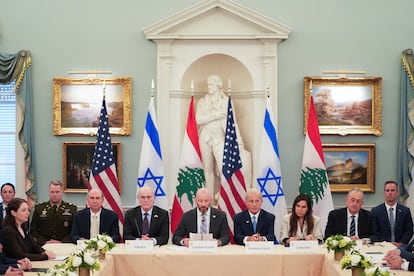
The new extension places the ball in Hezbollah’s court, according to a joint statement by the United States, Israel and Lebanon — whose government has declared Hezbollah’s armed activities illegal — released by the U.S. State Department. The text states that “the ceasefire is contingent on a complete cessation of Hizbollah fire and the evacuation of all Hizbollah operatives from the South Litani Sector.”
Hezbollah, for its part, rejects any “partial” ceasefire and demands a “genuine” full cessation of hostilities, including the withdrawal of Israeli troops from all Lebanese territory.
The main new element of the agreement is a plan to create “pilot zones” in Lebanon without Hezbollah presence, to be controlled by the Lebanese army. This could open the door to potential Israeli withdrawals, although it remains unclear how these would work or when they would begin. The two governments are due to meet again in two weeks with the aim of “reaching a comprehensive agreement,” the statement said.
The deal was reached during the fourth round of direct negotiations between Israel and Lebanon, held on Tuesday and Wednesday, and marked by insults that Trump directed at Netanyahu during one of their two phone calls, in which he forced the Israeli prime minister to back down from his plan to bomb Dahiyeh, the Shiite-majority suburbs of Beirut, after Tehran threatened to resume the war with the U.S.
Sign up for our weekly newsletter to get more English-language news coverage from EL PAÍS USA Edition