
ElPais
Manoliño And Other Dolphins Who Approach People To Escape Their Loneliness


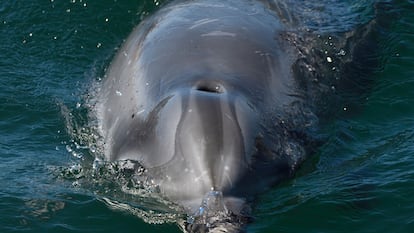
Manoliño, Spain’s most famous lone dolphin, was first spotted in 2019. Over time, he became a regular in the Muros‑Noia and Ferrol estuaries of the Spanish northwestern region of Galicia; he practically became one of the locals. For five and a half years, he approached boats and bathers, allowed himself to be touched in shallow waters near the shore, and even interfered with the work of divers who collected razor clams. He died in September 2025 after being struck by a ship’s propellers.
A study has analyzed his history and behavior alongside that of 16 other solitary social common dolphins — those that interact with people — recorded in Spanish waters since 1970, most of them (14) in Galicia. Among them is Nina, a female who was filmed by the celebrated environmentalist Félix Rodríguez de la Fuente as she played with children who hugged her and clung to her dorsal fin. They are not the only cases: between 1950 and 2022, solitary dolphins were recorded in 47 localities across 26 countries.
Dolphins live in complex groups where they form relationships that can last a lifetime. But occasionally an individual breaks the rules: it lives alone, comes close to the shore and seeks contact with humans. The reason is unclear. The study suggests several hypotheses: from searching for new territory to health problems, injuries or rejection by its group. Such behavior poses risks both to the survival and welfare of marine mammals and to the safety of people, who approach them as if they were pets. Nothing could be further from the truth.
“Manoliño, for example, who was a real sweetheart, was also a three‑meter, 400‑kilogram animal that, if it gave you a smack, would turn your head upside down,” notes Alfredo López, one of the study’s authors and director of the Coordinadora para el Estudio de los Mamíferos Marinos (CEMMA).
The dolphin was seen helping to lift fishing traps and helping children from a sailing club onto boats, showing freshly caught fish or playing with a dog. But there were also incidents because he removed divers’ masks and even the hoses that supply air to the navalleiros, the divers who harvest razor clams by diving 10 to 12 meters down.
00:44
Manoliño playing with a dog in A Coruña
From playing to biting
In the water, the advantage is always theirs. “They are lightning fast, not only in terms of agility but because their minds seem several steps ahead of yours. It’s as if they could anticipate what you’re going to do the next second,” López explains. Another problem arises when they approach a crowded beach and swimmers surround them. In those circumstances, they can feel harassed, as happened when Manoliño bit a woman on the leg, leaving several tooth marks.
Dolphins’ approach to people, driven by their need for social interaction, is gradual and goes through different stages. The study identifies stages 0 through 5. According to the expert, it is essential to prevent individuals in the early phases who are currently solitary from progressing to later stages and becoming social.
In stage 1, the dolphin begins to reveal itself, then starts to follow boats and show an interest in human activity. Once the distrust is overcome, social and tactile behaviors emerge, such as rubbing against boats or bathers. They can even use their penis as a tool to explore, touch or move objects such as ropes, without it necessarily implying a sexual purpose. “It is an exploration they perform with their whole body out of curiosity, and we may interpret it as sexual when it is not,” López clarifies.
In more advanced phases they can also show dominant behavior, such as swimming at high speed, forcefully exhaling, ramming with the head or leaping very close to people, even over them. The fifth and final phase would be the cetacean’s return to its fellow dolphins, something that can occur at any stage and is difficult to verify.
Some individuals are not strictly solitary, as was the case with Enol, who was seen for three years, mainly in the northern region of Asturias, between 1993 and 1997, always accompanied by his mother Ercina. He was not as friendly as Manoliño or Nina, and displayed aggressive, dominant and sexual behaviors toward the people he interacted with, in addition to biting many of them.
Gaspar, another case mentioned in the study, arrived in Galicia’s Rías Baixas in 2007 and slowly progressed through the sociability stages. He first showed an interest in oars, paddles and small boats, which he sometimes capsized. His favorite activities included putting his head into the outlet of the turbines where the water came out or getting entangled in boats’ ropes. He also wound ropes around his tail and fins and on two occasions was seen interacting with a dog in the port of Corcubión.
But he could also act dominantly when bothered. On one occasion he grabbed an underwater welder and dragged him five meters, breaking a rib. On another, he broke the arm of a person who jumped into the water to swim with him. He was last seen in 2010.
Manoliño also went through all the stages described in the study. At first he approached boats and people without interacting with them. By stage 3, he approached fishermen working in the estuary and bathers but did not allow them to touch him. In stage 4, which he reached quickly, he sought contact with anyone in the water. That behavior changed radically when he was speared in the left flank in October 2022: he reverted to stage 1. It did not last long and he gradually resumed approaching people.
But there were already warnings from the authorities: he should not be fed or touched. If on a boat, it was recommended not to approach him or to accelerate suddenly.
The most important thing is to prevent solitary dolphins from becoming social, the study warns, and that is achieved through education and management by the authorities. “We know that town councils are reluctant to restrict access to beaches or ports if such a situation occurs, but these measures could be included in a management plan for temporary application,” the scientists conclude.
Sign up for our weekly newsletter to get more English-language news coverage from EL PAÍS USA Edition












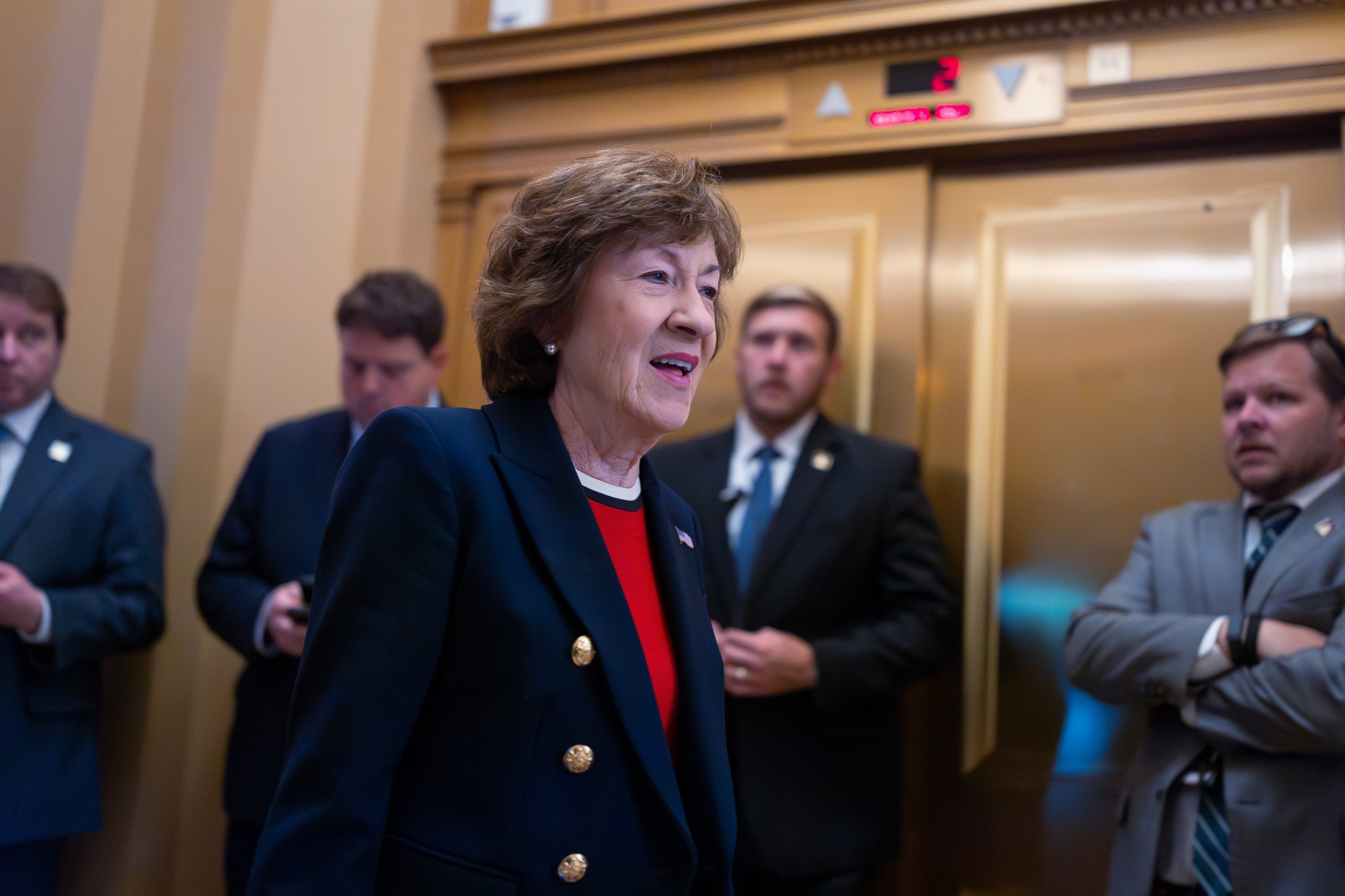

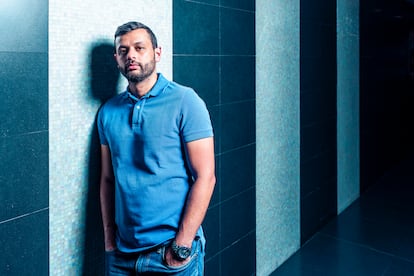
Arab Barghouti (Jerusalem, 35) says that “at the end of the day” he does not think of Marwan Barghouti as a politician, nor as the Palestinian leader of the Second Intifada (2000–2005), who was sentenced by Israel to five life terms in a trial full of irregularities 24 years ago. He thinks of himself as the son who wants his father “to come home.”
Marwan Barghouti (Kobar, 66) is the only Palestinian leader who commands consensus, even among Hamas fundamentalists. That “unified leadership,” his son argues, is “the reason” he believes Israel refuses to release the man known as “the Palestinian Mandela” (Nelson Mandela himself drew parallels between their experiences).
Arab Barghouti spoke with EL PAÍS on June 3 in Madrid. Among other events, in the Spanish capital he met with representatives from all parliamentary groups in Congress except those from the conservative PP, far-right Vox, and pro-independence Junts per Catalunya, as part of the “Free Marwan” campaign to call for his father’s release.
Question. Like you, many Palestinians grew up with parents in prison. What does the imprisonment of Palestinians represent for Israel?
Answer. It is collective punishment and an instrument of the occupation used to silence, oppress, and de-legitimize the Palestinian people’s right to self-defense. Over the past 58 years, more than 800,000 Palestinians have been imprisoned, one-third of them under administrative detention [without charges or trial], which is unlawful under international law. It affects every Palestinian family. As my mother [lawyer Fadwa Barghouti] noted, after October 7, 2023 [the day of the Hamas attacks and the start of the Israeli offensive in Gaza], mass incarceration has become a continuation of the genocide.
Q. You have denounced several assaults on your father in prison. How is he now?
A. His lawyer saw him a few weeks ago and said he was assaulted again at the end of April and also on May 12. Those attacks continue because Israel knows what my father represents. We are facing a deranged prison system that has killed more than 100 Palestinian political prisoners [since October 7, 2023]. That shows how desperate they are, because they fear a man behind bars, whom they lock in a cell and prevent from receiving medical treatment or [sufficient] food. My father has lost more than 10 kilos and has been held in solitary confinement for more than two and a half years, but he remains positive and very strong mentally.
Q. When Israel’s national security minister, Itamar Ben-Gvir, threatened your father on camera, you said that was the representation of the Palestinian struggle. Why?
A. Because there you had a bully, a fascist like Ben-Gvir, who tried to humiliate my father in front of the whole world just to show off. He is a convicted terrorist even in Israel. He is also a perfect reflection of what Israel is today. To me it makes no sense that world leaders do not speak out against Ben-Gvir and the horrific treatment he gives Palestinian political prisoners. That he is allowed to do whatever he wants demonstrates the state of the international community. My father, with his weakened body, represents the Palestinian people. When the Palestinian people starve, he starves; when a Palestinian is attacked, he is attacked. He is someone who embodies the Palestinian history and struggle.
Q. Israel has repeatedly refused to free him, most recently when Hamas demanded his release as part of the October ceasefire in Gaza.
A. My father supports coexistence and a political solution in Palestine. And that is why he remains in prison. In the past 15 years, Israel has released more than 800 Palestinians serving life sentences like his, in cases that, according to them, were more complicated than my father’s. Israel does not want peace with the Palestinians; it wants one of two options. The first is the ethnic cleansing of the Palestinian people, which occurs every day: in Gaza, where they already control more than 60% [of the territory] and where they have killed dozens, if not hundreds, of people; and in the West Bank, where settler terrorism has expelled 40,000 Palestinians. The second option is perpetual apartheid. They do not want a two-state solution or peace. That is why they refuse to release a unifying Palestinian leader who believes in international law, in coexistence and in peace, but who will never renounce the Palestinians’ right to achieve freedom, self-determination, and independence.
Q. How do you explain that Hamas, an Islamist faction, respects your father, who is a leader of the secular Fatah [the main PLO movement]?
A. My father was brave regarding the peace process, but also regarding the Palestinians’ right to defend themselves. He advocated for peace in the 1990s and met with Israelis in Tel Aviv, in Europe, in Palestine and elsewhere. He later understood that the Israelis had not committed to the Oslo Accords nor to the Palestinian people’s right to their own state. That was when he decided to tell the people what to do as a member of parliament during the Second Intifada. From then on, he became the face of that uprising. He is also a highly educated man who taught hundreds of Palestinian prisoners who, upon release, became ambassadors of his political vision and spread his message. Above all, he is a unifying figure.
Q. Does your father still see a two-state solution as possible?
A. My father understands that the Israelis are undermining that solution by building more and more illegal settlements and stealing more Palestinian land. But at the same time, he does not insist on the final form of the two-state solution. Our goal is freedom, dignity, and independence, whatever the ultimate shape of the solution may be.
Q. In 2015, Marwan Barghouti wrote that Israel used negotiations “to advance its colonial project.” Is that prophecy coming true?
A. My father understands what we’re up against, especially now that we’re dealing with an Israeli government as terrible as any we’ve ever seen before. However, the idea that peace in the Middle East can be achieved without addressing the Palestinian question is a myth. There will be no peace or stability in the Middle East without an answer to the Palestinian question. And I hope the international community understands that the only way to confront the Israeli regime, its apartheid, occupation, and war crimes is by sanctioning and isolating it.
Q. That is not the trend the EU is showing by maintaining its association agreement with Israel.
A. Some EU leaders are complicit in the shedding of our blood and the killing of our children, as are leaders of other countries, but we must focus on the future because we owe it to Palestinian children. I am here to build bridges with the EU, with all countries. Even with the governments of the United Kingdom and the United States.
Q. What role does the Palestinian Authority (PA) play in the current political paralysis?
A. I belong to a generation that is very critical of the PA for its inability to protect the Palestinian people, but what I blame them most for is not holding elections when political renewal is essential in Palestine. Right now we welcome all the measures President Mahmoud Abbas is taking, such as the local elections two months ago or the internal Fatah central committee vote a month ago, in which my father was re-elected with the highest number of votes among the candidates. We hope elections are held for the PLO’s Palestinian National Council, which would act as the parliament we do not have, making the whole system dysfunctional. We also trust that general elections will take place, which are essential for the Palestinian Authority to recover its legitimacy and indispensable to achieve political unity between Gaza, the West Bank, and East Jerusalem.
Sign up for our weekly newsletter to get more English-language news coverage from EL PAÍS USA Edition

Six people were stabbed at Penn Station, New York’s main intercity rail hub and its busiest station. The attack occurred on Sunday after 7.00 p.m. local time (1.00 a.m. CEST) between 33rd Street and Seventh Avenue, the New York Fire Department told local media. The incident comes as the city is on a high security alert ahead of a planned presidential visit on Monday by U.S. President Donald Trump, Game 3 of the NBA Finals, and the start of the FIFA World Cup.
Five of the six victims were taken to Bellevue Hospital. One suffered serious injuries, two sustained moderate injuries, and the remaining two were lightly injured. The sixth victim was admitted to NewYork-Presbyterian Hospital, the city’s emergency services said.
The suspect was arrested by police at the scene, but authorities have not released his identity or confirmed a possible motive. City comptroller Mark Levin suggested the assailant may have been experiencing a mental health crisis, and said the incident raises questions about the city’s psychiatric health network. The investigation, however, remains open.
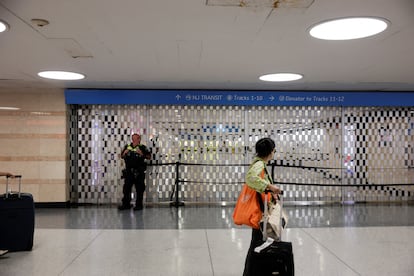
The incident came hours after the official watch party for Game 3 of the NBA Finals at Madison Square Garden, scheduled for Monday, was canceled. The game will pit the New York Knicks against the San Antonio Spurs. Officials said the cancellation was due to increased security measures related to the expected attendance of Trump and New York City Mayor Zohran Mamdani. “My heart is with everyone who was injured, their loved ones, and all those shaken by this unacceptable violence,” the mayor wrote on social media. “I’m wishing each of the victims a full and speedy recovery,” he added.
I’ve been briefed on the horrific stabbing at Penn Station. Based on the information available right now, six people were stabbed and the alleged perpetrator is in custody following a swift response from the Amtrak Police Department.
My heart is with everyone who was injured,…
— Mayor Zohran Kwame Mamdani (@NYCMayor) June 8, 2026
New York City Police Commissioner Jessica S. Tisch had recently warned about the huge workload facing the force, not only because of the decisive phase of the NBA Finals but also because of the imminent arrival of the FIFA World Cup.
Matches in the tournament, which kick off on June 13 in neighboring New Jersey, will make New York the base of operations for thousands of international fans.
Security at the World Cup in the United States regained international prominence this weekend after reports that nine people were wounded in a shooting near England’s national team base in Kansas City on Saturday.
Sign up for our weekly newsletter to get more English-language news coverage from EL PAÍS USA Edition

How To Get A Tourist Rental Licence In Andalusia (Spain) – Step-By-Step Guide 2025

Blue Stompers Jump Review At Bullring

Why Does Madrid’s Tap Water Suddenly Taste Different – And Should Residents Be Concerned?


-

 Argentina2 weeks ago
Trump Receives Flávio Bolsonaro In The Oval Office Three Weeks After Lula
-

 Uncategorized1 week ago
Montoya vs Brundle BEEF, Newey
-
 %2 weeks ago
Tourist Begs Police Not To Fine Her After Swimming In The Trevi Fountain During Heatwave
-

 Anthropic2 weeks ago
The IPOs Of SpaceX, OpenAI And Anthropic Threaten To Drive Wall Street To Bubble-Like Levels
-

 Foreign demand1 week ago
German Demand For Spanish Property Cools After A Strong Run
-

 %1 week ago
The Rising Cost Of Finding Love
-

 New Developments2 weeks ago
Luxury Villas For Sale, Estepona – ProjectL1
-

 %1 week ago
Major Strike In Portugal To Cause Widespread Disruption To Air And Rail Travel