Adidas
Nike Stumbles In Its Bid To Get Back On Track: ‘We Are A Brand Built On Victory, But Victory Must Be Earned’

Nike Inc. gathered employees at its Beaverton, Oregon, headquarters last month for “Founder’s Week,” a new tradition aimed at rallying staff and honoring the company’s roots.
Workers packed events featuring appearances from Serena Williams and top executives. The company offered free drinks for a “Thirst Thursdays” gathering. Even Phil Knight, the retailer’s 88-year-old co-founder, made a rare visit to campus.
But against the celebratory backdrop was a sense of urgency.
“Nike has seen and done a lot in more than 50 years,” Chief Executive Officer Elliott Hill, 62, wrote in a memo to employees that touted the renaming of the headquarters to the Philip H. Knight Campus. “But let’s be clear: we are operating in a different market, with new competitors, new expectations and a faster pace than at any time in our history.”
Why does Nike keep stumbling? For Hill, who came out of retirement 20 months ago to engineer a turnaround, the warning carries unusual weight. Investors and employees had hoped the beloved Nike veteran could revive the swagger and athletic focus that made the company the biggest sports brand in the world. Instead, sales and market share have slipped further. The stock has tumbled more than 45% since his arrival — erasing $57 billion in market value — and is trading near its lowest level in more than a decade.
Now, Nike risks falling further behind in the sports culture it once dictated, complicating its ability to innovate new products and command the status that made it dominant for decades.
This month’s World Cup, the first in North America in a generation, offers the opportunity for the US giant to have a defining moment. But it got off to a rocky start. The debut of Nike’s branded players’ jerseys drew criticism about puckering on the shoulders, while production delays had led to some tournament-related inventory not reaching retailers on the company’s expected timeline, according to a person familiar with the matter, who asked not to be identified to discuss confidential information. In another stumble this year, Nike removed an ad declaring “Runners Welcome. Walkers Tolerated” after it was viewed by some as shaming people who needed breaks or had disabilities.
Those missteps added to a broader challenge that has been building for years: a loss of market share to competitors that have grown more popular after sliding into the shelf space the company once abandoned. The Nike brand, which held almost a quarter of the global sports footwear market in 2016, now holds about 19%, according to data from Euromonitor International. Rivals such as Skechers, New Balance, On and Hoka have gained ground.
Nike’s revenue in its most recently reported quarter was roughly flat from a year earlier and down almost 10% from two years before, hurt by headwinds in Greater China and Europe, the Middle East and Africa. Analysts expect further declines when it reports fiscal fourth-quarter earnings June 30.
Rival Adidas AG — about half the size of Nike by sales — saw revenue jump more than 20% in that time, buoyed by the popularity of retro models like the Samba. The German company is outfitting 14 World Cup teams, compared with 12 for the U.S. brand.
“The impression is that Nike is still a business that’s somewhat on the back foot and is still trying to catch up,” said Neil Saunders, managing director of GlobalData, a retail research firm. “We should be seeing some signs of momentum, and we’re not.”

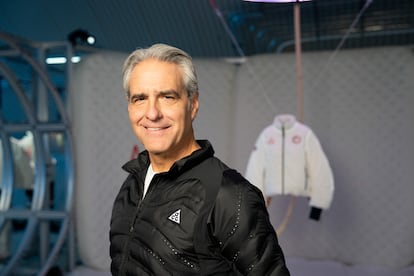
After Nike spent years building up its lifestyle shoes, Hill has sought to bring the company’s focus back to its sports roots, prioritizing getting its running and North America business back on track. But interviews with more than a dozen people close to the company show that many of those efforts have been slow to take hold, given its relationships with wholesalers had fractured and its innovation pipeline had thinned. That’s led to a broader question: If Hill can’t turn around the company, who can?
Mary Remuzzi, a Nike spokesperson, said the company is “in the middle of a deliberate reset” that takes time before producing meaningful results. She described its turnaround as unfolding in phases, beginning with what it calls a stabilization effort and progressing to a broader “Sport Offense” operating model.
“Nike is not a company you fix by pulling one lever,” she said. “Product, brand, marketplace, culture, athletes, consumers and partners move together. When all these pieces are connected, it creates the Nike multiplier that fuels growth and market share.”
In recent weeks, posters have popped up around the Beaverton headquarters, urging employees to adopt an “athlete mindset” on how they will push the company forward, noting “we are a brand built on victory, but victory must be earned.”
Hill’s warm welcome
Hill, who spent more than three decades at Nike, rejoined the company in October 2024 to replace John Donahoe, whose four-year tenure was marked by a deep push into lifestyle shoes and severed relationships with retailers such as Amazon and Macy’s. Ultimately, that left space for other brands to get in front of shoppers.
The news of the CEO switch was greeted with unabashed enthusiasm. Employees popped bottles of prosecco, while someone even made a version of the Barack Obama “Hope” poster with Hill’s face. Nike’s stock jumped almost 7% the following day.
One of Hill’s symbolic acts upon arrival was turning back on a dormant fountain outside Nike’s Sebastian Coe building. “It signals that the water’s running, that we’re back in our flow,” he said.
“I was very optimistic when Elliott was chosen to replace John,” said Kevin McCarthy, senior research analyst at Neuberger Berman, which owns Nike shares. “In hindsight, we all probably underestimated the magnitude of damage that was done.”
Hill has tried to move Nike away from the Air Force 1s and Dunks that Donahoe pumped into the market, betting that going all in on athletic performance will help win back customers. He restructured internal teams around sports — including basketball, global football and running — instead of men’s, women’s and kids divisions.
Hill has tried to restore some of Nike’s verve. He planks to playlists of “straight bangers” at employee workout classes, attends WNBA games and texts New York Liberty star Sabrina Ionescu. Nike has publicly dubbed him the “CEO of Sport.”
But building relationships with retailers that Nike deprioritized under Donahoe has taken time, while newer competitors have continued gaining momentum. And just a few months into Hill’s tenure, U.S. President Donald Trump’s sweeping tariffs rocked global supply chains.
McCarthy compared Nike to a tanker that isn’t nimble.
“We probably, and I include myself in this, had the wrong starting point in terms of expectations for how difficult a product by product, channel by channel, geo by geo turnaround would be,” he said.
The company’s trouble spots, meanwhile, keep getting worse. In Greater China, the company is expected to report a near 20% drop in revenue for the most recent quarter, hurt by local competition.
While total revenue has weakened, demand for Nike goods has hardly disappeared, said Simeon Siegel, an analyst with Guggenheim Securities. “People are still buying the product and they’re buying a lot of it, which means the problem they need to fix is reestablishing brand equity, not reestablishing brand velocity,” he said.
Still, the shift in focus on where Nike sold shoes led to a lack of innovation, he said. A new release under Hill is the highly touted Nike Mind, footwear that is purported to be mind-altering, with the ability to help get you “out of your head, connect with your surroundings and stay more present in the moment.”
“I want to see more innovation layers,” Neuberger’s McCarthy said. “We need to know when all this work and reorganization of the people and innovation and all that is going to start to come through.”
Nike’s Remuzzi said the challenges reflect the scale of the overhaul underway. The product pipeline for the next two years is “sharp and impressive,” she said.
Hill has bet heavily on using major sporting events to reestablish Nike’s credibility with athletes and consumers. In February, the company used the Milan Olympics to relaunch ACG, its outdoor brand, as a more performance-focused athletic brand.
And while the company has improved its running business under Hill, it has hit road bumps. At the London Marathon, Adidas captured the sport’s coveted sub-two-hour race. Two runners wearing the company’s new $500 shoe succeeded in the feat. In the women’s race, the winner was also wearing Adidas. The achievement carried particular sting for Nike, which had spent years trying to own the pursuit of the sub-two-hour barrier — a feat requiring runners to average roughly a 4-minute, 34-second mile for 26.2 miles.
The World Cup is a chance for Nike to show off for a massive global audience. “This is a moment where we prove ourselves, this is what we live for,” Camilo Andrade, the company’s global vice president and general manager for football, told Bloomberg TV this month.
Nike is running a major promotional campaign and is dressing teams including the U.S., France, England, and Brazil. But the release of the jerseys became a blunder. Nike acknowledged a design flaw when customers complained the shirts puckered at the shoulders: its guidelines for teams were to iron or steam out the puff.
Less margin
Outside of sports, Nike’s non-technical business, called sportswear, has been struggling. It is in an earlier part of its comeback, the company said in March, adding that the business posted a double-digit decline. While Hill’s efforts to rebuild relationships with wholesale partners has led to sales growth in the channel, sales for Nike’s direct-to-consumer business dropped 4% from a year earlier in its most recent reported quarter. Nike’s gross margin has slipped to about 40%, down from just under 45% two years earlier.
After returning from retirement, the question now is who will succeed Hill. The two presidents under Donahoe, Heidi O’Neill and Craig Williams, were at one point considered to be internal CEO prospects, but have since left the company. There is no clear person who would be next in line for the top job.
All the while, layoffs have been hitting teams. Just this spring, Nike said it was cutting 1,400 roles, which came after job reductions at Converse and across distribution centers.
For all the turmoil, Nike remains the world’s largest sportswear company — a position that, while increasingly challenged, is unlikely to disappear anytime soon.
“Take it from the old guy who’s seen every up and every down: We’re going to be fine,” he told employees in a memo. “Hard moments have a way of clarifying things.”
Sign up for our weekly newsletter to get more English-language news coverage from EL PAÍS USA Edition