China
Nuclear Powers Expand And Renew Their Arsenals In A Cold War Climate

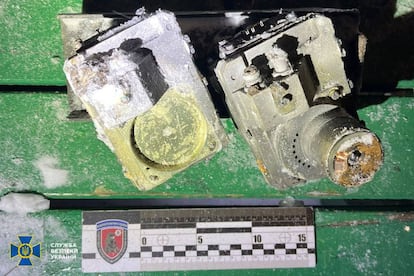
During one of the latest large artillery offensives against Ukrainian territory, on May 24, Russia used two Oreshnik missiles. Throughout the night and at dawn, Moscow launched more than 600 drones and 90 missiles against the capital, Kyiv. Four people were killed and around 100 were wounded. The intermediate-range Oreshniks struck Bila Tserkva, a town south of Kyiv, and the outskirts of the city of Donetsk, territory occupied by Russian forces in the Donbas region in the country’s east. The latter fell there by mistake. Moscow missed its target with a very powerful, hypersonic weapon that is almost impossible to intercept. The warhead was conventional, but this model can carry a nuclear payload. Russian President Vladimir Putin acknowledged last Thursday from Saint Petersburg that the projectile that was lost was “experimental.”
A test, according to the Kremlin’s version, of a missile with great destructive potential that the Russian military has already used on four occasions, always as a conventional weapon, against neighboring Ukraine. The Oreshnik is one of the examples included in the report published on Monday about nuclear arsenals by the Stockholm International Peace Research Institute (SIPRI). The research center says the nine nuclear-armed states (the United States, Russia, the United Kingdom, France, China, India, Pakistan, Israel, and North Korea) “modernized and improved” their arsenals over the past year, deploying new systems to deliver atomic munitions or systems capable of doing so.
Among these advances are the Oreshnik on the Russian side, but also, on the U.S. side, the LGM-35A Sentinel intercontinental missile, the Columbia-class nuclear-powered submarine, and the B-21 Raider heavy bomber. These are only some of the new capabilities for delivering atomic munitions driving the new nuclear arms race.
One of the warnings sounded in the report is the following: nearly four decades after the end of the Cold War, states are again relying on nuclear weapons as instruments of power. And that is despite efforts to reduce the role of such armaments. The need to display atomic muscle to deter adversaries is growing, which increases the risks of miscalculation and escalation at a time when the number of conflicts in the world is rising — the current total is 49 — most of them internal.
During the past year there were six interstate wars: Afghanistan–Pakistan; India–Pakistan; Iran–Israel/United States; Russia–Ukraine; Cambodia–Thailand; and the Democratic Republic of the Congo–Rwanda. Only in the latter two did a nuclear-armed actor not participate.
According to SIPRI’s inventory, completed in January 2026, there are 12,187 nuclear warheads in the world, around 9,745 in military stockpiles for possible use, about 130 more than a year earlier. Of the total, an estimated 4,012 are deployed on missiles, aircraft or in storage — Russia and the United States have over 1,700 each — about 100 more than in January 2025. Between 2,100 and 2,200, mostly Russian and American, are in a state of highest operational alert for immediate use via ballistic missiles.

Despite this, the total number of nuclear warheads continues to decline thanks to the dismantlement processes — faster than production — of those removed from Russian and U.S. arsenals under agreements reached after the fall of the Iron Curtain. The Stockholm research center warns that this trend could reverse in the current context. “There is increasing evidence that nuclear-armed states are setting aside, and even abandoning, their disarmament commitments and, instead, are flaunting their nuclear power,” says Hans M. Kristensen, a researcher at SIPRI.
In technical terms, the alarms are not so much about the number of deployed warheads, which is rising slightly, but about the delivery systems that accompany them and are being renewed at breakneck speed. Nevertheless, beyond the arsenals of less transparent countries such as North Korea, which has about 60 warheads, or Israel, with around 90, SIPRI’s latest inventory draws attention to the growth of China, which now has 620 nuclear warheads, about 20 more than the previous year. It is estimated that most are stockpiled in storage far from silos for launch.
At the Victory Day parade held in September 2025, Beijing displayed several previously unseen systems, such as a new transporter for its DF-31 intercontinental ballistic missiles and a new launcher for the DF-61. Both missile models can carry nuclear warheads.
The rhetoric about the war has once again placed the atomic bomb and its deterrent capacity at the center of attention, even more so after the New Strategic Arms Reduction Treaty, the only surviving U.S.–Russia arms control agreement, expired in February. Since then no public meeting between the parties has been held to renew it. Washington now insists that negotiations include China at the table.

And tensions are rising. Since the start of the invasion of Ukraine, Russia has several times issued threats brandishing its nuclear arsenal, particularly voiced by its former president and current deputy head of the Security Council, Dmitry Medvedev. The United States, despite Donald Trump’s ambiguity about NATO, continues to extend its nuclear umbrella over Europe. The European members of the Alliance — only France and the United Kingdom possess nuclear weapons, 290 and 225 respectively, of a strategic (long-range) character — are aware that without U.S. protection they would have no deterrent capacity.
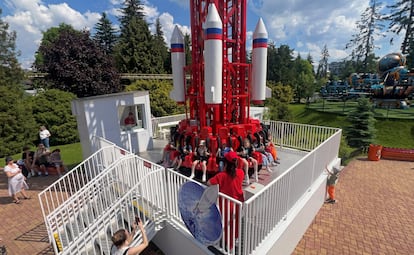
Washington stores tactical (short-range) munitions in five allied countries (Italy, Germany, Turkey, Belgium and the Netherlands), and other states such as the United Kingdom, Poland, Finland and Sweden have recently signaled interest in hosting this type of armament. In response to this interest, Moscow late last year deployed its hypersonic Oreshniks in neighboring and loyal ally Belarus — the two countries conducted military exercises with nuclear-capable weapons in mid-May. And alongside this increasingly intense battlefield, propaganda in the old Cold War style. On June 5, Saint Petersburg inaugurated an amusement-park attraction decorated with mock missiles and national colors. Its name: Oreshnik.
Sign up for our weekly newsletter to get more English-language news coverage from EL PAÍS USA Edition