
rental
Spain’s housing decrees trigger exodus from rental market, agents warn


The first evidence of how landlords are reacting to Spain’s controversial new housing decrees suggests that thousands of homes are already being withdrawn from the long-term rental market, making the housing shortage worse rather than better.
According to a survey by the National Federation of Estate Agent Associations (FAI), almost 6,000 rental transactions have been disrupted in just ten days following the government’s emergency housing decrees, which were rejected by Parliament and then reintroduced ahead of the snap general election on 29 November.
The FAI surveyed more than 600 estate agencies in Spain’s main cities and provincial capitals, finding that 88.9% had experienced disruption to their rental business as a result of the regulatory changes.
The most striking finding is that 4,235 properties have been withdrawn from or diverted away from the conventional long-term rental market. Of these, 2,067 were withdrawn altogether, 1,224 switched to the sales market, and 944 redirected towards seasonal or room rentals. Another 1,523 rental contracts have been put on hold.
These are figures reported by the agencies surveyed, not a national estimate, and the survey does not establish how many properties might eventually return to the rental market. Nevertheless, the scale and speed of the reaction are striking.
Landlords vote with their feet
The FAI reports that 78.1% of agencies have seen landlords withdraw properties from long-term letting, whilst 72.4% have experienced rental contracts being delayed or frozen. Based on these early findings, the federation warns that rental transactions could fall by 25% to 30% in the coming weeks.
The problem is particularly acute for small landlords, who account for much of Spain’s private rental supply and are especially sensitive to uncertainty over rent controls, eviction protections and their ability to recover possession.
FAI president José María Alfaro acknowledges the public frustration over the housing crisis but argues that the government’s response is having serious unintended consequences. He also criticises the decision to push the decrees through the Permanent Deputation whilst Parliament is dissolved, warning against hurried legislation in an already strained market.
The predictable consequences of more intervention
These findings are consistent with the concerns I raised in my previous articles about the decrees and the government’s decision to make housing the central battleground of the coming election.
Spain desperately needs more rental housing, yet the government’s approach risks encouraging existing landlords to withdraw properties whilst deterring new investment. Sitting tenants may benefit from greater protection, but those searching for somewhere to live face an increasingly difficult market with fewer choices.
The FAI is calling for an emergency national housing plan involving political parties, regional governments and the property sector, regardless of who wins the election. That would be a more constructive approach than using housing as a political weapon.
The survey is an early warning rather than definitive proof of a lasting collapse in rental supply. But it illustrates how quickly landlords can react when the rules become unpredictable. With the election still six weeks away and the future of the decrees uncertain, there is little reason to expect confidence to recover immediately.
Spain needs policies that encourage more homes onto the market, not measures that persuade their owners to take them off it.









Barcelona’s rent controls have kept official rental prices in check, as intended. But the latest figures for H1 2026 reveal a rental market still struggling to recover from a collapse in new contracts, leaving thousands of prospective tenants unable to find a home.
The Catalan government (Generalitat) has published the latest INCASÒL rental statistics for the first half of 2026, offering another opportunity to assess Barcelona’s rent control experiment, introduced in March 2024.
And, predictably, the Generalitat is celebrating the results. Rents are under control, we’re told. Unfortunately, that tells us remarkably little about whether people can actually find somewhere to live.
Controlled rents are controlled. What a surprise.
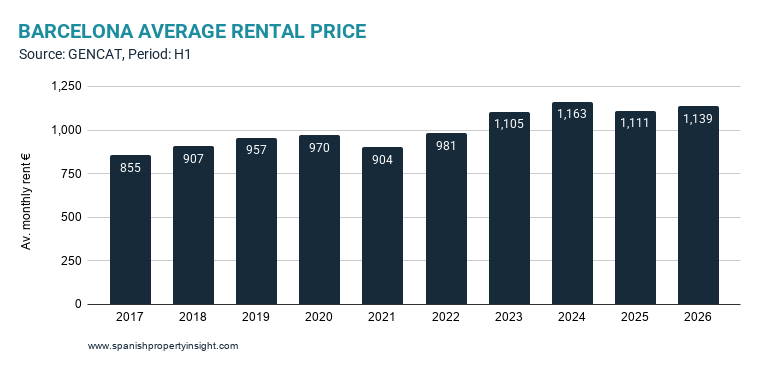
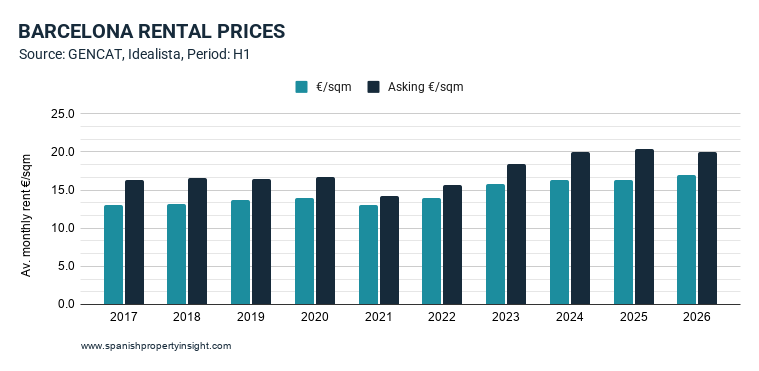
According to the latest figures, Barcelona’s average monthly rent increased by 2.5% year-on-year to €1,139 in H1 2026, whilst the price per square metre rose by 3.9% to €17.
The government presents this restraint as evidence of success. But when rental prices are controlled by law, it’s hardly surprising that the prices declared in official contracts remain constrained.
The real question is what happens to the market when prices are no longer allowed to balance supply and demand.
The collapse in rental contracts tells a different story
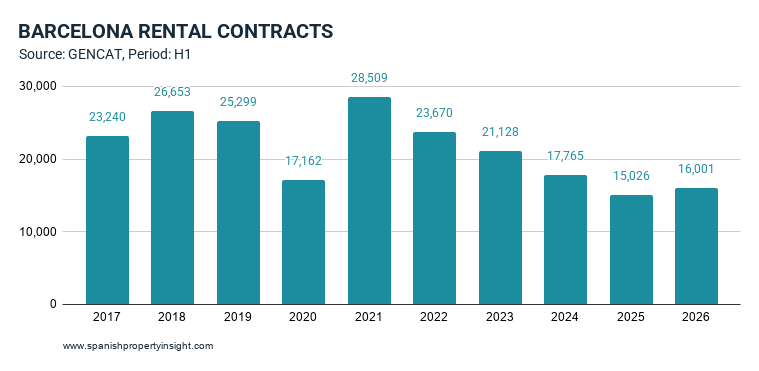
The number of new rental contracts increased by 6.5% to 16,001 in H1 2026, suggesting that the relentless decline following the introduction of rent controls may finally have bottomed out.
But before the politicians start opening the champagne, some perspective is needed.
There were 26,653 contracts signed in H1 2018, compared to just 16,001 this year—a decline of 40%. Even compared to the ten-year average, the number of contracts remains 27% lower.
In Q2 alone, just 7,845 contracts were signed, compared to 13,672 in the same quarter of 2018—a collapse of 43%.
And these figures refer to residential rental contracts lasting more than a year. Seasonal rentals are recorded separately by the Generalitat, so they cannot explain away the decline in ordinary rental contracts.
Asking prices fall, but what is really available?
Meanwhile, advertised rents on Idealista fell by 2% year-on-year to €20/sqm, narrowing the gap with official contract prices, which had widened dramatically after rent controls were introduced.
That is an interesting development, but asking prices are becoming an increasingly questionable guide to market conditions when so little accommodation is genuinely available.
A rough search of Idealista suggests around 2,000 rental listings in Barcelona, of which perhaps 650 are for long-term accommodation. And even an advertised flat is no guarantee of availability. Enquire about one and you may discover it has conveniently just gone, but the agent will happily add you to a waiting list.
In such a starved market, listings can serve as much to generate enquiries as to advertise genuinely available homes.
Meanwhile, the widening gap between asking and declared rents in recent years raises another uncomfortable question: how much rent is now being paid unofficially, including cash payments that never appear in INCASÒL statistics? The figures cannot tell us, but the incentives for undeclared payments are obvious.
The people who don’t appear in the statistics
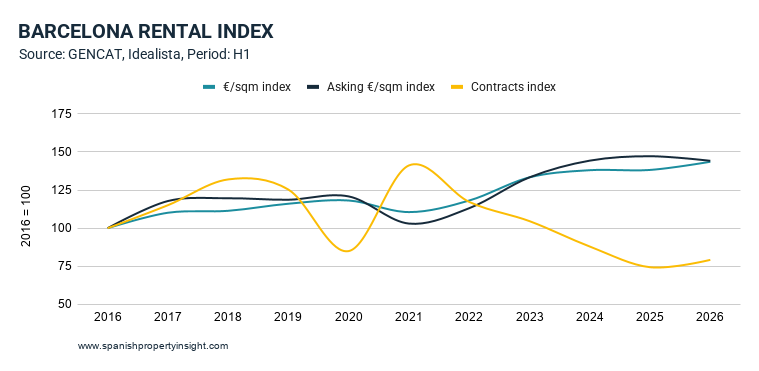
The index chart below illustrates the bigger picture. Since 2016, contract rents per square metre and asking rents have both risen by around 44%, whilst new rental contracts have fallen by 21%.
More strikingly, rental transactions have plunged since 2022, whilst prices have continued rising.
The people most disadvantaged by this situation don’t appear in the rental-price statistics at all. They are the prospective tenants who cannot find a home, even if they could afford a higher rent.
Rent controls favour sitting tenants and applicants with impeccable financial profiles. But when landlords have dozens of applicants competing for the same property at a controlled price, why take a chance on anyone with a less-than-perfect profile?
The least fortunate get pushed to the back of the queue, which is a strange outcome for a policy supposedly designed to help the vulnerable.
A government victory lap around a shrinking market
The Generalitat boasts that rent increases remain below inflation and that the overall stock of active rental contracts is growing. But that can happen simply because sitting tenants stay put for longer, reducing turnover and opportunities for newcomers.
Two years into Barcelona’s latest experiment with rent controls, the picture is becoming clear. The fall in new contracts may have stabilised, but rental opportunities remain dramatically below historical levels, whilst official rents are rising again.
Politicians can control what landlords charge on paper. They cannot legislate homes into existence.
And for the thousands of people who cannot find anywhere to rent, the government’s celebrated price containment is of precisely no use whatsoever.

Spain has introduced a new 10% VAT on short-term property lettings that could affect thousands of holiday-home owners, including those who only rent out their properties occasionally.
The legislation is already in force, but parliamentary approval is still pending and important practical questions remain unanswered.
What do the new rules say?
The measure forms part of Royal Decree-law 29/2026, published on 7 October, which introduces a range of housing measures. Although the decree came into force on 8 October, the new VAT rules are scheduled to apply from 1 December 2026.
Under the legislation, furnished properties rented to the same tenant for 30 nights or fewer will attract VAT at 10%, even when no hotel-style services are provided.
An exception applies to accommodation in the landlord’s habitual residence. Longer lettings generally remain exempt unless hotel-style services are provided, in which case 10% VAT already applies.
Importantly, the new rule is based on the duration of the letting, not whether the property is officially registered as tourist accommodation.
What does this mean for property owners?
Until now, owners letting holiday accommodation without hotel-style services have generally been exempt from VAT. The new rules would change that.
An owner currently charging €1,000 for a week’s accommodation could have to charge €1,100 including VAT, or absorb the tax and accept lower net income.
But the implications go beyond pricing. Private individuals can charge VAT without setting up a company, but owners affected by the new rules would generally have to register for VAT purposes with the Spanish Tax Agency, normally using Form 036, and submit periodic VAT returns using Form 303.
That means more paperwork, record-keeping and potentially accountancy costs, even for foreign owners who only rent out their Spanish holiday homes for a few weeks each year.
On the positive side, owners charging VAT may be entitled to reclaim VAT on qualifying expenses, subject to the normal restrictions, particularly where properties are also used privately.
What remains unclear?
Although the basic tax obligation is established, several practical questions remain, particularly for occasional and non-resident landlords.
How will the new rules apply to bookings made, or deposits collected, before December? How will rental platforms and property managers handle VAT collection and invoicing? What specific guidance will the Tax Agency provide for private owners who have never had to deal with VAT before?
Further clarification would be welcome before owners are expected to comply.
Will the new VAT rules survive?
Nobody knows. The decree is currently in force but must be ratified by the Permanent Deputation of Congress, which is expected to vote on 12 November, ahead of Spain’s general election on 29 November.
An earlier version of the housing legislation was rejected by Congress on 2 October, so approval cannot be taken for granted.
If the decree is rejected again, the new VAT measures will fall away before their scheduled introduction on 1 December. And if the decree is passed but the Socialist party running the country in coalition with the hard left lose the next General Election due to be held on 29 November, an incoming rightwing government would probably repeal the decree.
For now, holiday-home owners should be aware of the potential changes and their implications, but there is still considerable uncertainty about what will actually happen.
We should know more after the parliamentary vote, assuming the Government’s latest housing legislation survives.


Spain has introduced a new 10% VAT on short-term property lettings that could affect thousands of holiday-home owners, including those who only rent out their properties occasionally.
The legislation is already in force, but parliamentary approval is still pending and important practical questions remain unanswered.
What do the new rules say?
The measure forms part of Royal Decree-law 29/2026, published on 7 October, which introduces a range of housing measures. Although the decree came into force on 8 October, the new VAT rules are scheduled to apply from 1 December 2026.
Under the legislation, furnished properties rented to the same tenant for 30 nights or fewer will attract VAT at 10%, even when no hotel-style services are provided.
An exception applies to accommodation in the landlord’s habitual residence. Longer lettings generally remain exempt unless hotel-style services are provided, in which case 10% VAT already applies.
Importantly, the new rule is based on the duration of the letting, not whether the property is officially registered as tourist accommodation.
What does this mean for property owners?
Until now, owners letting holiday accommodation without hotel-style services have generally been exempt from VAT. The new rules would change that.
An owner currently charging €1,000 for a week’s accommodation could have to charge €1,100 including VAT, or absorb the tax and accept lower net income.
But the implications go beyond pricing. Private individuals can charge VAT without setting up a company, but owners affected by the new rules would generally have to register for VAT purposes with the Spanish Tax Agency, normally using Form 036, and submit periodic VAT returns using Form 303.
That means more paperwork, record-keeping and potentially accountancy costs, even for foreign owners who only rent out their Spanish holiday homes for a few weeks each year.
On the positive side, owners charging VAT may be entitled to reclaim VAT on qualifying expenses, subject to the normal restrictions, particularly where properties are also used privately.
What remains unclear?
Although the basic tax obligation is established, several practical questions remain, particularly for occasional and non-resident landlords.
How will the new rules apply to bookings made, or deposits collected, before December? How will rental platforms and property managers handle VAT collection and invoicing? What specific guidance will the Tax Agency provide for private owners who have never had to deal with VAT before?
Further clarification would be welcome before owners are expected to comply.
Will the new VAT rules survive?
Nobody knows. The decree is currently in force but must be ratified by the Permanent Deputation of Congress, which is expected to vote on 12 November, ahead of Spain’s general election on 29 November.
An earlier version of the housing legislation was rejected by Congress on 2 October, so approval cannot be taken for granted.
If the decree is rejected again, the new VAT measures will fall away before their scheduled introduction on 1 December. And if the decree is passed but the Socialist party running the country in coalition with the hard left lose the next General Election due to be held on 29 November, an incoming rightwing government would probably repeal the decree.
For now, holiday-home owners should be aware of the potential changes and their implications, but there is still considerable uncertainty about what will actually happen.
We should know more after the parliamentary vote, assuming the Government’s latest housing legislation survives.

FIA confirm Max Verstappen hit with 30-place grid penalty ahead of Brazilian Grand Prix
Burglar in Spain drinks himself to sleep in bar raid gone wrong

Burglar In Spain Drinks Himself To Sleep In Bar Raid Gone Wrong


-
DGT3 weeks ago
Viral video in Spain sparks fury over drivers who ‘have no idea how to drive’
-
Automated supermarket4 weeks ago
Spain’s 24-hour shop with no tills expands to Barcelona Airport
-

 Uncategorized4 weeks ago
Williams F1 driver caught up in four-car pit lane pileup
-
News4 weeks ago
Hundreds evacuated as huge fire erupts on Spain high-speed train route
-
Keeping cats and dogs outside3 weeks ago
Spain’s pet owners face fines of up to €200,000 for animal welfare offences
-
Council tax (IBI)3 weeks ago
Barcelona plans 150% property tax increase on tourist flats ahead of 2028 ban
-
Age Concern Marbella - San Pedro2 weeks ago
Halloween lunch sells out as 51 join Marbella get-together
-
airports3 weeks ago
Travelling between Spain and Italy? The extra border checks could soon end