california
The Race For Los Angeles Mayor: Two Democrats Battle Over Housing, Affordability And The Olympics

In the race for the mayoralty of Los Angeles, the second-largest city in the United States, two things are certain: a woman will win, and she will be a Democrat. But with a high share of undecided voters and only days remaining before the election, it is still unclear whether Karen Bass will win another term or whether the progressive challenger Nithya Raman will take the post.
As in many other countries, Americans’ daily lives are shaped far more by local governments than by the federal government. Their streets, schools, taxes and housing depend on decisions made by their cities and states. That is why, on November 3, many voters will be watching not only the battles for control of the U.S. Senate and House of Representatives, but also key local contests that will shape the future of their communities. Los Angeles, the heart of California, is one such case where voters will choose their next mayor.
On one side is Karen Bass, 73, who was born and raised in Los Angeles. The first woman to hold the office in the city’s 250-year history, she is seeking a second and final term as mayor. On the other is Nithya Raman, 45, a member of the City Council, born in India and educated at Harvard, who represents the city’s 4th District. Her constituency includes such densely populated and diverse areas as the Hollywood Hills, the San Fernando Valley and the Santa Monica Mountains. If elected, Raman would become Los Angeles’s first mayor of Asian descent.
The two candidates have been colleagues and are both Democrats. Their approaches to governing are not dramatically different, which has only added to voters’ uncertainty. With less than two weeks to go before the election, more than one in five voters are still undecided.
Polls so far suggest Raman may have the edge over Bass, but with nearly 21% of voters still undecided, it is still too early to know how the race will unfold. The latest survey gives Raman an eight-point lead, 47% to 39%, while an average of the three most recent polls puts her ahead by five points.
Raman, committing to infrastructure
Raman is not well known nationally, and until a few months ago she was barely known beyond her district, which includes the indie and increasingly upscale Silver Lake, where Raman lives with her husband and twins. However, almost at the last minute, she decided to enter the mayoral primary held in June, running against Bass and another candidate, Spencer Pratt, a 42-year-old Republican from the MAGA world and a former participant in a youth reality TV show. Pratt ultimately lost the primary after a lengthy and slow vote count.

What Raman is proposing, and what appears to be resonating with voters, is simplicity: transparency and organization, qualities she argues are essential in a city of nearly four million people. The broader Los Angeles area, including other cities and parts of the metropolitan region, has almost 13 million residents, half of them Latino. Raman is running a campaign in which she promises to direct tax revenues toward improvements in the city that Angelenos can see and feel.
First, she wants residents to be able to afford to live in the city. Building is expensive and complicated because of lengthy approval processes and permit requirements. The median price of a home stands at $928,000, according to the real estate site Zillow. Raman says she will simplify and speed up those procedures from day one and create an office dedicated to helping tenants.
In a city where the car is king, she wants to revitalize major avenues and fill them with shops and restaurants. She has highlighted the revival of the iconic Hollywood Boulevard, which has fallen into decline. She wants clean streets, free of potholes, with good sidewalks and adequate lighting, promising even to create a map showing broken streetlights. She also wants fewer homeless people on the streets. Despite municipal efforts, numbers continue to rise: up 3.4% in the city and 1.2% in the county between 2025 and 2026. More than 73,000 people are living on the streets in Los Angeles, according to a city report.

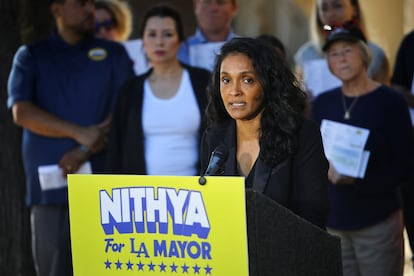
Raman also says that within her first 100 days she will hire more operators for the 911 emergency service, appoint a chief financial officer for City Hall (because the city currently has none), add a position to improve film productions in Hollywood, which have been leaving the city, and create a much-needed commission to tackle the problems facing Los Angeles International Airport, which has spent years waiting for the opening of its long-delayed automated people mover.
The 2028 Olympic Games are a central part of Raman’s platform, even though she opposed bringing them to the city not so long ago and remains skeptical about the mega sporting event set to arrive in 600 days. “I want the Olympics to succeed. But that cannot mean giving LA28 a blank check while Angelenos carry the risk,” she wrote in August on her X account, arguing that the private organizing committee, LA28, had reached “an irresponsible deal” with the city. For now, she will launch an initiative to plant 100,000 trees in the two years leading up to the Games.
Bass, by contrast, has been a strong supporter of the Games. In an interview with the Los Angeles Times, she called them “a once-in-a-lifetime opportunity to showcase Los Angeles to the world,” and argued the event is “a chance to deliver real, lasting benefits to our city and the people who call it home.”
Bass, under the shadow of homelessness and the wildfires
Beyond the Olympic Games, Bass says one of her priorities will be to push back against the mass immigration raids in a city that has been deeply affected by the hardline tactics of Immigration and Customs Enforcement (ICE) and that has repeatedly taken to the streets to protest U.S. President Donald Trump and his immigration policies.
Bass, who served in Congress from 2011 to 2022, including during Trump’s first term in office, says she will continue to fight as she did then. “The immigration raids may have left our daily headlines, but they haven’t stopped,” she told EFE.

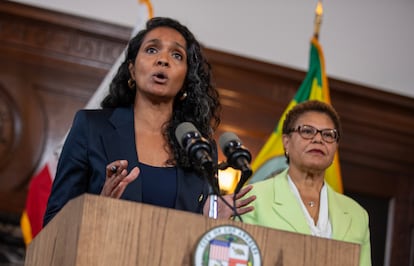
Housing is also central to Bass’s campaign. She argues that 10,000 homes have been built during her time in office, but since she was elected in November 2022, the high cost of living and the difficulty of finding affordable housing and well-paying jobs have caused the city’s population to fall. According to census figures, Los Angeles lost 54,000 residents between July 2024 and July 2025, the steepest population decline recorded by any major U.S. city.
In a state where costs are especially high, with gasoline prices reaching as much as $10 a gallon, Los Angeles is becoming increasingly unaffordable. Nearly one in 100 residents does not have health insurance, the poverty rate stands at 16% compared with 11% for California as a whole, and homeownership remains out of reach for many: only 36% of Angelenos own their homes, compared with 56% statewide, according to census data.
But the issue that has most overshadowed Bass’s legacy, and could weigh on her re-election bid, is the Los Angeles wildfires of January 2025. During some of the darkest days in the city’s recent history, fires tore through 16,000 hectares in Pacific Palisades on the west side and in Altadena and Pasadena to the northeast. Twenty-five people died and more than 11,400 homes were destroyed. Bass was criticized for being slow to respond because she was on a minor trip to Accra, Ghana. She declared a state of emergency remotely, returned after the fires had already erupted and, upon arriving at the airport, declined to answer reporters’ questions.


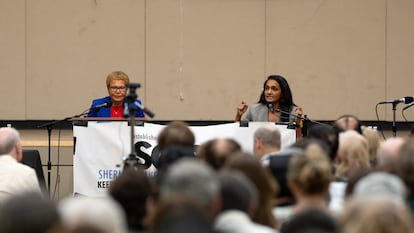
Although she tried to make amends by maintaining a visible presence at shelters and alongside victims after her return, many of those affected, especially residents of the Palisades, which falls within her jurisdiction, never forgave her. During a televised debate with Raman on October 14, Bass apologized.
“There’s not a day that goes by that I don’t think of the lives lost, the families that lost their home, and the families where the home is still standing but they’re not able to be in it,” she said. The mea culpa was necessary, but the political cost for Bass will not be known until voters deliver their verdict on November 3.
Sign up for our weekly newsletter to get more English-language news coverage from EL PAÍS USA Edition