
Bullfighter injured
Second serious injury in Spain’s La Maestranza bullring reignites controversy

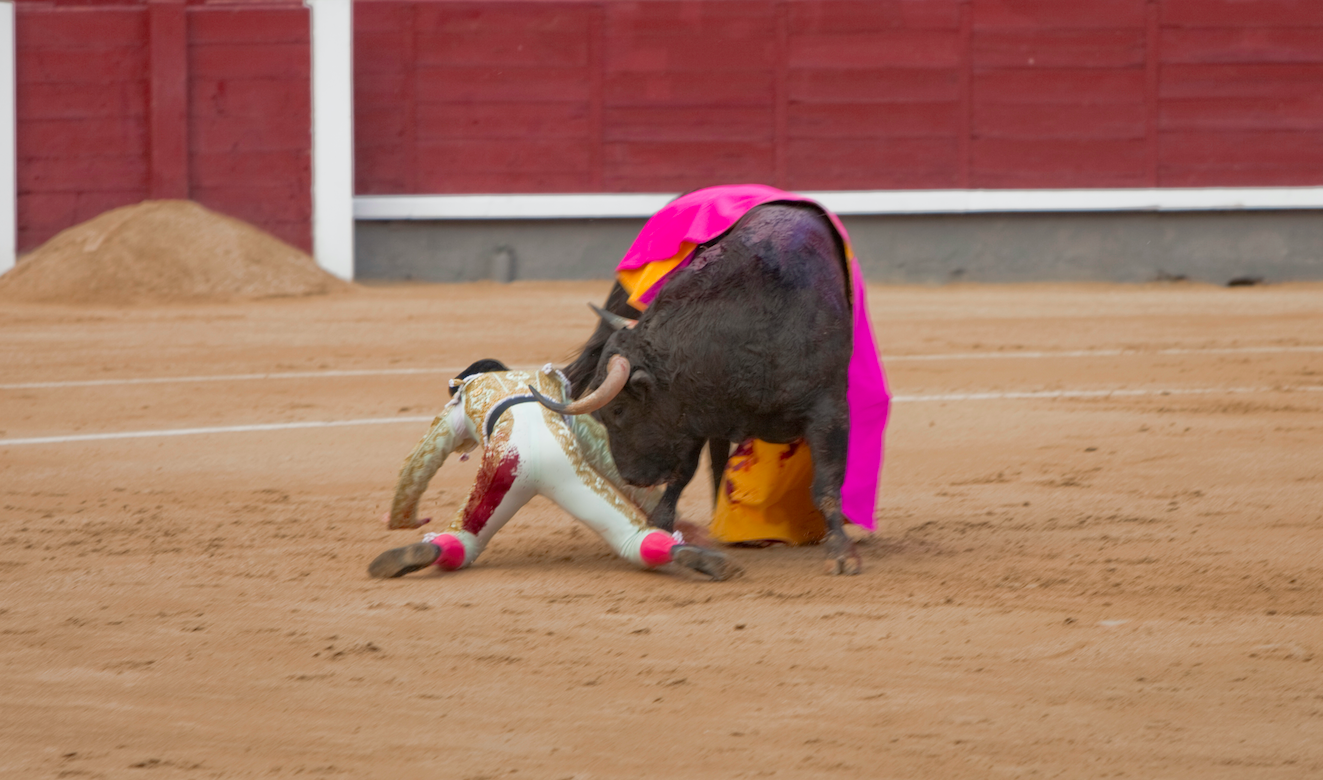
The latest injuries have once again brought bullfighting into public conversation in Spain. Photo credit: Andrey Dan/Shutterstock
Spain is having an unlucky week in the bullfighting sector following a second serious injury at the Maestranza in Sevilla on Thursday 23 April during the Feria de Abril, when matador Andrés Roca Rey was injured in the final stages of a corrida.
A corrida is a traditional Spanish bullfighting event in which a matador performs a structured sequence of passes against a bull inside the arena, ending in a final close-contact phase. It is during this final stage that the risk of serious injury is highest due to proximity to the animal and reduced reaction time.
Roca Rey was injured during this phase when attempting a close pass with the bull. He was struck in the upper inner right thigh and sustained a deep wound measuring approximately 35 centimetres, requiring immediate treatment in the bullring infirmary before transfer to hospital in Sevilla for surgery the same day.
Medical treatment and condition after surgery
Doctors confirmed the injury is ”severe” and involved deep muscle damage in the thigh caused by the bull’s horn, though no major blood vessels were affected. He underwent surgery in Sevilla and remains under hospital observation while recovery is assessed. The severity of the wound means rehabilitation will depend on the healing of internal tissue, with no official return date given.
The incident came just days after another serious injury in the same Feria de Abril programme, when Morante de la Puebla was also hospitalised after being gored during a separate corrida at La Maestranza.
Morante de la Puebla’s injury in the same festival
Morante de la Puebla was injured on April 20 during a corrida at La Maestranza when he was gored in the lower gluteal region, with the horn causing a wound that affected the anal and rectal area (commonly known as a ‘‘hole in Juan’’), requiring emergency surgery. He was taken to hospital in Sevilla and underwent a complex operation to repair internal damage, including rectal injury, before being admitted for further monitoring.
The incident occurred during the same Feria de Abril cycle, adding to concern around the frequency and severity of injuries during one of Spain’s busiest bullfighting periods.
Two serious injuries in one festival week
The fact that both injuries occurred within days of each other has drawn attention to the intensity of the Feria de Abril schedule, where corridas take place on consecutive afternoons and leading matadors perform multiple times in a short period. La Maestranza is one of Spain’s most prominent bullrings and central to the festival programme, attracting large audiences throughout the spring season.
While injuries are an established risk in bullfighting, two hospitalisations within the same festival week is uncommon and has intensified scrutiny around the physical dangers involved.
Public reaction and renewed ethical debate
The latest injuries have once again brought bullfighting into public conversation in Spain, where reactions to the practice tend to intensify following high-profile incidents in the arena.
Discussion is often shaped less by long-term participation in the sport and more by immediate reactions to events involving visible injuries. For critics, incidents like those seen in Sevilla reinforce concerns about the nature of the practice, particularly the deliberate confrontation between humans and animals in a controlled setting.
Others continue to view bullfighting through the lens of tradition and cultural identity especially in older generations and traditional Spanish families, particularly in regions where it remains closely embedded in local festivals and heritage. These differing perspectives mean public debate tends to resurface sharply after major incidents, before fading again between events.
Rather than shifting opinion permanently, episodes such as this week’s injuries tend to reopen an already established divide in how the practice is understood and discussed in Spain.
Emergency response and ongoing recovery
Medical teams at La Maestranza responded immediately to the incident. Each corrida is supported by on-site emergency facilities designed to stabilise injured participants before hospital transfer when required.
Roca Rey remains under specialist supervision following surgery and will remain under observation with no confirmed return timeline.







OECD Warns Spain For Taxing Workers Too Much
This airline is ending free hand luggage on cheapest tickets

This Airline Ends Free Hand Luggage

Luxury Villas For Sale, Estepona – ProjectL1

Stylish 3-Bedroom Apartment With Panoramic Sea Views – Benalmádena
Brussels warns Spain that migrants regularised under controversial scheme will be deported back to Spain if they try to move to other EU countries


-
 New Developments3 weeks ago
Luxury Villas For Sale, Estepona – ProjectL1
-
 New Developments3 weeks ago
Stylish 3-Bedroom Apartment With Panoramic Sea Views – Benalmádena
-
eu response to spain migration policy2 weeks ago
Brussels warns Spain that migrants regularised under controversial scheme will be deported back to Spain if they try to move to other EU countries
-

 %3 weeks ago
Poland Disconnects Utilities At Russian Consulate That Moscow Refuses To Hand Over
-

 Uncategorized3 weeks ago
How Lewis Hamilton spent break with A-list star
-

 Uncategorized4 weeks ago
Lewis Hamilton goes from Karate Kid to Samurai Warrior with Kill Bill guru
-
AER Lingus4 weeks ago
High-speed internet at 35,000 feet: Aer Lingus launches Starlink Wi‑Fi
-
Groundforce4 weeks ago
Spain’s Easter holiday airport strikes: Walkout suspended over weekend but disruption expected to kick in from first day of Semana Santa