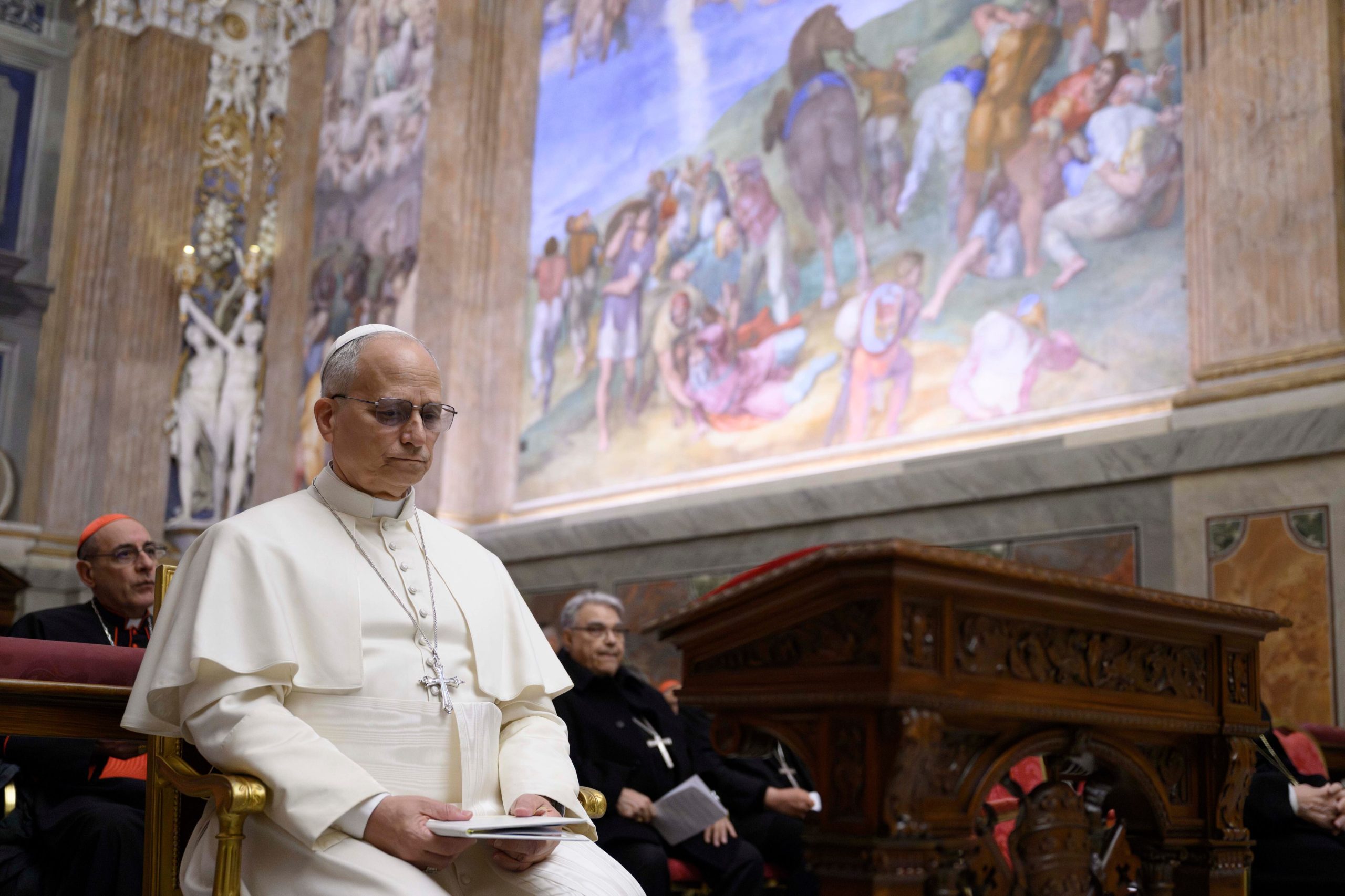
Last year Time magazine included Pope Leo XIV among the 100 most important figures in the world in artificial intelligence (AI). It is no coincidence. Only eight days passed from his papal appointment to his first public remarks on the technology: “Truth is never separated from charity… Thus, truth does not distance us, but rather allows us to face with greater vigor the challenges of our time, such as migration, the ethical use of artificial intelligence and the protection of our beloved Earth,” he said in his second official address. His first encyclical, Magnifica Humanitas (magnificent humanity), is devoted precisely to this technology.
AI is a concern at the Vatican. For the pontiff, the issue was so important that it even influenced his choice of name. “Pope Leo XIII […] addressed the social question in the context of the first great industrial revolution. In our own day, the Church offers to everyone the treasury of her social teaching in response to another industrial revolution and to developments in the field of artificial intelligence that pose new challenges for the defence of human dignity, justice and labor,” Leo XIV said in his first address to the College of Cardinals.
“Artificial intelligence needs to be disarmed,” the pope declared yesterday during the presentation of his encyclical. “The word is strong, I know, but deliberately chosen because this moment needs words capable of attracting attention […] The Church has long been working for nuclear disarmament […] In a similar sense, artificial intelligence now demands to be ‘disarmed,’ freed from logics that turn it into an instrument of domination, exclusion and death,” he added. Before him, Christopher Olah, co-founder of Anthropic, the developer of Claude and Mythos — a generative AI system so sophisticated it has triggered global alarm over its potential to undermine cybersecurity — took the floor. “We need moral voices that the incentives cannot bend. We need more of the world — religious communities, civil society, scholars, governments — to do what His Holiness has done here: to take this seriously.”
In the 1891 encyclical Rerum Novarum, Leo XIII adapted the Church to the social reality brought by the turn-of-the-century change, calling for labor rights for the precarious industrial proletariat of the time that included children and pregnant women who faced 20-hour workdays, and criticizing the excesses of monopoly capitalism (43 years after the publication of the Communist Manifesto). The first U.S. pope intends to do the same in the context of AI, even though he presented his encyclical alongside a prominent member of the AI industry — a fact that has been noted (“It’s as if Leo XIII had presented Rerum Novarum together with Henry Ford,” an analyst commented).
The encyclical, published this Monday, is not presented solely as a way to address the social consequences of AI. The Church is under increasing scrutiny, and it sees in this technology a potential source of problems for the institution. “It is no revelation that the Catholic Church is experiencing one of the deepest crises in its history, fundamentally due to the loss of credibility because of widespread sexual abuse within its structure,” says theologian Juan José Tamayo, honorary emeritus professor at Carlos III University in Madrid and author of Cristianismo Radical (Radical Christianity). “AI is a communication mechanism for spreading the Catholic message, the Pope’s message, and that of the hierarchy in general, to harmonize it with the idea of a universal Church. That is why they need AI to convey a message to the entire citizenry that in some way neutralizes that crisis.”
Investments in AI
Time presents Pope Leo XIV as a “spiritual counterweight” to Silicon Valley’s leadership. But the pontiff’s rhetoric, and that of his predecessor Pope Francis — who was highly critical both of AI and of the industry developing it — contrasts with the Church’s investment policy.
The Vatican bank, the Institute for the Works of Religion (IOR), manages assets worth $6.85 billion, according to its own reports. The amount has almost tripled since 2020, when it totaled $2.56 billion. The institution devotes 10% of its budget to charitable works that reinforce “humanitarian assistance that responds to the most urgent needs of the poor and the marginalized.”
The rest of that money is invested. Where? The IOR does not make its positions public. What is known are the values that, in the Church’s view, are suitable for investment — that is, those “aligned with Catholic values.” In February this year the IOR and U.S. financial services firm Morningstar launched two stock indices, one European and one U.S., each including 50 mid- and large-cap companies that “adhere to Catholic teachings regarding life, social responsibility, and environmental protection.”
Among the principal holdings of those indices are companies such as Meta, Microsoft, Amazon and Alphabet (Google’s parent), as well as ASML, Intel or Nvidia Corp, Apple and Tesla. In other words: AI developers, cloud infrastructure providers, manufacturers of the hardware necessary for this technology to operate, and companies whose flagship products incorporate AI.
Excluded from these indices are companies tied to sectors the Vatican has for years advised against investing in: gambling, abortion, and products related to terminating pregnancies (such as condom manufacturers), the fossil fuels and mining industries (because of pollution), or the arms industry. That last exclusion contrasts with the fact that many of the tech firms that do have the Church’s approval have contracts with the Pentagon or have provided direct support for the Palestinian genocide.
The Vatican-branded indices serve as a guide for asset managers and funds — such as iCapital, Altum Faithful or Portocolom — that specialize in attracting savings from religious congregations or organizations that observe Catholic principles. They manage billions of euros in assets, so their moves are influential. And those indices prominently include many of the main AI developers.
The friar who put the Church in the conversation
On Saturday, September 13, 2025, Karol G performed before a packed St. Peter’s Square on a night that also featured Andrea Bocelli, John Legend, and Pharrell Williams. The unusual festival, Grace for the World, capped a week of reflection sessions organized by the Fratelli Tutti Foundation, established by Pope Francis. During those days a dozen Nobel laureates visited the Vatican to debate various topics.
There was a panel dedicated specifically to AI. The question to be addressed was how human, animal, and machine intelligences can coexist. The caliber of participants was high: Geoffrey Hinton, Nobel Prize winner in Physics and creator of the Transformer algorithm that made generative AI possible; Yoshua Bengio, another godfather of AI; Stuart Russell, also well known in the field; cosmologist Max Tegmark, and historian Yuval Noah Harari.
The organizer of that panel — able to bring together such leading figures from academia — was a Franciscan monk, Paolo Benanti. This theologian served as an AI adviser to Pope Francis, a role he has also performed for Italian Prime Minister Giorgia Meloni. Benanti’s writings reflect a human-centered view of AI. He supports the development of a sapient AI only if it remains strictly a tool.
“The research question itself already implies a deterministic and doomster view of AI,” one participant in those meetings told EL PAÍS. The debates were heated. Of the dozen experts convened, only two sought to focus the discussion on the current problems caused by AI, such as its high energy consumption, environmental impact, the biases many models embed, or its effect on mental health.
After the working group concluded, Tegmark, Bengio, Hinton and Russell promoted a new letter opposing the development of AGI (artificial general intelligence, the kind that would theoretically match or surpass human capacities). Among the signatories were Benanti and Steve Bannon, former communications adviser to Donald Trump.
“Benanti’s rhetoric is essentially similar to that of [OpenAI CEO Sam] Altman: AI is so efficient, powerful and dangerous that AGI is imminent, so the crucial thing is that the right people develop it,” said a participant in the Vatican discussions.
There is no scientific evidence to suggest we are close to seeing AGI. Nevertheless, the Church is making a move with its encyclical on AI — both because of the social consequences of this technology, emphasized by Pope Francis and now by Leo XIV, and because of the elephant in the room at the Holy See: how the development of machines that can provide answers — whether correct or incorrect — to every question, even existential ones, could affect the institution’s very existence.
Sign up for our weekly newsletter to get more English-language news coverage from EL PAÍS USA Edition



















 Competiciones4 weeks ago
 Foreign demand3 weeks ago
 New Developments3 weeks ago
 New Developments3 weeks ago
 New Developments4 weeks ago
 America4 weeks ago