
Costa Blanca South
New Vega Baja bus network to improve connections across the region

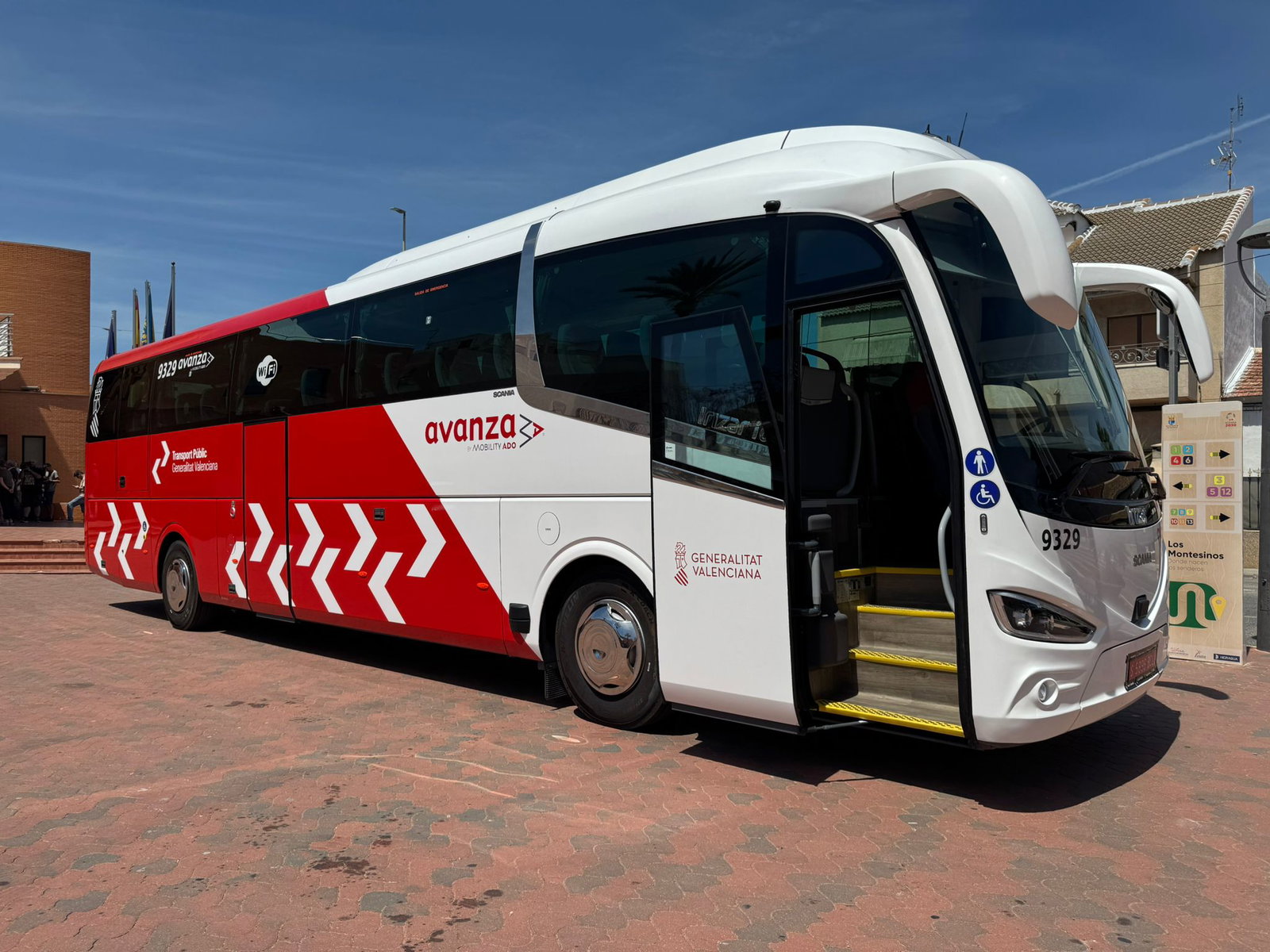
Avanza buses are offering the new CE-710 bus network. Image: Generalitat Valenciana.
Getting around the Vega Baja by public transport is about to become much easier.
From 1 June, the Generalitat Valenciana is launching the new CE-710 bus network, a major upgrade designed to improve connections between towns across the Vega Baja and key destinations including Alicante, Elche, Torrevieja, Alicante Airport, hospitals and the University of Alicante.
The new transport corridor is intended to provide better mobility for residents, students, workers and visitors, while helping to reduce reliance on private vehicles throughout the region.
Better Links for 28 Municipalities
The CE-710 corridor will serve 28 municipalities, including Orihuela, Torrevieja, Guardamar del Segura, Almoradí, Rojales, Pilar de la Horadada, Los Montesinos, Catral, Cox and Callosa de Segura.
In total, the service will operate 14 bus routes using at least 22 vehicles. More than 43,000 journeys are scheduled each year, covering almost 1.9 million kilometres across the comarca.
Among the biggest improvements are new and enhanced connections between Orihuela, Crevillent, Elche and Alicante, making travel between some of the area’s most important population centres more convenient.
Passengers will also benefit from better access to both Hospital Vega Baja and Torrevieja Hospital, as well as stronger links to San Isidro railway station and direct services to Alicante Airport from several Vega Baja municipalities.
Meeting Growing Demand
Residents of Los Montesinos will benefit from more frequent services to Torrevieja, with three daily connections planned under the new network.
Regional officials say the project responds to the growing transport needs of the Vega Baja, where the population exceeds 400,000 residents and increases significantly during the summer months as tourists and seasonal residents arrive.
The new network is expected to improve accessibility across the comarca, strengthen links between communities and make it easier for people to reach employment, education, healthcare and transport hubs throughout the province.
With services beginning on 1 June, the CE-710 network marks one of the most significant public transport improvements introduced in the Vega Baja in recent years.



A Colombian gold artefact on display at the MARQ Museum in Alicante. Image: MARQ.
Alicante’s MARQ Museum is preparing to host one of the most important international exhibitions in its history with the arrival of Gold and the Universe: Indigenous Knowledge from Colombia, running until May 2027.
The exhibition will bring almost 300 artefacts from Colombia’s world-famous Museo del Oro to the Costa Blanca, including more than 150 pieces crafted from gold and tumbaga. It represents one of the largest loans of Colombian gold treasures to Spain in recent decades and offers visitors a rare opportunity to view objects that seldom leave their home country.
The collection explores how pre-Hispanic indigenous cultures viewed gold not as a symbol of wealth or status, but as a spiritual material closely connected to nature, balance and the cosmos. Through the exhibition, visitors will gain an insight into the beliefs, traditions and worldviews of the communities that created these remarkable pieces centuries ago.
A Journey Through History and Living Traditions
Visitors will experience a multi-sensory journey through three galleries at MARQ, combining archaeology, anthropology, sound and storytelling. Ancient ceremonial objects, intricate jewellery, human-animal figures and traditional ritual items will be displayed alongside music recreated from flutes more than 1,000 years old.
One of the exhibition’s most distinctive features is its connection between past and present. Alongside ancient artefacts, visitors will also see contemporary works created by indigenous communities in the Colombian Amazon, highlighting traditions, skills and cultural practices that continue to survive today.
Museum officials believe the exhibition will offer a deeper understanding of indigenous knowledge and its relationship with the natural world, while also providing a unique cultural experience for visitors of all ages.
Following its run in Alicante, the exhibition will travel to Santiago de Compostela before continuing to Austria, further strengthening cultural ties between Spain and Colombia and bringing this extraordinary collection to an international audience.
For more information, visit marqalicante.com.

Reconnect with life. Credit: Protea Wellness
Summer on the Costa Blanca is a season filled with sound – laughter on restaurant terraces, family visits, lively fiestas, evening markets, and long conversations by the sea. But for many people, especially over the age of 50, these enjoyable moments can gradually become harder to follow without fully realising why.
Hearing loss rarely happens suddenly. It develops slowly over time, making it surprisingly difficult to recognise it yourself. Many people simply adapt without noticing. You may find yourself asking others to repeat themselves more often, struggling to follow conversations in busy restaurants, or turning the television volume up louder than everyone else would like. Some people begin avoiding social situations altogether because listening becomes tiring and frustrating.
Life on the Costa Blanca also brings together people from many different countries and backgrounds. In one evening you may hear English, Spanish, Dutch, German, Scandinavian accents and more around a dinner table or social gathering. Even a mild hearing loss can make understanding different voices, accents, and fast- moving conversations far more challenging, particularly in busy environments with background noise. Many people assume they are simply struggling to keep up with conversations, when in reality their hearing may have changed.
The good news is that modern hearing aids are now far more advanced than many people imagine. Today’s devices are discreet, comfortable, and intelligent enough to help users hear speech more clearly in noisy environments such as cafés, restaurants, and outdoor social gatherings. Many can also connect wirelessly to mobile phones and televisions, making everyday communication easier and more enjoyable.
Most importantly, improving hearing can have a major impact on quality of life. People often report feeling more confident socially, less fatigued after conversations, and more connected with family and friends once their hearing difficulties are addressed.
Yet the first step is often the simplest: having a hearing test.
Many people are surprised to learn that a professional hearing assessment is completely free, takes around one hour, and includes a full explanation of the results with absolutely no obligation. The appointment provides valuable clarity and allows people to better understand their hearing health, whether a hearing loss is identified or not.
This summer, while enjoying everything the Costa Blanca has to offer, it may be worth asking yourself one simple question: are you hearing life as clearly as you should be?
Contact Protea Wellness Audiology
Call: 698 418 642
www.proteawellnessaudiology.es
contact@proteawellnessaudiology.es
Address: Quesada Business Centre, Calle Los Arcos 17, Ciudad Quesada, 03170


Gran Premio De Hungría En Directo | Caída Multitudinaria En La Salida Entre Bezzecchi, Jorge Martín, Di Giannantonio, Aldeguer Y Raúl Fernández
Marbella releases full beach rules for Noche de San Juan bonfires in 2026
Southern Spain braces for warm start to week with North-South temperature divide
In The Final Stretch Of Colombia’s Presidential Campaign, Undecided Voters Are In High Demand

How To Get A Tourist Rental Licence In Andalusia (Spain) – Step-By-Step Guide 2025
Spain heatwave 2026: When the next extreme temperatures could hit and which areas may suffer most


-
Abelardo de la Espriella2 weeks ago
In The Final Stretch Of Colombia’s Presidential Campaign, Undecided Voters Are In High Demand
-
 New Developments3 weeks ago
How To Get A Tourist Rental Licence In Andalusia (Spain) – Step-By-Step Guide 2025
-
aemet3 weeks ago
Spain heatwave 2026: When the next extreme temperatures could hit and which areas may suffer most
-
Competiciones4 weeks ago
E
-

 Asia2 weeks ago
Yuk Hui, Philosopher: ‘Tech Companies Want To Exploit Us And Control Us Every Second’
-

 Uncategorized3 weeks ago
FBI investigation launched over Valtteri Bottas Cadillac theft
-
buffet4 weeks ago
Toyo Japanese, Asian favours in Fuengirola
-

 Álvaro Arbeloa4 weeks ago
E