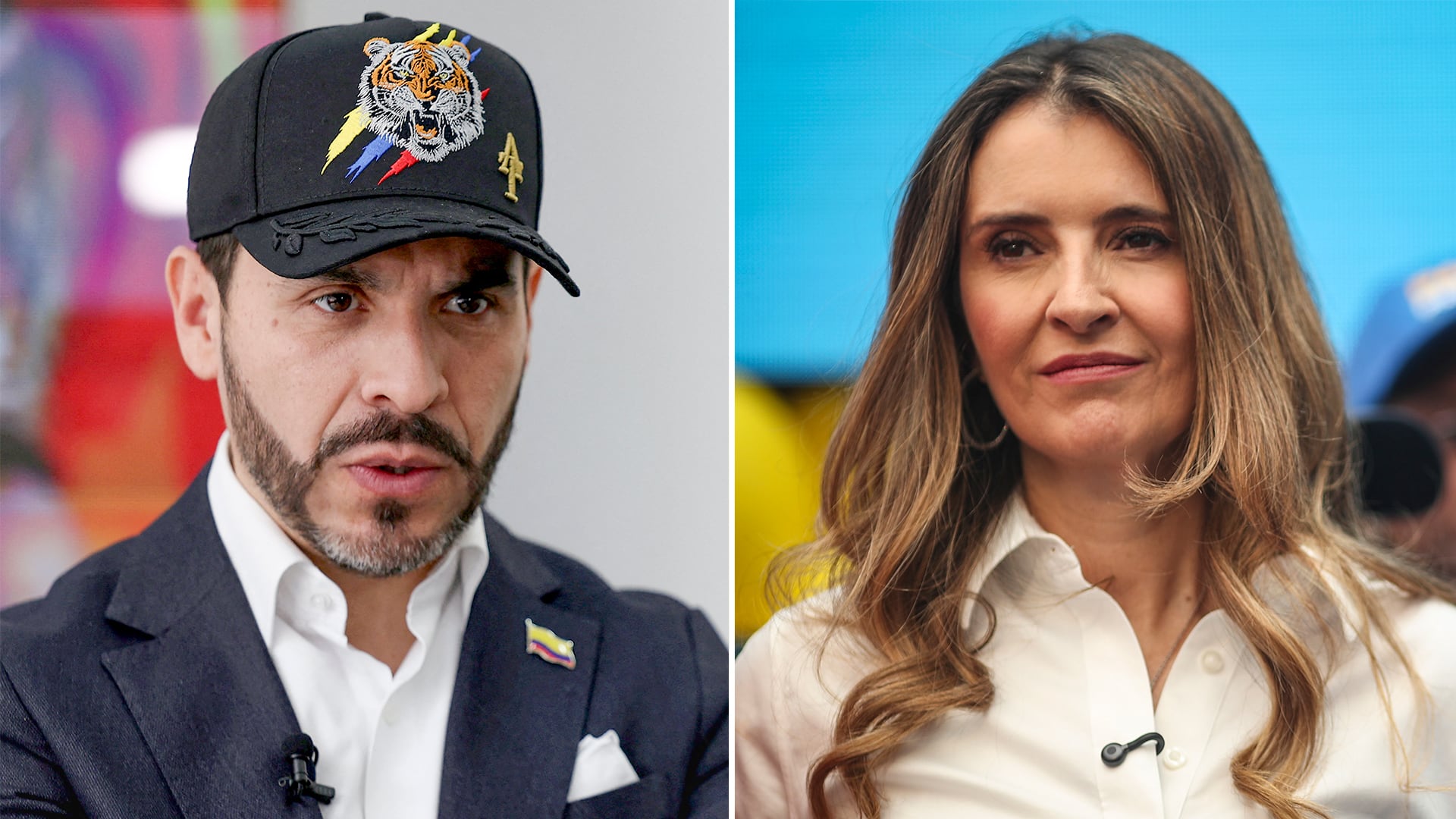
The far-right candidate is navigating treacherous ground to reach the second round of the Colombian presidential election. Abelardo de la Espriella, who is vying for second place in the polls with Uribista candidate Paloma Valencia, gave two interviews — one on radio and one on television — that have dominated the debate due to his misogynistic remarks. On the radio program Piso 8, he claimed that he gained many female votes because of the size of his genitals and asked the reporter present to zoom in on a photo that highlighted them. On television, he called a veteran journalist ignorant when she asked him about a comment the criminal lawyer had made years earlier: “Ethics has nothing to do with the law.” Journalists and politicians came out in defense of women and criticized the lawyer, making sexism a central issue in the electoral arena. This presents an opportunity for Valencia to gain ground, but De la Espriella also has a path to maintain his lead in the polls.
The electoral opportunity was first recognized by Juan Daniel Oviedo, Valencia’s vice-presidential running mate, who shared a video of De La Espriella’s radio program appearance on social media. “To say that he won the female vote ‘because of how big he is’ only speaks to his own small-mindedness,” he wrote. The far-right candidate’s misstep resonated particularly with Ovideo, an economist, who had been the target of homophobic comments from De La Espriella just days after the presidential primary in which Oviedo faced Valencia and other right-wing candidates. Rather than damaging his campaign, these comments ended up giving the former Bogotá councilman more visibility: he garnered the second-highest number of votes, second only to Valencia, and thus became her running mate for president.
But Oviedo capitalized at that moment on votes from the political center, which his running mate, Valencia, now faces the difficult challenge of winning over without losing the support of her traditional base on the established right. That’s why, when the senator speaks about gender, she always does so from a conservative perspective: she doesn’t consider abortion a right, she says feminism is left-wing, and she talks about defending children who are adopted by diverse families (like that of her vice-presidential candidate).
This Tuesday, Valencia also saw an electoral opportunity and rejected the comments of her right-wing opponent. But she did so discreetly, without mentioning his name or speaking of sexism. Instead, she suggested an apology. “Women journalists shouldn’t have to put up with sexual jokes, offensive insinuations, or personal attacks for daring to ask questions,” she said on her social media, adding: “Whoever is wrong in their treatment of women should acknowledge it and apologize.” A middle ground in which she points out her opponent’s obvious sexism without calling him a misogynist. A stark contrast to the reaction of the left-wing candidate, Iván Cepeda: “We must defeat the patriarchy in Colombian society.”
However, those surrounding Valencia on the campaign trail were less discreet. “Sexist attitudes cannot continue to be normalized or disguised as humor, nonsense, or vulgarity. That is neither charisma nor authenticity. It is a lack of respect,” said former senator David Luna, who is campaigning for Valencia.
Although the Uribista candidate has much to gain if De la Espriella’s comments backfire, she could also lose a great deal if the far-right campaign portrays her as the “woke” candidate, the one who espouses political correctness. This is demonstrated by the reaction of Senator-elect and influencer Alejandro Bermeo, who is close to De la Espriella’s campaign communications team and a member of the party that endorsed him, National Salvation. “The establishment, with the direct backing of Paloma Valencia, is fabricating a #MeToo movement against Abelardo de la Espriella,” he said on social media. “Like desperate ‘progressives,’ they’re using gender issues as a weapon to eliminate anyone who doesn’t belong to the ‘yes we can’ club of watered-down progressivism,” he added.
Valencia’s campaign has already struggled to attract a segment of the right-wing electorate, who are drawn to De la Espreilla not only for his “outsider” rhetoric but also because they perceive him as “stronger.” “I have the balls to do what Colombia needs done,” the candidate declared at an event in Bogotá last week, in another instance where he elected to allude to his genitals to emphasize his gender. He has also stated that he does fight against violence against women, having represented, as a lawyer, the family of Rosa Elvira Cely, a woman brutally raped and murdered in Bogotá in 2012, and Natalia Ponce de León, a woman attacked with acid by her partner in 2014.
What remains to be seen is whether a sexist incident will deflate a candidacy or simply prove ineffective among right-wing voters. Engineer Rodolfo Hernández, who ran against Petro four years ago as an outsider to the political establishment and a right-wing candidate, was hit hard by a video published by journalist Daniel Coronell two days before the election, in which he appears on a yacht in Miami dancing with several women in swimsuits. The former mayor of Bucaramanga had also previously stated that “ideally, women should dedicate themselves to raising children,” but that comment did not prevent him from advancing to the second round.
Another example of this lack of impact was provided by Donald Trump in 2016, when he was the Republican candidate. A month before the election, an audio recording surfaced in which the businessman spoke about grabbing women’s genitals whenever he felt like it: “When you’re a star, they let you do anything to them.” Despite the scandal the audio generated, he defeated Hillary Clinton, who represented “old politics” for a large part of the electorate. The anti-establishment vote can carry more weight than the rejection of sexism.
That has been precisely De La Espriella’s strategy. His AI-generated videos repeatedly claim that Valencia represents “the usual suspects,” a term that includes not only traditional Uribismo but also the senator’s old political rivals: former president Juan Manuel Santos, presidential candidate Claudia López, and Interior Minister Armando Benedetti. None of the three are even remotely involved in the Uribista campaign, but the far-right candidate’s campaign has sought to establish this narrative. Valencia has defended herself by arguing that she is “one of the usual suspects,” but in the sense that she has always worked for Colombia, while he has lived abroad for many years. This second narrative has not been as successful.
Valencia and De La Espriella know that any misstep between now and May 31 will determine who wins among right-wing voters and advances to a virtually certain runoff against left-wing Senator Cepeda. They also know that sexism played a role in the campaign, but it’s still unclear whether it worked in favor of or against the candidate who boasted about his genitals to a reporter.
Sign up for our weekly newsletter to get more English-language news coverage from EL PAÍS USA Edition













 Competiciones3 weeks ago
 Foreign demand3 weeks ago
 New Developments3 weeks ago
 America3 weeks ago
 New Developments3 weeks ago
 New Developments2 weeks ago
 Holiday rentals4 weeks ago