Connect with us

%

British Tourist Films Spain Hotel Sunbed Race After Guests Queue For Two Hours

Published

on

british-tourist-films-spain-hotel-sunbed-race-after-guests-queue-for-two-hours

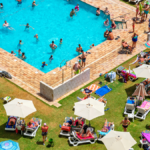
Spain’s summer sunbed race is back. Credit: Andrei Nekrassov / Shutterstock

A Scottish holidaymaker filmed guests racing for sunbeds at a hotel in Salou after reportedly waiting from 8am until the pool area opened at 10am. The clip has revived one of Spain’s most familiar summer holiday frustrations: paying for a relaxing break, then starting the morning in a queue for shade seeing a front-row of sunbeds already with towels on them. 

Spain hotel guests queued before breakfast for a poolside spot

A British tourist has filmed the morning scramble for sunbeds at a hotel in Salou, where guests reportedly queued for up to two hours before racing towards the pool area as soon as the doors opened.

Leah Norman, 37, from Scotland, was staying at the Best Oasis Park Hotel in Salou when she filmed holidaymakers waiting inside the hotel before heading out to claim loungers. According to UK reports, some guests had been waiting from around 8am for the doors to open at 10am.

The footage has struck a nerve because it captures a scene many holidaymakers have experienced. Towels placed on loungers early in the day, beds appearing “taken” while nobody is using them, and families left trying to find shade once the best spots have already gone.

Why Salou sunbed queues hit a nerve for British families

For parents with children, older travellers, or anyone just trying to avoid long exposure in the heat, a shaded lounger can become an extremely important part of the holiday routine. And in a packed July or August hotel, these sunbed battles are becoming a more and more frequent disruption.  

In a place like Salou, that is not a small or quiet resort, pool pressure is not uncommon. The Costa Daurada town recorded more than 2.4 million visitors and 8.6 million overnight stays in 2025, according to figures published by Salou tourism sources. UK arrivals were listed at 448,197, up 33.4 per cent on the previous year.

Spain’s wider tourism pressure is also rising. The National Statistics Institute (INE) said Spain received 10.3 million international tourists in May 2026 alone, 9.5 per cent more than in the same month of 2025. Across the first five months of the year, arrivals were up 5 per cent.

Against that background, hotel pools in resorts popular with British and Irish visitors can quickly become flashpoints, especially where the number of guests wanting shade and poolside space is higher than the number of loungers in the most desirable spots.

Don’t worry, hotel towel rules are usually local policy, not Spanish law

For now, sunbed rules are normally set by the hotel, not by a national summer-sunbed-protection Spanish law. So some resorts may remove towels left unattended after a set period. Others put up signs asking guests not to reserve loungers at all. In many hotels, enforcement depends on staff, peak-season pressure and whether other guests want to get more involved.

That is where the arguments can often arise. Removing another guest’s towel may feel tempting when there’s no one around, but it can quickly turn into a poolside confrontation. Recent cases, including disputes in Tenerife and Mallorca, show how quickly arguments over reserved loungers can escalate when hotels do not clearly enforce their own poolside rules. The best option is to ask reception, a lifeguard or pool staff what the hotel’s actual policy is and whether unattended items can be removed by staff.

The issue has already moved beyond online jokes in parts of Europe. In May, The Guardian reported that a German holidaymaker was awarded almost €1,000 after a court found his family could not access sunloungers during a Greek package holiday, although the case depended on its own circumstances and does not create a universal rule for every Spain hotel guest.

How Spain holidaymakers can avoid the sunbed battleground

For anyone booking a Spain hotel during peak season, reviews can most likely reveal more than perfect pool pictures. Searching recent reviews for terms such as “sunbeds”, “towels”, “pool opens”, “shade” and “queues” can show whether guests are regularly competing for loungers.

Families who need shade may also want to check whether the hotel has parasols, shaded terrace areas, nearby beach access, or paid lounger options on the seafront. In Salou, the Best Oasis Park is advertised as being close to Llevant beach, which gives guests another option if the pool area becomes crowded.

The Salou clip is unlikely to be the last sunbed scramble of the summer. Spain’s busiest resorts are now entering the peak holiday period, and every new viral video feeds the same debate: whether hotels should enforce clearer rules on reserving loungers or not, or whether guests have simply accepted the sunbed battle as part of the package holiday routine.

%

Granada Kebab Shop Shock As Inspectors Uncover Insects, Unlabelled Meats And Drugs

Published

on

granada-kebab-shop-shock-as-inspectors-uncover-insects,-unlabelled-meats-and-drugs

The shop was closed and sealed while officers continued examining the findings. Photo credit: Bermek/Shutterstock

What started as a routine inspection at a Granada Kebab shop uncovered far more than anyone ever expected. Inspectors reportedly found insects, food products without proper labels and identification and serious hygiene problems before discovering an alleged cannabis plantation and other drugs inside the premises, leading to its immediate closure.

The discovery turned a normal check up into the centre of a police investigation, with officers finding problems linked to food safety alongside an alleged drug operation inside the same building. The fast-food outlet was closed after inspectors uncovered a series of issues that raised serious questions about the conditions inside the premises and what was taking place away from the public area.

Inspectors find serious hygiene problems inside premises

During the inspection, officers discovered insects inside the premises, along with food products that did not have the required labelling. Inspectors also found meat and sauces that were not correctly identified, meaning there was no clear information showing where the products came from or how they had been stored. Food traceability is important because it allows businesses and inspectors to identify ingredients, check their origin and ensure they have been handled correctly.

The inspection also found problems with refrigeration equipment, accumulated grease and poor maintenance conditions inside the premises. These issues meant inspectors could not confirm that food was being stored and prepared under the standards expected from a business serving customers. The discovery of these conditions inside a food outlet has raised questions about what customers cannot see when they walk into a premises.

Hidden cannabis plantation discovered inside building

The investigation reportedly uncovered another discovery inside the building when officers found an indoor cannabis plantation. A total of 88 cannabis plants were reportedly found in the cultivation area, alongside equipment used to grow cannabis indoors. Investigators also reportedly found that the cultivation area was connected to an illegal electricity supply, which is now part of the investigation. The discovery changed the nature of the inspection, with officers moving from food safety concerns to investigating suspected drug-related offences. A restaurant that appeared to operate as a normal fast-food shop was allegedly being used for cannabis cultivation in areas where customers closely waited for their take-away.

Cocaine, MDMA and methamphetamine among substances found

The discovery reportedly went further, with police finding other suspected drugs inside the premises. Officers reportedly seized more than 80 grams of cocaine, MDMA and methamphetamine, along with precision scales and around €7,000 in cash. The combination of several different substances, scales and cash led police to investigate whether the premises was being used for drug-related activity. The owner was reportedly detained on suspicion of offences linked to public health and electricity fraud. The investigation remains open as officers continue looking into the alleged activity taking place inside the premises.

Local concerns after unusual discovery

The case has attracted attention from neighbours because of the number of different issues found during the same inspection that went by completely unnoticed by customers. A fast-food restaurant is expected to provide customers with food prepared in safe and hygienic conditions, making the discovery of insects, unlabelled products and alleged drug activity particularly serious. For people living nearby, the findings have raised questions about how long the alleged activity may have been taking place and what was happening inside the building.

Premises sealed after inspection

Following the discovery, the kebab shop has been closed and sealed while officers continued examining the findings. The business cannot reopen while the investigation continues and the reported breaches are reviewed.

The alleged illegal electricity connection linked to the cannabis plantation is also being investigated alongside the food safety issues and suspected drug offences. Police are continuing to gather information about the operation and whether anyone else may have been involved.

A discovery nobody expected

For anyone walking past the kebab shop, it may have appeared to be an ordinary place to stop for a quick meal. However, the inspection uncovered a very different situation inside. Finding insects, unlabelled meat and poor hygiene conditions would already have been a serious discovery, but officers then reportedly uncovered an indoor cannabis plantation, other drugs, cash and equipment linked to the alleged operation. 

The case has turned a routine inspection into a much larger investigation involving food safety breaches and suspected criminal activity. The premises remains closed while police continue their enquiries into what was found inside the Granada fast-food outlet.

Continue Reading

%

Private Messages Could Be Scanned In Europe As EU Vote Reignites Surveillance Fears

Published

on

private-messages-could-be-scanned-in-europe-as-eu-vote-reignites-surveillance-fears

Europe’s private message scanning row is back. Credit: Buketaltindal / Shutterstock

A European Parliament vote has revived a fierce privacy row over whether tech platforms can scan private messages for child sexual abuse material. WhatsApp, Signal and Telegram are excluded under the amended text, but users of non-encrypted services such as Gmail, Instagram DMs, Discord and Snapchat could be affected.

Private inboxes are back in Europe’s privacy row

Private messages, family photos, direct chats and email accounts are once again at the centre of a major European privacy row after the European Parliament backed changes to a temporary law allowing online platforms to voluntarily detect and report child sexual abuse material.

The measure is part of what critics call “Chat Control”, although the formal legal issue is a derogation from the European Union’s ePrivacy rules. It is an exemption that allows some communication service providers to scan certain private communications for child sexual abuse content without breaching strict privacy rules.

The Council of the European Union, which represents national governments, says the measure is needed so online providers can resume voluntary detection and reporting while a permanent child protection law remains under negotiation. 

Child protection organisations have long warned about the scale of online abuse. The Internet Watch Foundation said it assessed 451,210 reports in 2025, with 311,610 confirmed to contain or lead to child sexual abuse material.

How WhatsApp, Signal and Telegram can stay outside of this version

The European Parliament amended the text to exclude communications protected by end-to-end encryption. In practice, that separates apps such as WhatsApp and Signal from other private messaging services, because only the sender and recipient are meant to be able to read the content. Reuters reported that WhatsApp, Telegram and Signal are excluded from the temporary rules under the Parliament-backed changes.

The European Parliament said MEPs want to exclude “communications to which end-to-end encryption is, has been or will be applied” from the scope of the law.

This means your day-to-day family WhatsApp group, private Signal chat or Telegram conversation isn’t the main target here. The bigger issue is likely to be non-end-to-end encrypted services.

Why Gmail, Instagram DMs and Discord could face different rules

The revived system could matter more for private messages and email services that are not protected in the same way as WhatsApp or Signal. 

Spanish reports have listed Instagram direct messages, Gmail, Discord, Snapchat, Skype, Xbox and iCloud as examples of services where private communications could be affected if providers choose to use voluntary detection tools.

That doesn’t mean that every message on those services will be read or analysed by a person. The debate is more about automated detection technology used to identify suspected child sexual abuse material and report it.

Privacy campaigners argue that scanning private communications without suspicion or a court order still amounts to mass surveillance. Supporters argue that voluntary detection helps identify victims, remove illegal material and alert law enforcement.

The vote moved forward despite more MEPs opposing it

The most confusing part of the vote is that more MEPs present voted to reject the Council position than to support it. According to the European Parliament, 314 MEPs voted in favour of rejecting the position, 276 voted against rejection and 17 abstained. However, because this was a second-reading procedure, rejection required an absolute majority of all MEPs, not just a simple majority of those voting. Because that threshold was not met, the Parliament’s amended position moves forward. 

How child protection pressure is driving the law

Supporters of the measure argue that the temporary system is necessary because the previous interim law expired on April 3, 2026. The Council said the reinstated derogation would allow online service providers to detect, report and remove child sexual abuse material while broader legislation is still being negotiated. Irish Justice Minister Jim O’Callaghan, quoted by the Council, said the measure was crucial to identify children at risk, bring offenders to justice and prevent further abuse.

The problem facing lawmakers is pressing. The National Center for Missing and Exploited Children said its CyberTipline received 21.3 million reports in 2025 involving more than 61.8 million images, videos and other files related to suspected child sexual exploitation.

But critics argue that the seriousness of the crime does not automatically justify blanket scanning of private communications, especially when less intrusive tools, user reports and targeted police action remain available. 

EU governments now have three months to decide

The current vote concerns a temporary derogation, not the wider permanent Child Sexual Abuse Regulation that has been stuck in negotiations since the European Commission first proposed it in 2022.

The Parliament’s amended text now goes back to the Council of the European Union. EU governments have three months to approve or reject Parliament’s amendments. If they do not accept all the changes, Parliament and Council will move to a conciliation process to agree on a final version.

Anyone relying on private email, social media DM’s or gaming chats for sensitive conversations should watch the next Council step, because that is where the final shape of the temporary rule will become clearer.

Continue Reading

%

France Deploys 20,000 Police As Under-16 Curfews Introduced For Morocco Clash

Published

on

france-deploys-20,000-police-as-under-16-curfews-introduced-for-morocco-clash

Road closures and crowd-control measures have been put in place. Photo credit: Pierre Laborde/Shutterstock

Paris is prepared for one of the biggest security operations of the year as France faces Morocco in a World Cup quarter-final, with 8,000 police officers deployed in the capital and more than 20,000 officers mobilised nationwide.

The high-security operation comes as authorities prepare for large crowds, possible street gatherings and fears that celebrations or frustration after the final whistle could lead to violence, vandalism and clashes with police.

Road closures, drone surveillance, extra patrols and restrictions in some areas will all be used as France attempts to prevent a repeat of previous football-related disorder. For many residents, the concern is not the match itself but what could happen afterwards.

Paris residents fear a repeat of recent football chaos

While thousands of supporters are preparing to watch the quarter-final, some people living in Paris are worried about the night of disruption. Their concerns come after a series of football celebrations in recent years have ended with damaged property, clashes and police intervention.

The most recent major incident came in May after Paris Saint-Germain won the Champions League, when celebrations in the capital were overshadowed by vandalism, fires, damage to shops mass arrests and confrontations between police and groups involved in disorder.

Morocco’s 2022 World Cup run still remembered

Scars still remain of Morocco’s historic 2022 World Cup campaign, when thousands of supporters gathered across France after the team reached the semi-finals. Morocco made history as the first African nation to reach a World Cup semi-final after defeating Spain on penalties in the last 16 and knocking out Portugal in the quarter-finals. While many supporters celebrated peacefully, some gatherings later became tense and dangerous, with fireworks, damaged property, blocked roads and clashes involving police.

Police prepare after previous football disorder

During previous football-related unrest, two people were killed, officers were injured while trying to control crowds and hundreds were arrested. For local residents, the concern is not about supporters celebrating a football result. It is about the likeliness that large crowds become difficult to manage, with people turning celebrations into scenes of violence and destruction.

Some businesses have taken precautions ahead of the match, while families living near popular gathering areas say they may avoid city centres until crowds have dispersed. Restaurant and bar owners are expecting large numbers of customers, but some locals fear noise, damage and disruption continuing late into the night.

Road closures and security restrictions planned

Paris has introduce restrictions around key areas where supporters are expected to gather. Road closures and crowd-control measures have been put in place in busy parts of the capital, with police prepared to limit access if crowds become too large or public safety becomes a concern.

Residents living near popular celebration points have been warned to expect a heavier police presence and possible disruption throughout the evening. The measures are aimed at preventing large gatherings from becoming uncontrollable and protecting businesses and residents in affected areas.

Drones and thousands of officers ready

The security operation will combine thousands of officers on the ground with aerial surveillance. Police drones will monitor crowds, track movement and help identify areas where tensions may be increasing.

CCTV networks will also be closely watched, while specialist police units will remain ready to respond quickly if violence or disorder breaks out. The scale of the operation reflects concerns over how quickly football celebrations can change when large numbers of people gather in city centres.

Curfews introduced for under-16s

Some municipalities have introduced temporary curfews for children under the age of 16 ahead of the match. In those areas, young people will not be allowed to remain outside alone during certain evening hours unless accompanied by an adult.

Local authorities say the restrictions are designed to prevent young people becoming caught up in possible disturbances and to help keep public areas under control. Families have been advised to check local arrangements before making plans.

Morocco’s passionate support adds pressure

Morocco’s rise on the international football stage has created a huge following among supporters, particularly within Moroccan communities in France. The team’s remarkable 2022 World Cup run captured worldwide attention after Morocco became the first African nation to reach the semi-finals.

That achievement led to major celebrations across Europe, but it also highlighted the challenges police face when thousands of supporters gather in city centres. With Morocco once again facing one of football’s strongest teams, authorities are preparing for the possibility of large crowds taking to the streets whether the result brings celebration or disappointment.

France is prepared for the final whistle

For many Parisians, the biggest concern is not what happens during the match but what happens afterwards. Recent football celebrations have shown how quickly crowds can become difficult to control, leaving residents dealing with damaged streets, disruption and a heavy police presence.

With 8,000 officers in Paris, drones monitoring gatherings and restrictions introduced in some areas, authorities are preparing for a night where emotions could run high. Officials hope supporters celebrate peacefully, but communities across the capital are preparing for the possibility of a difficult evening if crowds become aggressive or destructive.

Continue Reading
Advertisement
Advertisement

Spanish Real Estate Agents

Tags

Trending

Copyright © 2017 Spanish Property & News