The suspect is led away by Guardia Civil officers following his arrest in Granada. Credit: Guardia Civil
A sharp suit and confident manners were enough to talk his way into dozens of homes across Andalucía, but behind the polished exterior was a fraud that has cost more than 40 elderly and disabled residents a combined €350,000. Guardia Civil have now arrested the 41-year-old accused of running it.
How a smart appearance opened dozens of front doors
Guardia Civil said the man, now in provisional prison, spent months posing as a sales representative for various companies. His educated manner and formal dress were enough to convince strangers he was legitimate, letting him walk into homes across six Andalucian provinces without raising suspicion.
Once inside, he asked for personal documents that seemed routine for any sales visit: banking details, pension certificates and a signature or two. Investigators said his targets were carefully chosen, mostly elderly people and those with disabilities, many of whom lived alone.
Signatures turned into secret loans and phone contracts
Those documents and signatures then became the raw material for a second crime. Officers said he used the stolen paperwork to take out credit agreements, buy mobile phones and even finance vehicles, all in his victims’ names and without their knowledge.
In some cases, investigators believe he forged signatures rather than relying on ones he’d already gotten from the victims, exploiting how little oversight there is once he had the right documents in his hands.
A second visit that doubled the damage
The fraud didn’t always end with the first visit either. Guardia Civil said the man sometimes returned to homes claiming a financing error had occurred, telling victims they needed to pay cash, make a transfer or use a portable card machine to cancel an operation that never even existed. For anyone who paid up, it meant a second financial hit, one that could prove devastating for people living solely on a pension.
The Armilla traffic stop that unravelled the network
The case only came together after officers carrying out a routine citizen security operation in Armilla, near Granada, stopped the man’s car in May. In the boot, they found contract papers, invoice books and documents bearing other people’s data, including a rental agreement drawn up in the name of a person who had already died.
That discovery let Guardia Civil link complaints that had previously looked isolated, building a single case, Operación Larberik, out of reports scattered across Jaén, Granada, Sevilla, Málaga and Córdoba, including several victims in Almería.
More than 40 victims, and investigators expect more to come forward
The man has been formally charged with continued fraud, usurping another person’s identity and falsifying public and private documents, according to Guardia Civil. A second suspect, an acquaintance accused of handling some of the stolen money or goods, is also facing charges.
Officers seized two high-end phones, two motorcycles, a car, more than €1,000 in cash and a portable card machine when he was detained. Guardia Civil said the investigation remains open and is urging anyone who was visited by an unsolicited sales representative and later noticed unexplained contracts or charges to come forward.
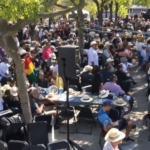
Sunday’s political rally in Badalona. Credit: ANF FB
Alberto Núñez Feijoo, leader of Spain’s main opposition party, used a packed rally in Badalona on Sunday to set out a harder, tighter immigration line, tying work, law-abiding behaviour and the Spanish passport to one another. He said Spain should welcome people who come for hard graft and obey the country’s rules, then slam the door on anyone arriving to break them.
His remarks landed as Ceuta is still dealing with the fallout from mass crossings earlier in the summer, a crisis with of the city’s new port camp and pressure for a royal visit. Feijoo is due in Ceuta on Monday with European People’s Party president Manfred Weber.
What was said in Badalona
Feijoo argued that a country with self-respect should be demanding of people born here and of those who move here. Nationality, he said, brings rights and duties. Recovering “the prestige of the Spanish passport” means reviewing how citizenship is granted, how it is kept, and how it can be lost.
He put the message in plain language. Spain, if he governs, would stay open to “hispanos” and to anyone arriving to work and respect the law. Those who come to dodge the rules would find the country “cerrada a cal y canto”, or “bolted shut”. He also called it a “sinsentido” that irregular entry can look easier than arriving with a job contract, and said public services cannot hold if people arrive without control while nationality is handed out on a mass scale.
Run an ordered immigration policy rather than uncontrolled arrivals.
Keep Spain open to people who come to work and follow the law, including Latin American arrivals he described as “hispanos”.
Bolt the country shut to those who arrive irregularly or come to break the law.
Make work the normal route in, so a contract is not harder than an irregular crossing.
Strengthen border protection, with Ceuta used as the immediate example.
Review how Spanish nationality is granted, kept and withdrawn.
Strip nationality from naturalised citizens convicted of serious crimes, including gang membership, murder and repeat sexual assault.
Treat the passport as something earned, not gifted.
He challenged critics directly: if anyone objects to taking nationality from a convicted killer, gang member or repeat sex attacker, they should explain why.
Why this matters now
The next general election in Spain is expected in 2027. Feijoo, beginning his electioneering, also used the rally to attack Pedro Sanchez’s government over Ceuta, budgets and taxes, promising a “limpieza total” if his party, PP, returns to office.
For readers already in Spain, the practical point is the passport and residency test he wants to rewrite. Current nationality law is set out in the Spanish Civil Code on the official BOE site, and any withdrawal of citizenship would need a huge legal change, not just a speech.
Whether that package ever becomes law depends on an election Feijoo is openly inviting. For now, Badalona was the pitch: work and obey the law, or Spain stays locked.
The couple were stopped by a Moroccan police officer. Photo credit: Mary. W
Picture this: you spend a wonderful week driving through Morocco, taking in the sights, food, traditions and some of the country’s most fascinating cities, only to have the whole trip end on an odd note when getting pulled over by a police officer, and that is exactly what happened to a British couple during their Moroccan road trip. Frank and Mary W., who live in Almería, had been looking forward to visiting Morocco for a while.
When they finally managed to arrange their holiday, they spent several days exploring the country. Their trip had taken them through several Moroccan cities, including Fez, Chefchaouen, Al Hoceima and Rabat, giving them the chance to experience the country’s culture and traditions at their own pace. But on their final day, as they were leaving Rabat, the holiday took a turn that left the couple more confused than anything else.
Pulled over by police
The couple were stopped by a Moroccan police officer, and when Frank asked why they had been pulled over, the explanation seemed remarkably simple. They had, the officer told them, “driven over a white line.” For the couple, that raised more questions than it answered.
They tried to understand exactly what they had done wrong and why crossing the particular road marking warranted a fine, but before they had managed to make sense of the situation, the officer began writing out the penalty. The amount, they were told, was 400 Moroccan dirhams, around €37. There was just one problem: they did not have 400 dirhams on them. That was when the situation became even more confusing.
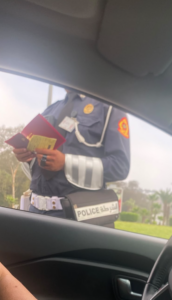
The officer lowered the amount to 350 dirhams. Photo credit: Mary. W
When a fine starts to look negotiable
After being told they could not pay the full amount, the officer lowered the figure to 350 dirhams, around €32. For the couple, this was difficult to understand. A fine is normally a fixed penalty: you break a rule, you receive the corresponding fine and you pay it. At this point, however, the amount appeared to have some room for negotiation. The officer began haggling with them over how much they could pay, rather than simply telling them how to settle a fixed penalty.
They were not trying to negotiate the fine; they were simply trying to explain that they did not have the amount the officer had initially demanded. Eventually, the officer agreed to accept 150 dirhams, roughly €14, and they were allowed to continue their journey. After a week of sightseeing, driving and exploring Morocco, their final encounter with the country’s roads had left them with a very strange impression of how a traffic fine was supposed to work.
What the rules actually say
There is an important distinction between the couples experience and the formal Moroccan system. Being stopped by police while driving is not unusual in Morocco, and current government travel advice warns motorists that driving conditions can differ considerably from those in Britain and Spain and advises particular care on the roads. Morocco does have an official system of fixed traffic penalties. The country’s General Treasury publishes three classes of road offence, with standard amounts of 700, 500 and 300 dirhams.
Reduced amounts can apply when fines are paid promptly, meaning the amount paid can legitimately vary according to the offence and when the penalty is settled. That is different from what happened here, however. In this case, the amount appeared to change after the couple explained that they did not have enough cash to pay the original 400-dirham demand.
Not necessarily the usual process
There are, however, published reports of corruption involving Moroccan law enforcement, including allegations of officers soliciting money during traffic stops. A 2025 review by the U4 Anti-Corruption Resource Centre, operated in collaboration with Transparency International, says such reports include motorists paying less than the prescribed fine.
That does not establish that corruption occurred in this case, but it pretty well seems like it. The experience left them questioning how the system worked after the officer repeatedly changed the amount he was prepared to accept.
A strange end to the trip
For the couple, the experience left them questioning how the system worked and, in particular, how a penalty could change during a roadside conversation. For anyone from Spain considering driving to Morocco, it is worth remembering that roadside procedures may work differently from those they are used to at home.
A police stop itself is not unusual, and Morocco has formal traffic penalties, but this experience was far removed from the straightforward fixed fine they had expected. They paid their 150 dirhams and were able to continue on their way, but the explanation they were left with was still the same one that had started the whole episode. So remember when visiting, don’t drive over white lines, regardless of where on the road they are located.
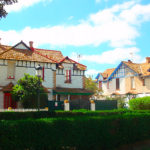
Walk through the Barrio Reina Victoria and the British influence is difficult to miss. Photo credit: Jose A CC 2.0/Wikipedia
Would you believe me if I told you there is a little British neighbourhood hidden away in Huelva? Known as the Barrio Reina Victoria, the Barrio Obrero and, rather fittingly, the Barrio Inglés, it isn’t an expat community living in Spain. The entire neighbourhood was built in British styles, with pitched roofs, chimneys, timber details, gardens and the sort of architecture you would expect to find in Britain rather than southern Spain.
But the really fascinating part is that Huelva became home to what has been described as Spain’s first unofficial British colony. Long before British retirees began settling along the Spanish coast, the Rio Tinto mines attracted a British community that established its own homes, clubs, sports and way of life in this corner of Andalucía. The Barrio Reina Victoria was one of the most visible results of that extraordinary period, a British-built neighbourhood that has survived for more than a century.
When Britain arrived in Huelva
The story starts in 1873, when the Rio Tinto mines were sold to foreign investors and the British-owned Rio Tinto Company Limited took control of the operation. The mines were enormously important to the local economy, and British engineers, managers and workers began arriving in the province, many bringing their families with them. The community became remarkably self-contained. The British established housing, social clubs and recreational facilities, while bringing familiar customs and pastimes from home. Huelva was developing a British presence unlike anything most people would associate with Spain today.
As the population connected to the mining company grew, so did the demand for suitable housing. In 1916, the Rio Tinto Company commissioned architects Gonzalo Aguado and José Pérez Carasa to design a new residential neighbourhood in Huelva. The development followed the principles of the British garden-city movement, with houses surrounded by gardens and plenty of open space. The first plans contained 71 buildings and 213 homes, with the first phase completed by 1919. More houses were added during the 1920s, creating the neighbourhood that remains today.
A British neighbourhood under the Andalucían sun
Walk through the Barrio Reina Victoria and the British influence is difficult to miss. The houses feature pitched roofs, chimneys, exposed brick, timber framing, gables and dormer windows, while gardens and open spaces form an important part of the neighbourhood’s layout. Some of the later homes designed by British architect R.H. Morgan in the 1920s made the connection even more obvious, incorporating Old English architectural features and decorative timber work.
Yet this isn’t simply an English village transported wholesale to Spain. Local Andalusian influences were incorporated into the designs, producing an unusual combination of British architecture and southern Spanish surroundings. The result is particularly striking under the Huelva sunshine. Traditional British-looking houses sit behind gardens and colourful façades, creating a neighbourhood that feels familiar and completely foreign at the same time. The Barrio Reina Victoria was declared a Cultural Heritage Site and protected as a Historic Site in 2002, ensuring that this unusual piece of Huelva’s history is preserved.
The British brought football to Huelva
Believe it or not the mining community didn’t just come to mine, they also left an extraordinary sporting legacy. The Real Club Recreativo de Huelva was founded on 18 December 1889, emerging from the British community and its sporting activities. The club is officially recognised as the oldest football club in Spain. Its first recorded football match followed just days later, on 29 December 1889, when the then called ‘Huelva Recreation Club’ played against sailors from ships in the city’s port.
Huelva continued to make football history. On 13 August 1892, the Velodrome was inaugurated, becoming the first purpose-built football ground in Spain. So while football is now inseparable from Spanish culture, one of the country’s earliest chapters in the sport was written by British residents in Huelva more than 130 years ago.
And they brought golf too
Football wasn’t the only British sport to take root, golf arrived with the British mining community too. The North Lode Golf Club was established at Minas de Rio tinto in 1914, making it one of Spain’s earliest golf clubs.
Then, in 1916, the Club de Golf de Huelva was founded on land provided by the Rio Tinto Company. Huelva consequently became one of the country’s early centres for the sport, decades before golf courses became such a familiar sight to visitors and expats across Spain. The British miners had brought the sports they enjoyed at home and established them in their new surroundings.
The British legacy is still here
The Rio Tinto Company and the British mining era are no longer the force they once were, but their fingerprints remain all over Huelva. They can be found in the old mining and railway infrastructure, in the history of Recreativo, in the city’s early golf clubs and, perhaps most charmingly, in the streets of the Barrio Reina Victoria.
For British expats living in Spain, it is a reminder that the British connection with Andalucía didn’t begin with package holidays, cheap flights or retirement communities on the coast. It stretches back to the 19th century, when British workers arrived in Huelva in search of opportunity in one of the world’s most important mining regions. More than 150 years later, the neighbourhood they helped create still stands, with its British-style houses sitting beneath the Andalusian sun. You don’t need to cross the Channel to find ‘little Britain’, It’s hiding in Huelva.