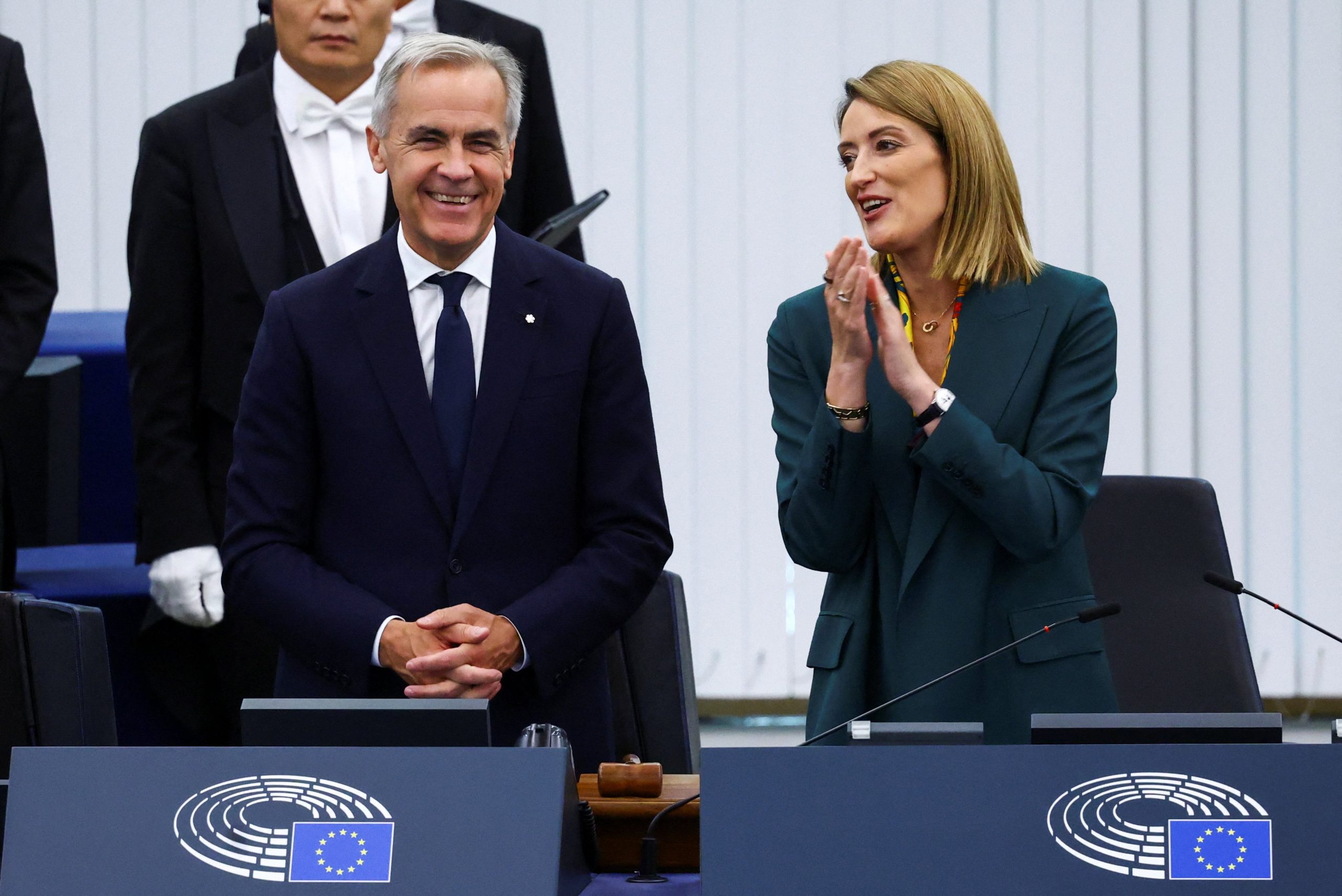
After nearly two years of waking up to news about the latest economic coercion by U.S. president Donald Trump and his threats of annexation, Canadians last week were greeted with a hopeful invitation from the president of the European Commission, Ursula von der Leyen, for Canada to become an associate member of the European Union. It is a status that is yet to be defined, but it would theoretically open the door to reduced dependence on the United States. Canadians have received the proposal with relative pleasure, caution and some skepticism.
In Montreal, Bill Ryan, a 70-year-old social worker, said that in many respects—and echoing the words of Canadian prime minister Mark Carney—Canada is the most European of the non-European countries. “Our values tend to align more with the EU’s than with the U.S.’s, especially now that the country is moving further to the right and tightening ties with authoritarian regimes,” he added.
Ryan says that “Canadians are fed up with Trump’s behavior, and many feel that not even a change of government in the U.S. will bring back the country we knew. Something fundamental has changed across our border, perhaps permanently.” And he is not wrong: according to recent polls, 41% of Canadians now consider the U.S. an enemy country and almost half, 48%, say they have an unfavorable view of Americans.
For Nicolas Nadeau, a 42-year-old corporate consultant who bursts out laughing when asked whether Canadians feel European, the move toward the EU is more a response to Trump—“a very diplomatic way to take a position on what’s happening with the U.S.,” he says. Nadeau thinks it is generally good news, but warns that it is still unclear what this new relationship will entail and that it is too early for definitive analysis.
This lack of clarity is something Canadian analysts and political commentators have been warning about, some stressing possible risks. Others, like the columnist Andrew Coyne, called it a historic week for the country: “We shall see. It is early days. But something enormous is underway. Even as the old world order cracks, a new one is forming. And Canada is at the center of it,” he wrote in his Friday column in The Globe and Mail.
Although he only sketched out broad areas of cooperation, Carney was very clear in his widely praised speech to the European Parliament on certain matters: youth mobility, academic exchange and even a specific program Canada wants to join, Erasmus+. The possibility of their children studying in Europe is what most excites Stephanie Orford, 44, a marketing content writer and mother of two children ages six and eight—and it is the first thing she mentions when asked about the new alliance. She insists it is urgent that it move forward and says she feels “relieved” that Canada is reaching out to Europe.
From the opposition, both the Conservative Party and the New Democratic Party (NDP), a federal left-wing party, emphasized the need for any new relationship with the EU to be debated first in the Canadian Parliament.
“It is unacceptable that Canadians are learning of Mark Carney’s interest in a new relationship with Europe through media coverage of his visit to the European Parliament, rather than by a speech to the House of Commons,” NDP press secretary Sam Hersh said on Wednesday.
Conservatives are particularly concerned that a new relationship could lead to the adoption of European regulations and a loss of control over borders and immigration. “Conservatives are clear: yes to free trade and defence cooperation with Europe within NATO. No to having EU taxes, laws or its radical open-borders migration policy imposed on Canadians,” Conservative leader Pierre Poilievre wrote on X after Carney’s speech.
Immigration also raises questions for Verónica Pérez, 45, a graphic designer born in Montreal to a Spanish mother and Peruvian father: “There would be greater freedom of movement for workers, but will it be for everyone or only for certain sectors, like defense or artificial intelligence? Will migration rules be different for Europeans and for the rest of the world? Will Canadians agree? Because, with immigration debates… it could mean even more immigration,” Pérez asks, expressing caution about this week’s announcements.
From Toronto, human rights advocate Matthew Redding, 36, an NDP voter and a sharp critic of Carney’s policies, says that while he supports the idea of diversifying Canada’s ties to depend less on the U.S., it should not come at any cost. “Carney’s speech to the European Parliament suggested this maneuver could be used to reinforce some of the more worrying directions of his government, focused on developing more fossil fuel projects, armaments and AI, rather than charting a path toward a more sustainable, democratic future that respects human rights.”
Despite the criticism and the reasonable doubts, a September poll found that 81% of Canadians support greater integration with the EU in areas such as trade, work, travel, academic exchange and security cooperation, provided Canada remains outside the bloc. And when asked whether Canada has more in common with European nations or with the United States, 56% sided with the former while 16% felt closer to Americans.
Many loose ends remain, but support for a rapprochement with the EU and for Carney to lead the process is broad. At the Thursday press conference he held after his speech to the full European Parliament in Strasbourg, the prime minister foreshadowed a series of debates in the Canadian Parliament and, ultimately, a vote. More details about this alliance, and about the possibility of associate-member status, are expected at the EU-Canada summit to be held in Montreal on October 29 and 30.
Sign up for our weekly newsletter to get more English-language news coverage from EL PAÍS USA Edition

































 Argentina2 weeks ago
 Energy efficiency & certificates2 weeks ago
 Alex Saab1 week ago
 Uncategorized1 week ago