
%
Apps To Identify Artwork In Spain


Spain’s big museums hold some of the most photographed paintings in Europe, and a phone can now tell you what you are looking at in front of most of them. The apps that do it work in different ways. Some search the web for matching images, one reads a single museum’s catalogue, one quotes gallery and auction prices, and one tells the story aloud and takes questions. Below are six apps to identify artwork, with examples from the Prado, the Reina Sofía, the Thyssen-Bornemisza and the Guggenheim Bilbao.
Many museums restrict photography in their galleries, so check each museum’s rules before using a camera-based app.
Three works to start with
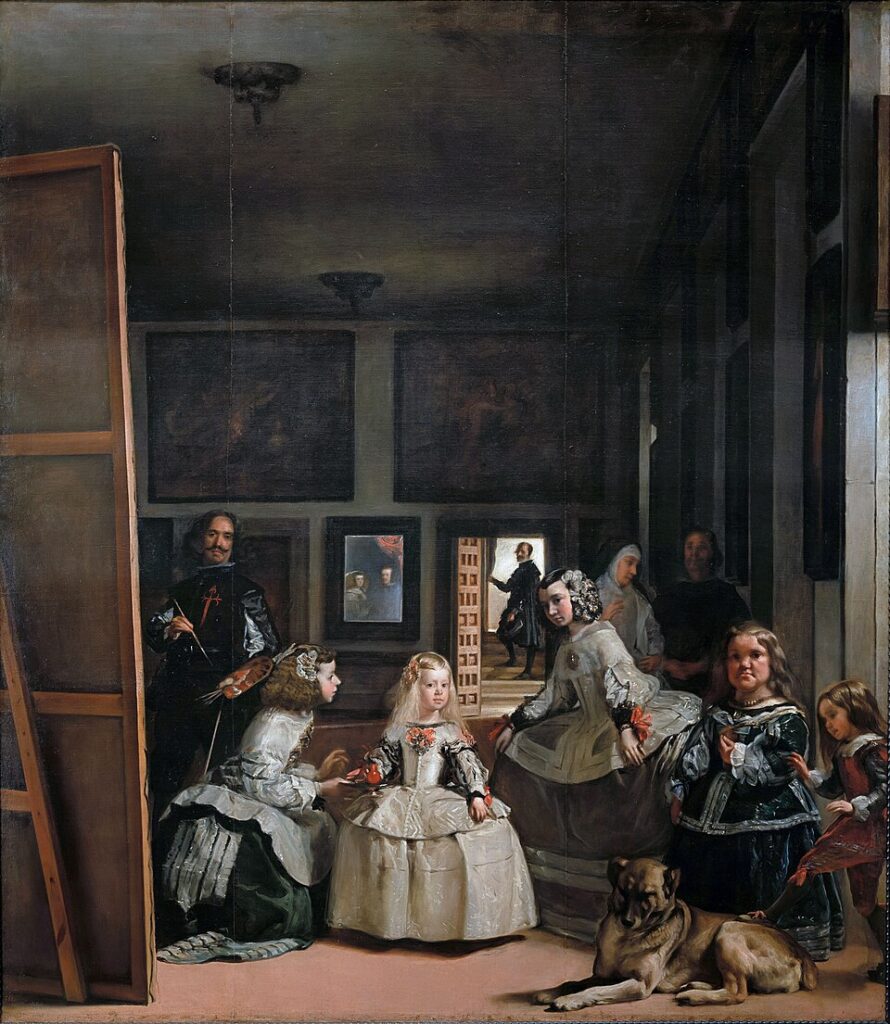
At the Prado, Velázquez’s Las Meninas hangs in Room 12: a canvas of 1656 that the museum measures at just over 3.2 metres tall. Naming the painting is the easy part. The harder questions are about the people in it: who the dwarf on the right is, and why the king and queen appear only in the mirror on the back wall.
On the other side of the Paseo del Prado, at the Thyssen, Ghirlandaio’s portrait of Giovanna Tornabuoni hangs in Room 5 there, and the small card behind her carries lines by the Roman poet Martial and the year 1488 in Roman numerals.

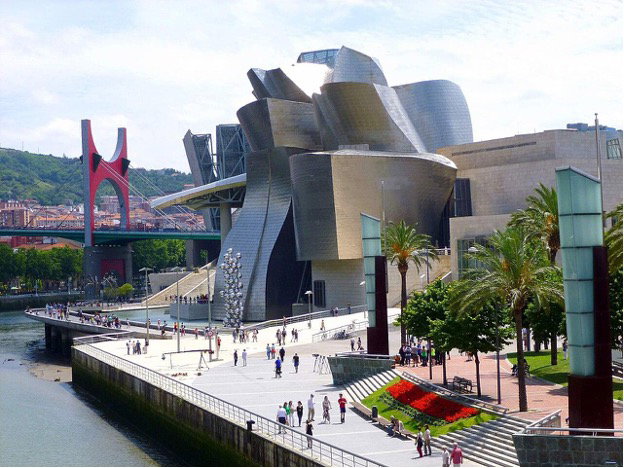
In Bilbao, the thing worth identifying may be outdoors: the Guggenheim’s titanium shell and, beside it, Daniel Buren’s Red Arches on La Salve bridge.
Six apps to identify artwork in Spain’s museums
1. Chiaro
Chiaro, an audio guide app that starts from a photo, is meant for the ears. Photograph a painting, a church front or a mural in Lavapiés and it tells the story aloud in any of 18 languages, Spanish among them, then takes questions, typed or spoken. Where a visual search returns a page of links, Chiaro starts talking about a second after the photo is taken. It is also careful about what it names. It does not go on the picture alone but also uses where the photo was taken, so a Picasso photographed in Barcelona is matched against what hangs there; an AI agent then double-checks the first guess before the story starts, and when it meets a work it doesn’t know, such as a piece in a new temporary show, it looks it up online. A wide 0.5x camera fits a whole façade into one frame, which helps outside the Guggenheim or under the Sagrada Família’s Nativity façade. It needs an internet connection; beyond the first few days the free tier covers a guide and a chat each day, and Chiaro Plus is €8.99 a week in the Spanish store.
2. Google Lens
On iPhone you reach Lens through the Google app; Android has it as a standalone app. Google’s Spanish App Store listing pitches the camera as a way to find out “who created that artwork”. Results arrive as a page of matching images and links, so what you learn depends on what the web says about the picture, and Search Live turns the camera into a spoken back-and-forth if you would rather talk.
3. Apple Visual Look Up
Visual Look Up is already on your iPhone, with no download; Apple offers it in a set list of regions and languages. When a photo contains something it can recognise, stars appear on the Info button in Photos; tap it, then Look Up. Apple lists famous art, landmarks, statues, plants and pets among what it covers. Because it works on photos already in your library, a picture taken at the Reina Sofía can wait until the train home.
4. The Prado’s Official App
The Museo Nacional del Prado app is the museum’s own audio guide: free, with no in-app purchases in the Spanish App Store. It covers more than 200 works, offers routes of one, two and three hours, and has a keypad for going straight to a painting. Its 15 content languages include Catalan, Galician, Basque and Valencian; Ukrainian covers only the most requested works. It does not identify works through the camera.
The museum’s other app, Photo Prado, is for souvenirs rather than information. It makes an AI picture of you beside Las Meninas, Goya’s Family of Charles IV or Bosch’s Garden of Earthly Delights, among others, and only works at two points in the Jerónimos hall, one by the Friends of the Prado desk and one opposite Café Prado.
5. Smartify
Smartify is a social enterprise that works with museums, and it says every in-app purchase helps cultural venues care for their collections. Its scanner reads paintings, sculptures and objects. The listing is frank that it partners with museums to protect artist copyright and can’t identify every artwork. Tours cost €0.99 to €5.99 in the Spanish store. It runs on iPhone and Android, in 13 languages including Catalan.
6. Magnus
Magnus is the art-market app. In English only, and on iOS 18 or later, a photo brings up the artist and price data, with gallery asking prices alongside auction records, a kind of information no museum label carries. The current release is a ground-up relaunch with a new recognition engine, and the developer’s site points to the App Store alone. It is most useful at art fairs such as ARCOmadrid, at IFEMA from 3 to 7 March 2027.
At a Glance
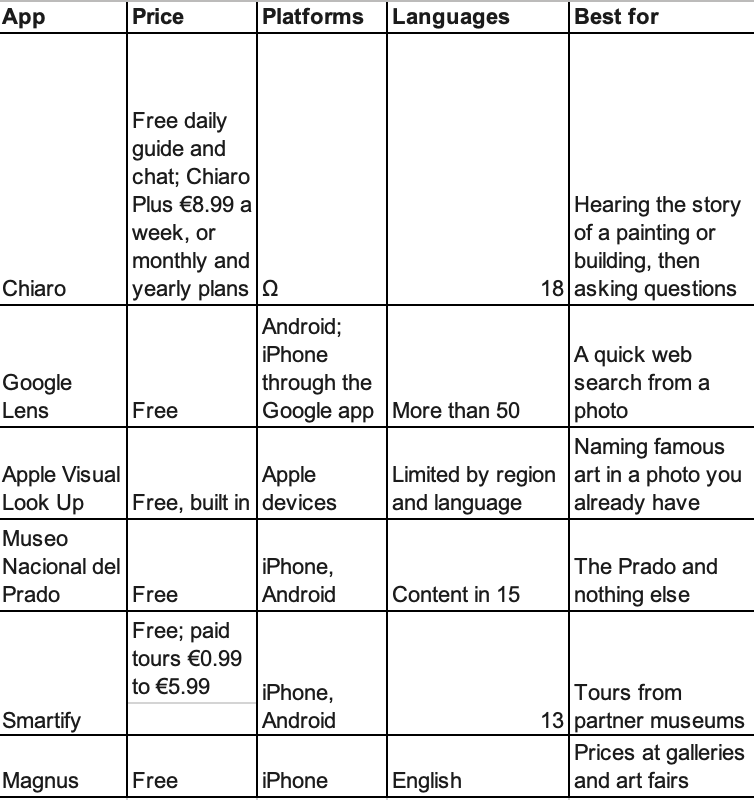
App features, prices and availability change. Check the store listings before downloading
Photography rules vary between museums and can change. The Prado, for example, does not allow visitors to take photographs inside its galleries, so check each museum’s current policy before using a camera-based app. App features, prices and availability also change, so check the store listings before downloading.









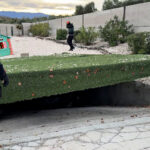
Officers lifted the artificial grass and found an access hatch. Photo credit: Guardia Civil/Ministro de Interior
A children’s playground is supposed to be somewhere parents can let their little ones run around without a second thought. But in Granada, the swings, playhouse and artificial grass were hiding something far more sinister: a concealed entrance to an underground cannabis farm containing 1,954 plants.
The underground plantation was found on a property in Las Gabias, where the Guardia Civil uncovered the entrance beneath what appeared to be a small children’s playground. The surface had been dressed with artificial grass, a swing, a playhouse and a small mat. White decorative stone covered the surrounding ground, helping disguise the structure. It was not simply a cannabis farm hidden in a basement. The play area itself concealed a hydraulic hatch and a vehicle ramp leading down into the bunker.
A hidden entrance beneath the swings
Officers lifted the artificial grass and found an access hatch used to operate a large hydraulic door. Once it was opened, a ramp led down into the underground installation, which measured around 180 square metres and stood five metres high. Inside around 2,000 cannabis plants in two large growing rooms. Both were fitted with lighting, ventilation and climate-control systems designed to support intensive cultivation.
The discovery raises an obvious question about the setting: the entrance had been disguised as a place for children to play. The Guardia Civil has not said that children were present or that the area was being used by children, but the equipment was deliberately arranged to make the concealed access look like an ordinary play space.
Electricity theft on the scale of 100 homes
Investigators also found an electricity tower which was allegedly being used to make an illegal connection to the power network. The load detected was equivalent to the electricity consumption of around 100 homes.
The bunker was described by the Guardia Civil as the largest and most sophisticated underground cannabis-growing installation discovered so far in Granada province.

Five arrested as investigation widens
The discovery formed part of Operation Nazarí-Sabika 04, an investigation into an alleged criminal organisation involved in growing and processing cannabis and supplying specialist equipment to other drug-trafficking groups across Spain. The operation began more than a year ago and entered its main phase on November 17, when officers carried out 13 searches in Granada city and the municipalities of Albolote, Jun, Las Gabias and Maracena.
Five people were arrested and three others are being investigated on suspicion of drug cultivation and production, electricity fraud, illegal possession of a prohibited weapon and membership of a criminal group. The alleged ringleader has been remanded in custody. Across the three plantations uncovered during the searches, officers seized 2,479 cannabis plants. They also confiscated two cars, two vans, a caravan, a trailer, a stun gun and €22,970 in cash.
A cannabis business behind the operation
Officers also sealed premises specialising in cannabis-growing equipment, known as a grow shop, which was allegedly linked to the organisation. The Guardia Civil estimates its value at several million euros. Investigators believe the shop’s owner used it to obtain equipment for the underground plantation and to supply products to other locations around Spain.
The investigation was carried out by the Guardia Civil’s criminal intelligence and Policía Judicial units in Granada, together with officers from its Las Gabias investigation team.

The ‘vulture-Fund’ Bogeyman Blamed For Spain’s Soaring Rents And Housing Crisis

Muere La Mujer Apuñalada Por Su Expareja En Bilbao

Costa Rica Niega El Ingreso A Francesca Albanese, Relatora De La ONU: “Nunca Me Había Sentido Tan Humillada”


-

 New Developments4 weeks ago
Luxury Villas For Sale, Estepona – ProjectL1
-

 New Developments3 weeks ago
The San Roque Club – Townhouses For Sale
-
costa blanca live music4 weeks ago
Beatles tribute: The Liverpool Band returns to Orihuela Costa
-
countryside4 weeks ago
Rural revival: Five Almeria villages make moving inland easier and more enticing
-

 New Developments4 weeks ago
Stylish 3-Bedroom Apartment With Panoramic Sea Views – Benalmádena
-

 %3 days ago
Black Friday Shock As Just 6% Of Deals Pass OCU’s Genuine Bargain Test
-

 America4 weeks ago
Así Ha Sido La Primera Jornada Del World In Progress 2026: Del Anuncio De Sánchez De Ayudas Para Las Víctimas De Urda A La Reivindicación De Rebeca Grynspan Del Papel De La ONU
-
Eating out in Gibraltar4 weeks ago
Young woman left horrified after Gibraltar restaurant receipt carries shocking racist slur