
Drivers in Germany
Almost 400 motorists caught in bizarre German speed camera trap

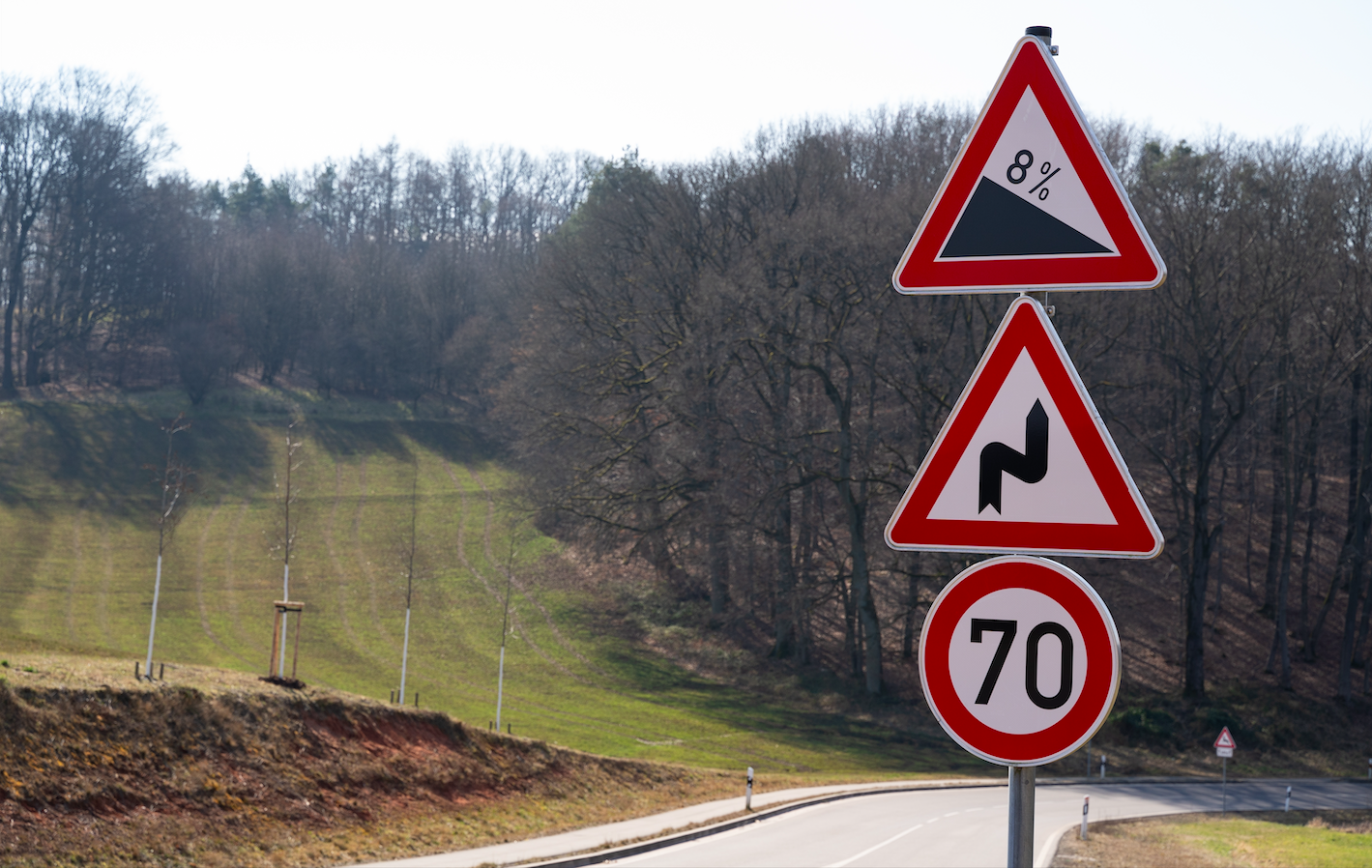
Police say the sign had been constructed from a round 70 km/h sign. Photo credit: Mentor Beqiri/Shutterstock
When driving on a motorway, you generally trust the signs telling you what speed you can legally travel. You are hardly going to pull over and investigate whether somebody has quietly put up a fake one, particularly when it looks like an ordinary road sign.
That is the bizarre situation motorists found themselves in on a road in Haldensleben, Germany, after an unknown person interfered with the speed limit next to a mobile speed camera. It looked convincing enough to affect what drivers believed they were legally allowed to do. By the time authorities realised what had happened, the consequences had already become a headache for the town, and for hundreds of motorists who had been caught on camera.
The fake sign looked convincing
The bizarre incident happened on Magdeburger Straße, a main route into Haldensleben in Saxony-Anhalt. The road is surrounded by businesses and petrol stations, meaning a change to the speed limit did not necessarily look suspicious to passing motorists. The fake sign showed a maximum speed of 70 km/h, despite the actual limit being 50 km/h. It had been put up independently and was not an official traffic sign issued by the authorities.
Police say the sign had been constructed from a round 70 km/h sign, a stand and a metal pipe. While officials noticed differences between the homemade setup and the equipment normally used by the authorities, it was apparently convincing enough to affect drivers passing the location. There was an important detail that the person putting up the sign presumably knew: a mobile speed camera was operating on the same stretch of road.
Almost 400 drivers caught by the camera
Between September 4 and September 6, the camera recorded almost 400 photographs of vehicles exceeding the 50 km/h limit and issued the fines. For a driver who had just passed what appeared to be a legitimate 70 km/h sign, being photographed at 60 or 65 km/h would have seemed particularly unfair. From their point of view, they were below the speed shown on the sign.
The problem became even bigger for the authorities once they discovered that the sign had been placed there illegally. The city removed the fake sign, but by then hundreds of photographs had already been taken. What happened next was an unusual twist: the motorists caught by the camera fortunately did not end up paying the fines.
Almost 400 cases had to be dropped
The city of Haldensleben ultimately had to discontinue all the affected penalty proceedings from that weekend. The reason was not simply that there had been a fake sign. Authorities could not establish beyond doubt exactly when the sign had been put up. Without knowing the precise point at which the fake 70 km/h limit appeared, it was impossible to determine with sufficient legal certainty which drivers had passed the camera while the misleading sign was in place.
That meant the cases could not simply be pursued on the basis of the camera photographs. The decision even affected motorists who had been travelling faster than 70 km/h. The city therefore lost the fines that could otherwise have been issued from the affected measurements.
Police believe it was deliberate
Authorities are not treating the incident as someone putting up a strange road sign for a laugh. Police believe the unknown person may have deliberately wanted to mislead motorists and cause them to exceed the genuine 50 km/h limit, knowing that the speed camera was operating nearby.
The police have opened an investigation for Amtsanmaßung, a German offence involving unlawfully assuming or exercising an authority that belongs to a public official. They are also describing the incident as a dangerous interference with normal road traffic. There is currently no identified suspect but police have appealed for witnesses who may have seen someone putting up the sign or noticed suspicious activity around the location.
The sign was removed, but the damage was already done
Once the authorities discovered what had happened, the homemade sign was taken down.That solved the immediate problem for motorists, but it could not undo the hundreds of speed-camera photographs already recorded over those three days. The incident has left Haldensleben with an unusual outcome: almost 400 motorists were caught by a speed camera, yet the uncertainty surrounding a single roadside sign meant the resulting penalty cases had to be abandoned.
For drivers, there is also an obvious lesson in how easily a convincing piece of roadside equipment can create confusion. The sign looked official enough to influence traffic, while the camera continued operating according to the actual 50 km/h restriction. And whoever put it there remains unknown.






Almost 400 motorists caught in bizarre German speed camera trap
España – Croacia En Directo | Yamal, Sobre Su Segundo Gol A Livakovic: “Lo Conozco De Los Entrenos”
Mallorca’s historic Alcudia to welcome Spain’s most beautiful villages this October

Detenido Un Hombre Por La Muerte De Una Mujer De 47 Años En El Distrito De Arganzuela De Madrid
Spanish airline Vueling named Europe’s best low-cost carrier for 2026
Spain’s wildfire toll revealed as almost 300,000 hectares go up in flames


-
 Arganzuela1 week ago
Detenido Un Hombre Por La Muerte De Una Mujer De 47 Años En El Distrito De Arganzuela De Madrid
-
Best airlines2 weeks ago
Spanish airline Vueling named Europe’s best low-cost carrier for 2026
-
2026 wildfires2 weeks ago
Spain’s wildfire toll revealed as almost 300,000 hectares go up in flames
-

 Claudia Sheinbaum2 weeks ago
The Azcatitlan Codex Returns To Mexico From Europe After Nearly Two Centuries
-

 %2 weeks ago
Mallorca Property Overrun By Wild Goats
-

 basque country1 week ago
British Actress Naomi Watts Attacks Ageism In Hollywood As She Picks Up Prestigious Donostia Award At San Sebastian Film Festival
-

 Uncategorized2 weeks ago
Heartbreaking Instagram post reveals death of F1 star
-

 America2 weeks ago
Delcy Rodríguez Se Reunirá Con Trump En Nueva York En Un Gesto Inédito De Acercamiento