Housing politics
Barcelona Rent Controls: Rents Rise While Rental Opportunities Remain Scarce
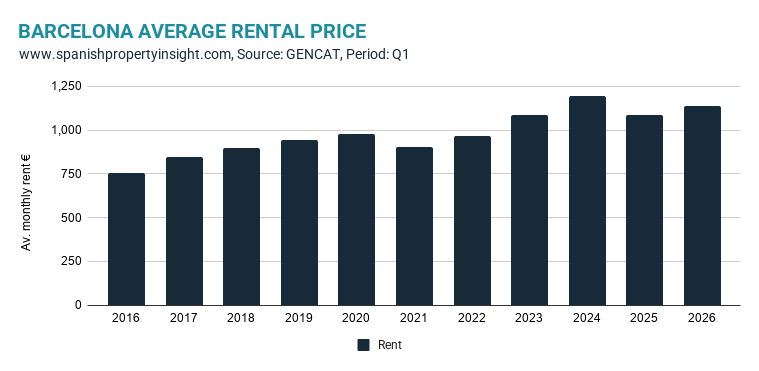
Barcelona’s latest rental figures deliver an awkward result for supporters of rent controls: rents are rising again, while the number of people managing to secure a new rental home remains far below normal.
The Catalan government has now published INCASÒL data for Q1 2026, giving us the latest reading on Barcelona’s rental market two years after rent controls were introduced. The figures are based on registered rental contracts and deposits, and show 8,156 new contracts signed in the city during the quarter, with an average rent of €1,137.35 and an average price of €16.89/sqm.
Rents are rising again
Compared with Q1 2025, the average monthly rent increased by 4.6%, from €1,087 to €1,137, while the price per square metre rose 4.3%, from €16.2 to €16.9.
That is hardly the result rent controls were supposed to deliver. The whole point of the policy was to suppress rental inflation, yet two years after controls were introduced, registered rents are once again moving upwards.
The Generalitat’s own monitoring series confirms that Barcelona’s average contractual rent in Q1 2026 was still about 4.7% below the Q1 2024 level immediately before the controls took effect. But that comparison conceals the rebound over the last year.
Meanwhile, asking prices moved in the opposite direction. Idealista data averaged around €20/sqm in Q1 2026, down 2.1% year-on-year, narrowing somewhat the unusually large gap that had opened between advertised and registered rents. Idealista recorded €20.1/sqm in January, €20.0 in February and €19.9 in March.
More contracts, but still nowhere near normal
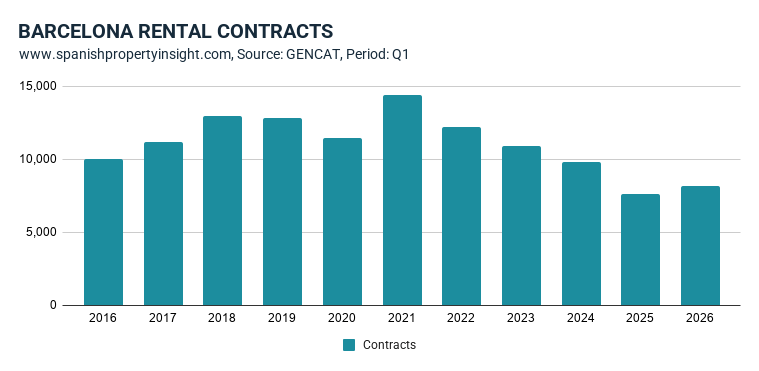
There was one superficially encouraging number: new contracts increased by 7.1% year-on-year to 8,156. However, the average number of Q1 contracts over the previous ten years was roughly 11,338, meaning activity in Q1 2026 remained 28% below normal. Even after this year’s modest recovery, around 3,200 fewer households found a new rental home than would have done in an average first quarter.
And that is the part of the market rent-control enthusiasts tend to overlook.
People who want to rent but cannot find a property do not appear in the rental-price statistics. Neither do people prepared and able to pay a higher rent who nevertheless cannot secure a home because landlords have withdrawn properties, switched use, or become extraordinarily selective about tenants.
They show up only indirectly—in the collapse in new contracts.
Price controls cannot manufacture homes
Rent controls can dictate what appears on a registered contract. They cannot create additional housing.
The result is a rationed market. Sitting tenants with protected rents can do very well, while the dwindling number of applicants with impeccable financial profiles compete for whatever becomes available. Those with less attractive profiles—young people, the self-employed, lower-income households or families perceived as higher risk—are pushed towards the back of the queue.
The latest figures therefore offer little evidence that Barcelona’s fundamental rental problem has been solved. Quite the opposite: despite extensive government intervention, rents are rising again and access remains dramatically below historical norms.
Rent controls may control the price printed on a contract. They cannot help the thousands of people who never manage to sign one.