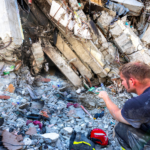
Despite exhaustion, teams continue working because experience has shown that survival remains possible. Photo credit: ttanni/Shutterstock
Nine days after Venezuela’s devastating earthquakes, most disaster responses around the world would already be shifting from rescue to recovery. But not here. Rescue operations have entered what urban search and rescue specialists describe as one of the most difficult and emotionally demanding stages, where every passing hour makes survival less likely, yet rare rescues continue to show why teams refuse to stop searching.
Just hours earlier, security guard Hernán Alberto Gil Flores was pulled alive from beneath the rubble after spending eight days trapped inside a collapsed shopping centre, reinforcing why British and Spanish rescue teams remain among those working around the clock alongside international colleagues in the search for survivors.
Why day nine matters
The first 72 hours after an earthquake are usually the most critical for survival. After that, dehydration, injuries, extreme heat, limited oxygen and unstable structures all make survival increasingly difficult. But experienced urban search and rescue teams know survival is still possible.
Air pockets formed inside collapsed buildings can preserve life for days if even small amounts of air and water are available. These rare cases are why teams continue working long after optimism fades. Every site is different, and rescuers will not assume there are no survivors until every realistic possibility has been checked.
Britain’s rescue mission
Britain has deployed a 68-strong UK International Search and Rescue team after Venezuela requested assistance. The deployment includes firefighters, structural engineers, medics, veterinarians, search dogs and specialist equipment designed for self-sufficient operations in disaster zones. Firefighters enter unstable structures to carry out rescues, while engineers assess whether buildings are safe to access and identify the most stable entry points.
Medical teams are positioned close to extraction zones to treat survivors immediately, while veterinarians ensure search dogs remain fit to work in extreme conditions. The team also carries cutting tools, lifting equipment, communications systems and specialist detection devices used to locate life beneath rubble. National Fire Chiefs Council Chair Phil Garrigan said the deployment reflects the UK’s commitment to supporting partners “in extremely challenging conditions” and helping save lives wherever possible.
Spain’s rescue effort
Spain has also deployed specialist emergency teams, canine units and technical rescue equipment as part of the international response. Spanish rescuers are working alongside other nations, combining urban search expertise with engineering skills to reach areas where survivors may still be trapped. The mission carries added significance due to long-standing cultural and historical ties with Venezuela, as well as the large Spanish community living there.
Many families maintain close personal connections across both countries, giving Spain’s involvement additional emotional weight. Spanish teams are experienced in earthquake response and structural collapse operations and are working in coordination with international partners to expand search coverage across heavily damaged areas.
The technology searching for life
Modern urban search and rescue relies on a mix of advanced technology and human skill. Rescue dogs are often sent into collapsed areas first because they can detect human scent trapped beneath tonnes of debris. When a dog alerts handlers, teams use sensitive listening devices capable of picking up faint tapping, movement or voices. Thermal imaging cameras can sometimes detect body heat in accessible voids, while fibre-optic cameras are inserted through small gaps to inspect spaces too dangerous for entry.
Importantly, rescue teams do not dig at random, they combine dog alerts, structural assessments, technical readings and eyewitness information to identify the most likely survival zones. A single signal can redirect hours of carefully planned work.
A rescue that renewed hope
The rescue of Hernán Alberto Gil Flores has become a defining moment of the operation. He survived for eight days beneath collapsed concrete inside a partially intact structure that created a small air pocket.
Rescuers established contact with him days before extraction and carefully tunnelled through unstable debris while providing water and support through narrow openings. The operation required more than 100 hours of precise work to avoid further collapse. When he was finally brought out alive, exhausted but conscious, rescue teams reacted with relief after days of continuous effort. His survival has reinforced belief among rescuers: even on day nine, hope cannot be lost.
The human cost
Behind the technical operation is a deeply human reality. Rescue workers operate for long hours in dangerous conditions, often making decisions where every choice carries serious consequences.
Families continue to wait near collapsed buildings, hoping for news and refusing to abandon the possibility that loved ones may still be alive. Meanwhile, rescue coordinators must balance urgency with safety as aftershocks continue to threaten weakened structures.
Giving everything
Despite exhaustion, teams continue because experience shows survival remains possible in rare but real cases, even after extended periods. Every passing hour reduces the chances of finding survivors, but it does not remove them entirely. That is why British and Spanish rescue teams, alongside international colleagues, continue their work as day nine unfolds in Venezuela.
The rescue of Hernán Alberto Gil Flores has reinforced that extraordinary survivals can still happen when hope appears to be fading, and until every viable space has been checked, the search continues.










 Uncategorized1 week ago
 Abelardo de la Espriella2 weeks ago
 Amazon2 weeks ago
 Comisiones Obreras2 weeks ago