Connect with us

%

British Drug Dealer Swaps Cocaine For Pokémon Cards In Bizarre Barter Deal

Published

on

british-drug-dealer-swaps-cocaine-for-pokemon-cards-in-bizarre-barter-deal

Children have been swapping Pokémon cards for decades. Photo credit:Kittyfly / Shutterstock.com

There was a time when money was not the only way to buy something or settle a debt. Before bank cards, online transfers and the joy of discovering that your direct debit has mysteriously gone up again, people traded what they had for what they needed. A few vegetables could become a loaf of bread. Milk could be swapped for eggs. A piece of cloth might be exchanged for food.

It was simple: if both sides thought the deal was fair, the trade was done. Fast-forward a few hundred years and apparently we have come full circle. Only now, instead of milk for vegetables, someone is accepting Pikachu and Charizard.

Pokémon cards become an unlikely currency

A 26-year-old British drug dealer has been jailed after some of his customers apparently settled their debts with Pokémon trading cards. Jack Young-Larter, from London Road in Maidstone, Kent, was sentenced to three years and four months at Maidstone Crown Court on Thursday, September 17, after pleading guilty to supplying cocaine and cannabis and possessing criminal property.

Kent Police discovered that his customers had paid him in several ways, including cash and bank transfers. Messages found on his phones also showed Pokémon cards being used as payment. Officers found a collection of rare cards at his home which they described as having a high monetary value. Around £2,000 in cash was also seized. Neither the money nor the cards will be returned to him. Both were subject to a Deprivation Order because of their connection to his criminal activity.

Why are Pokémon cards worth so much?

For anyone who remembers Pokémon cards as something children swapped in the playground, using them to pay a drug dealer might sound like a particularly strange choice of currency. But some Pokémon cards really can be worth serious money. Not every card is valuable. Prices depend on factors including rarity, condition, the particular set or edition and demand from collectors.

The Pokémon Company says the secondary-market value of its cards is determined by demand within the Pokémon community. Its sets contain different levels of rarity, with some cards considerably harder to find than others. That scarcity matters. A card produced in huge numbers is unlikely to command a fortune, while a rare card in excellent condition can attract collectors prepared to pay substantially more.

Childhood favourites become collector gold

Older cards can be particularly desirable when they have survived in good condition. Popular Pokémon such as Charizard and Pikachu have enormous collector followings, while unusual artwork, limited releases and particular printing characteristics can make individual cards even more sought after. Then there is nostalgia.

Pokémon has been around for decades, so some of the children who once spent their pocket money on booster packs are now adults with money of their own to spend on the cards they grew up with. What once looked like a children’s hobby has developed into a serious collector’s market, giving some cards a value far beyond their original price.

From playground swaps to drug debts

There is something rather fitting about the way the cards were apparently being used, handing over one card in exchange for another. The whole system depends on both sides deciding that the trade is fair. Young-Larter’s customers simply appear to have taken that idea somewhere considerably less innocent. Instead of swapping a duplicate card for one missing from their collection, they could use cards to settle a debt.

It is an oddly modern version of an ancient idea. Bartering existed long before wallets, bank accounts and contactless payments. People exchanged goods directly because they needed something another person had. The difference is that a sack of potatoes has fairly obvious uses. A Pokémon card only has financial value if somebody else is willing to pay for it. In the collector market, apparently, that is more than enough.

Police uncover drug operation

The Pokémon cards were only part of what officers discovered when Kent Police searched Young-Larter’s home on May 1. They found nearly 110 grams of cannabis, more than 25 grams of cocaine, scales, empty deal bags and two mobile phones. Police examined the phones and found messages relating to the marketing and supply of cocaine and cannabis. He was sentenced to three years and four months in prison, while the cash and Pokémon cards were confiscated under the Deprivation Order.

The cards may have started life as something children collected and swapped at school. Now, over twenty years later, some have become valuable enough to trade for serious amounts of money. Young-Larter’s customers apparently recognised that value too, once, it was trading food for different items. Now, apparently, it can be Pokémon cards for cocaine. Somewhere along the way, the barter system took a very strange turn.

%

EuroMillions: Spain Creates Another Millionaire

Published

on

euromillions:-spain-creates-another-millionaire

Another winning lottery shop. Credit: Manuel Milan – Shutterstock

Spain has another EuroMillions millionaire after Friday night’s draw, but the country’s latest lucky ticket did not take the biggest prize on offer.

A single ticket in the UK matched all five numbers and both Lucky Stars to scoop the €130 million jackpot. The Spanish result was different, with a new millionaire created through El Millón extra random number. The winning numbers drawn were 11 – 12 – 15 – 38 – 49 and lucky stars 10 and 12.

€1 million prize lands in Cadiz

The winning El Millón code was sold at receptor 22,755 in San Enrique de Guadiaro, Cadiz, giving one Spanish ticket holder a €1 million windfall.

Spain also produced one winner in the third EuroMillions category, matching all five main numbers but missing both stars. That ticket was confirmed at lottery shop No. 8 in San Sebastian, Guipuzcoa, and collected €31,693.31. Friday’s draw attracted more than €83.1 million in total sales across the participating countries, according to Loterías y Apuestas del Estado.

Spain’s biggest EuroMillions win

Spain has a long record of big EuroMillions prizes. The country’s biggest-ever win came in October 2017, when a ticket confirmed in Las Palmas de Gran Canaria landed €190 million. That prize remains Spain’s record EuroMillions payout, with the ticket sold at lottery shop No. 54 in the El Mirador shopping centre. The previous Spanish record was €137.3 million, won in Parla, Madrid, in 2014.

Spain has also produced hundreds of other major EuroMillions winners since the game began in 2004.

Which country wins most EuroMillions jackpots?

Historical EuroMillions statistics put the UK ahead for total jackpot-winning tickets, with 137, followed by France with 133 and Spain with 124. Those figures cover the game’s history and can change as new jackpots are won.

Spain’s position is particularly notable given that the UK and France have larger populations, while EuroMillions tickets are sold across nine participating countries. Friday’s jackpot has now been won, so Tuesday’s EuroMillions draw will offer a guaranteed €17 million to whoever matches five numbers and two Lucky Stars.

Continue Reading

%

Noah’s Ark Is 100% Confirmed As Huge Discovery Is Made, Scientists Say

Published

on

noah’s-ark-is-100%-confirmed-as-huge-discovery-is-made,-scientists-say

Formation contains the buried remains of Noah’s Ark and has described the latest evidence as confirmation that the formation is man-made. Photo credit: MehmetO/Shutterstock

For thousands of years, the story of Noah’s Ark has been one of those tales that refuses to disappear. Whether you see it as religious history, legend or one of the world’s great archaeological mysteries, there is one question that has never gone away: where is the ship? Now researchers investigating a strange boat-shaped formation in eastern Türkiye say they have found something beneath the ground that could change the search completely.

New scans have detected what appear to be straight lines, right-angle intersections and sizeable spaces beneath the formation, while drilling has recovered layers of organic material and encountered an exceptionally hard underground layer that reportedly broke the drill bit. The team behind the investigation has even claimed that the latest work has “100 percent confirmed” that the formation is man-made, but there is an important catch: nobody has actually uncovered Noah’s Ark, yet.

What has been found beneath the site?

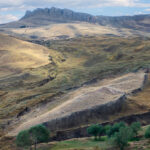
The investigation is taking place at the Durupınar Formation, around 20 miles south of Mount Ararat. The site has attracted Ark hunters for decades because its outline looks remarkably similar to a ship when viewed from above.

It was first identified in aerial photographs in 1959 and measures around 157 metres long. Researchers have repeatedly debated whether the unusual shape is the remains of a vessel or simply the result of natural geological processes. This year, however, researchers have taken the investigation much further.

Radar reveals mysterious structures

An international team led by archaeologist Professor Cenker Atila of Sivas Cumhuriyet University has been carrying out geological and archaeological work using ground-penetrating radar, electrical resistivity tomography, LiDAR and core drilling. The project has official approval from Turkish authorities.

The radar surveys have produced some of the most intriguing results so far. Researchers say they have identified features that appear to form possible corridors, chambers and tunnels beneath the surface. One group of anomalies appears to extend for roughly 151 feet, with an average height of more than 14 feet.

Underground features raise new questions

Other areas detected by the radar reportedly measure around 26, 39 and 23 feet in height. There is also a particularly intriguing section where researchers say the underground features appear to divide into three layers. That has led the team to draw comparisons with the biblical description of the Ark as having three decks.

But radar cannot simply show archaeologists a photograph of a room buried underground. The equipment detects changes in materials and boundaries beneath the surface, meaning the features still have to be physically investigated before anyone can establish what produced them.

Then the drilling began

That is where the latest phase becomes particularly interesting. Researchers have taken core samples from inside and outside the boat-shaped formation, reaching depths of up to around 18 metres. According to the research team, the cores have produced layers containing large amounts of organic material. They are now being sent for laboratory testing to determine exactly what the material is and how old it might be.

At one point, the drilling reportedly stopped after the equipment struck an extremely hard layer around four to five metres beneath the surface. The drill bit broke when it hit the material. Andrew Jones, founder of Noah’s Ark Scans and vice president of the research project, said petrified or highly mineralised wood are among the possibilities being considered.

That is still only a possibility. The material has not been confirmed as wood, let alone wood from a ship. Independent laboratory testing, including dating, will be needed before researchers can establish what they have actually recovered. The team has also reported encountering several cavities during drilling, including one that filled with mud and water.

A robot could go inside

The next step could be even more dramatic. Researchers are preparing a small exploration robot called Gopher, designed to enter narrow spaces through the boreholes and capture video footage while collecting samples. The idea is to investigate the underground spaces identified by the radar without immediately cutting open large sections of the formation. If the cavities really do contain man-made structures, the footage could provide the first direct visual evidence of what lies beneath the mysterious mound.

Researchers have also collected around 1,000 soil samples from 150 locations and found pottery outside the formation dating from the Chalcolithic period through to the Iron Age. That shows people were using or visiting the area over a very long period, although the pottery does not prove any connection with Noah or the Ark.

Is Noah’s Ark really there?

This is where the extraordinary claims need to be separated from what has actually been established. Jones has said he believes the Durupınar Formation contains the buried remains of Noah’s Ark and has described the latest evidence as confirmation that the formation is man-made.

However, at the moment there is currently no peer-reviewed scientific study proving that the underground structures were constructed by humans, and no wooden vessel has been uncovered for them to be confirmed a peer review study would be necessary.

The mystery is far from settled

National Geographic has previously reported that many archaeologists consider the Durupınar formation a natural geological feature and that modern searches for the Ark remain highly controversial. The biblical reference itself says the Ark came to rest on the “mountains of Ararat”,over 4.300 years ago which does not necessarily identify the modern Mount Ararat or the Durupınar site. Even the project’s own Turkish website says its work is investigating the geological and geophysical evidence rather than authenticating the historical or religious claim.

So, after centuries of searching, there is still no confirmed Ark sitting beneath the Turkish mountains. What researchers do have is a very unusual formation, increasingly detailed images of what lies beneath it, physical samples now heading for laboratory analysis and a plan to send a robot into the unexplored spaces. And that means the next stage of the investigation may finally produce something much more useful than another photograph of a rock that looks like a ship: evidence that can actually be tested.

Continue Reading

%

Two Spanish Airports Hit By Separate Aircraft Emergencies Within Hours

Published

on

two-spanish-airports-hit-by-separate-aircraft-emergencies-within-hours

The first incident happened at Barcelona-El Prat. Photo credit: muratart/Shutterstock

If you’ve ever been on a plane when something goes wrong, you’ll know how quickly the mood can change. One minute people are settling into their seats or watching the departure board, and the next everyone is looking around trying to work out what is happening.

That was the reality for passengers at two Spanish airports on Friday, after two separate aircraft emergencies unfolded within hours of each other. One plane had to turn back shortly after taking off from Barcelona, while another ended up making an emergency landing in Valencia.

Smoke and flames force plane to turn back

The first incident happened at Barcelona-El Prat shortly after a Delta Airlines flight bound for Atlanta took off. Smoke and flames were detected from one of the aircraft’s engines during the departure, prompting the pilots to turn around and head back towards the airport.  The situation triggered the airport’s emergency response, with firefighters and other emergency teams mobilised to make sure the aircraft could land safely.

Civil Protection also activated the AEROCAT aviation emergency plan at alert level as a precaution while the plane returned to El Prat. The aircraft landed without any reported injuries or material damage, and passengers were able to leave the plane normally. It was later removed from the runway, with reports putting the time at around 1:30pm. Investigators are looking into what caused the engine problem, with a possible bird strike and an internal engine fault among the possibilities being examined. 

Second emergency hits Valencia

The situation was not connected to what happened in Barcelona, but only a few hours later another aircraft needed to make an emergency landing at Valencia Airport. The aircraft was an Airbus A320 operated by Swiss, travelling from Zurich to Valencia.

Rather than going straight in to land, the plane spent time circling before eventually coming down at Valencia Airport at around 3:30pm. The aircraft then remained on the runway for several minutes while the situation was dealt with. That was enough to cause disruption elsewhere at the airport, with five other flights diverted to alternative airports.

Five flights diverted

The affected flights had been due to arrive from Malta, Rotterdam, Amsterdam, Basel and Marrakech. Arrivals and departures at Valencia were also suspended for several minutes while the Swiss aircraft remained on the runway. The disruption was temporary, and airport operations subsequently returned to normal.

There were no reports of injuries resulting from the emergency landing, meaning both incidents ended without the kind of consequences passengers and airport staff would have feared when emergency procedures were activated.  For people travelling through Valencia that afternoon, however, the incident meant that a problem involving one aircraft quickly became a problem for several other flights. Passengers whose planes were diverted had to wait for their journeys to be reorganised before continuing to Valencia.

When an aircraft needs priority

An emergency landing can affect much more than the aircraft involved. Air traffic controllers have to make room for the incoming plane, while ground teams prepare for its arrival and other aircraft may have to wait, change their route or use another airport. How much disruption follows depends on how long the aircraft remains on the runway and what other traffic is scheduled at the time.

That is why the same type of emergency can have very different consequences for passengers. One aircraft can return to its departure airport and be dealt with without major disruption, while another can leave an airport temporarily unable to handle its normal flow of arriving and departing flights

Two incidents, hours apart

For the people caught up in the two flights, Friday’s problems began as something they could not have anticipated when they boarded or arrived at the airport. What started as a regular journey changed suddenly, leaving crews to deal with situations that passengers had no control over.

There is also something particularly unsettling about the timing. The two aircraft were operated by different airlines and were travelling on completely different routes, yet both ended up needing emergency assistance at Spanish airports within the same afternoon.

Continue Reading
Advertisement
Advertisement

Spanish Real Estate Agents

Tags

Trending

Copyright © 2017 Spanish Property & News