ElPais
Casavalle, The Vulnerable Neighborhood On The Outskirts Of Montevideo Awaiting Pope Leo XIV

In Casavalle, one of Montevideo’s most vulnerable neighborhoods, Uruguayan priest Pablo Coimbra walks through a cluster of half-finished homes. The district, steeped in history, is set to receive Pope Leo XIV this weekend.
Built with solid foundations, concrete floors and aluminum-framed windows, the houses stand out amid the makeshift tin shacks and dirt roads that dominate the settlement.
“We have shown that it improves the quality of children’s education. Living without a bathroom, in a shack, is one thing; having a decent home is another,” Coimbra says ahead of the highly anticipated papal visit.
Coimbra has led Our Lady of Guadalupe Parish for the past six years. Founded in 1987, it belongs to the diocesan clergy. The community is now painting walls and preparing its facilities to welcome the pontiff during his visit to Uruguay.
The parish sits at one of Casavalle’s central hubs, behind a large modern square with skate ramps, playgrounds and sports courts. Around it are a police station, a school, a health clinic and a civic center housing a range of public services. The layout recalls that of old Spanish towns, organized around a central plaza where all civic life was concentrated.
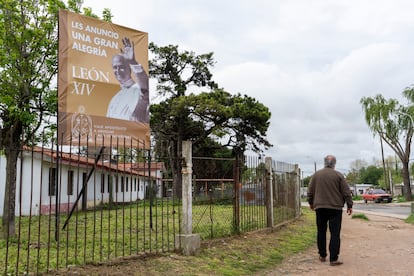
But here, on the outskirts of Montevideo, opportunities and services are not always within reach. The presence of public institutions coexists with a reality shaped by poverty and violence: frequent shootouts, small-scale drug trafficking gangs battling for territory, contract killings, and children killed by stray bullets. These are the streets Pope Leo will walk through in Montevideo, where mud is a constant and sewage runs along the sidewalks.
The parish’s asymmetrical design breaks with the traditional image of a Catholic church. Its structure is defined by overlapping geometric brick volumes arranged on different levels, with sloping lines and staggered roofs. Inside stands an image of Our Lady of Guadalupe that arrived after John Paul II’s visit to Uruguay nearly four decades ago. The pope gifted the image, and the clergy later donated it to this parish on the condition that the church bear the Virgin’s name.

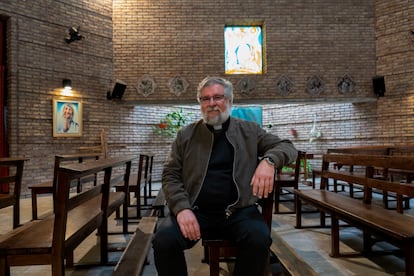
From there, where he celebrates Mass for 200 people every Sunday, Coimbra speaks about the neighborhood’s challenges and explains what sets the Church’s work apart from that of public institutions. “I wouldn’t say the state is absent here, because that’s not true. The State is present. But it’s not efficient. The bureaucracy, the delays…,” says Coimbra, explaining that it is difficult for the state to meet the community’s pressing needs.
The difference, he says, lies in daily contact. “We live here, I live here. So we are constantly going out into the neighborhood, visiting people, getting to know them, having direct contact with families, with their problems, with the realities of daily life.”
For a few hours, the papal visit will place Casavalle at the center of attention. The parish’s work, however, continues every day. “People here feel very excluded, left behind, and that’s why they’re so excited about the visit,” the parish priest says.
‘When is the Pope coming?’
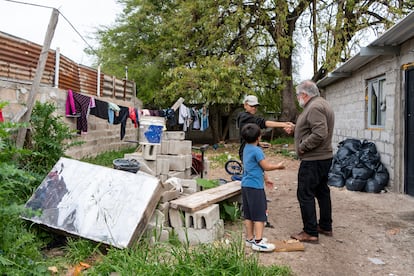
“Father, when is the Pope coming?” The question comes up again and again during the walk through Casavalle. “Not long now,” Coimbra replies.
Some residents stop to greet him; others take the opportunity to tell him about their problems. “The demands are constant, you need to have a strong character,” the priest says. It requires knowing when to say no and where to set limits.
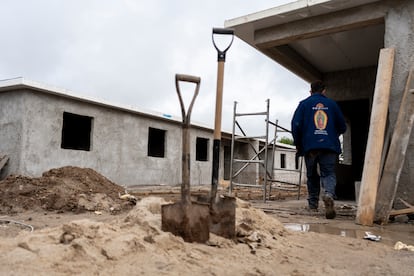
Just a few yards from the parish, where a stage is being erected for the Pope’s address, work continues at a frantic pace. In the background, there is the sound of plena, the Afro-Caribbean-rooted musical genre that is a staple of Uruguayan culture, known for its danceable, percussion-driven rhythms. The music blends with the sound of the concrete mixer and the thud of wet cement against the walls. There is a rhythm to the work, but also a sense of urgency. Although several homes are nearing completion, there is still much to be done. The ramp the pontiff will use is not yet finished, and damp days, with the sun reluctant to break through, have not made the task any easier.
The homes vary in size and design. Some are intended for older adults, while others are designed for large families. Some measure 72 square meters, while the largest spans 84. Their layouts are tailored to the needs of the people who will live in them.
Selecting the families was a key part of the process. The criterion was not whether they were Catholic, Coimbra explains, but whether they genuinely needed housing and could contribute to a harmonious community.
The neighborhood itself has also played a role in protecting the construction sites. Security guards monitor the area around the clock, but, according to the priest, protection has not depended solely on them. When some people tried to make off with building materials, local residents intervened to recover them. Vigilante justice played its part in a country where church and state have been separate for more than a century, since the 1918 Constitution.
The parish’s social work extends well beyond housing. Each month, it distributes 100 food baskets to families in the neighborhood and operates a community dining hall that serves afternoon snacks and dinner to more than 60 people, mainly children and teenagers, from Monday to Friday.
The parish also has a grass soccer field, enclosed by fencing and equipped with floodlights, a striking contrast to the surrounding shacks, whose residents watch from what effectively serves as the stands. From Monday to Friday, it hosts a soccer school for children between the ages of six and 15. The facility also offers mixed volleyball and other recreational activities, alongside programs providing social and family support.
From accountant to priest
Coimbra decided to become a priest while walking along Sarandí pedestrian street in Montevideo’s Ciudad Vieja district. He was 28 years old. He had just stepped off a bus near the Gateway of the Citadel when he felt what he describes as a clear inner voice telling him: “I want you to be a priest.” He asked God for a sign, and as he continued walking, a television crew approached him with an unexpected question: “Would you become a priest?” He answered yes. Deeply moved, he walked to Montevideo Cathedral, where he felt his doubts disappear.
The calling, however, had begun much earlier. Born in Salto, a department in northern Uruguay, into a working-class family, Coimbra served as an altar boy from childhood. He recalls an image of Jesus bearing a phrase that stayed with him for years: “Come and follow me.” At 18, he moved to Montevideo to study accounting. He lived in a boarding house with other young people from the interior, worked while attending university, and, after graduating, joined the Social Security Bank (Banco de Previsión Social) in 1991, achieving what many Uruguayans consider a dream job: a position in the public sector. Although he never drifted away from the Church, for years he envisioned a very different future.
After his ordination, Coimbra hoped to work in a neighborhood parish and remain close to ordinary people. Instead, his first assignment drew on his training as an accountant. He was tasked with conducting an audit of Radio Oriental, a Church-owned radio station known for its sports and news programming that was facing financial difficulties. He later took over its administration and eventually became parish priest of San Pedro Apóstol in Buceo, a neighborhood that stretches to Montevideo’s waterfront promenade.
A survey showing a weaker Catholic presence in Montevideo’s peripheral neighborhoods strengthened his conviction that the Church should address both material and spiritual needs. Today, that commitment is reflected in his work as pastor of Our Lady of Guadalupe Parish, in the heart of Casavalle, where he seeks to bring the Church closer to the daily life of the community.
Sign up for our weekly newsletter to get more English-language news coverage from EL PAÍS USA Edition