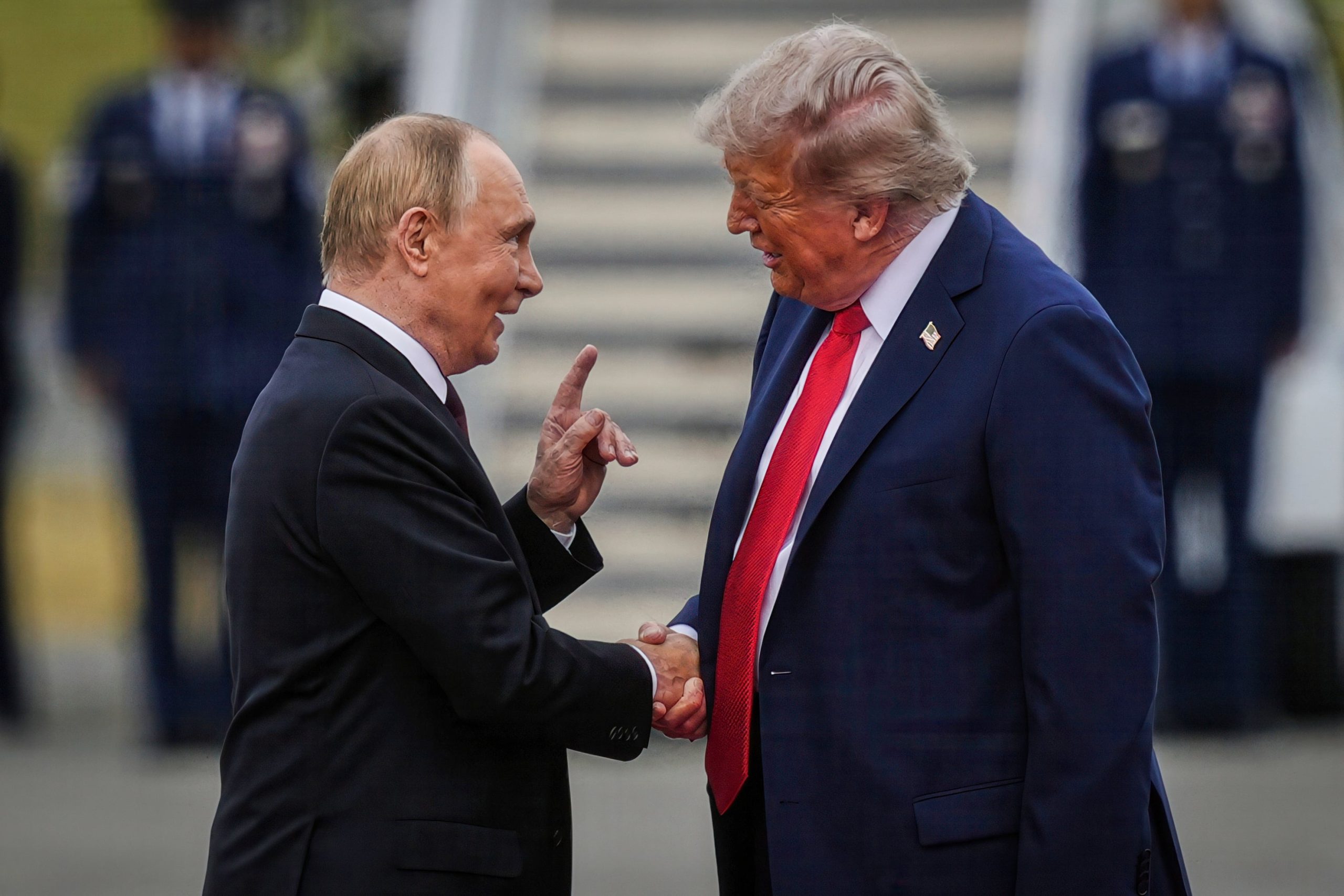
Each new opinion poll has confirmed Spaniards’ opposition to U.S. President Donald Trump. The latest survey by 40dB. for the April barometer of EL PAÍS and the Cadena SER radio network delivered a striking result: respondents viewed Donald Trump as the greatest threat to global peace, slightly ahead of Russian President Vladimir Putin, with Israeli Prime Minister Benjamin Netanyahu in third place.
The research also revealed a profound pessimism about the planet’s future — fewer than 10% expect it to become more prosperous and stable. Spaniards were also almost evenly split, largely along ideological lines, over whether defense spending should increase. All internal survey data can be downloaded here.
When respondents were asked which leaders most endanger global peace, 81% pointed to Trump, compared with 79.3% who cited Putin and 71.2% who named Netanyahu. The rest of the figures suggested by 40dB. rank further behind: Iran’s new supreme leader, Mojtaba Khamenei (62.9%); North Korea’s Kim Jong‑Un (62.25%); and, at a greater distance, the head of state of the other global superpower, China’s Xi Jinping, at 49.3%.
While the greatest hostility toward Trump was found among left-wing voters, even supporters of Spain’s conservative Popular Party (PP) were not particularly favorable toward him. Voters of the PP — the leading opposition party in Spain — identified Putin as the greatest threat (80%), but only slightly ahead of Trump (71.3%). Only among supporters of the far-right Vox was there any sign of sympathy for Trump, with his perceived level of threat falling to 36.5%. This divergence between the electorates of the two right‑wing parties was also evident in views of Netanyahu: 60% of PP voters saw him as a threat to peace, compared with just 24% of Vox voters.
Previous studies had already shown that the public overwhelmingly opposed the start of the war in Iran. Now, weeks into the conflict, there has been no increase in support for continuing the offensive until the Iranian regime is overthrown. The majority of respondents — 56% — rejected that option, a view shared across all political preferences, with the exception of Vox voters. Much larger majorities expressed support for a ceasefire in the Palestinian conflict, for pursuing a negotiated solution to Venezuela’s political crisis, and for maintaining international aid to Ukraine.
The opinion poll also confirmed that international news has become a central part of Spaniards’ information diet: two out of three said they follow it. But the data revealed a striking gap by age and gender. Between the oldest and youngest respondents, there was nearly a 20‑point difference, with older people far more likely to keep up with global events. A similar divide separated men and women, with men paying much closer attention to international news.
The turbulent global situation has cast a thick veil of fatalism over the population. The numbers were stark: nearly 70% described themselves as pessimistic about the future; around half expected it to be violent, authoritarian, and unequal, while fewer than 10% foresaw any improvement. The possibility of democratic backsliding in the U.S. and the European Union was seen as plausible by 59% in the first case and 54% in the second.
Two out of three respondents — or even more, depending on the scenario — believed the United States was likely to embark on new military ventures, including in Greenland and Cuba, and that the conflict in the Middle East would trigger a global economic crisis. Half considered a world‑scale war possible. Fear that Putin might invade an EU country fell to 39%.
There was broad consensus around defending Spain’s economic, territorial, and energy sovereignty, as well as upholding international law — positions supported by more than 75% of those surveyed by 40dB. More than half would favor the creation of a European army. By contrast, over 50% oppose Spain providing military support to the United States in its campaign against Iran or prioritizing its relationship with Washington. On this point, PP voters were divided, while Vox supporters stood out for their pro‑U.S. stance.
There was broad agreement across voter groups on the hypothetical deployment of Spanish troops to conflict zones, with most voters in every electorate opposing the idea.
Another issue where respondents were split down clear ideological lines was the question of increasing military spending. Some 46.3% were in favor and 45.3% against. On the right, the overwhelming majority supported the idea, while the left was broadly opposed, though less sharply among voters of the Spanish Socialist Party (PSOE). Views were even clearer regarding a hypothetical return to mandatory military service: only Vox voters would support it.
Despite what might be expected, there was little disagreement over NATO. Nearly two out of three respondents favor remaining in the Alliance.
The survey closed with a final question: Would you be willing to take personal risks to defend democracy in Spain? Half said yes and 36% said no, with no major differences across the political spectrum.
Sign up for our weekly newsletter to get more English-language news coverage from EL PAÍS USA Edition










 New Developments2 weeks ago
 New Developments4 weeks ago
 Uncategorized4 weeks ago
 Uncategorized3 weeks ago
 New Developments2 weeks ago
 Uncategorized3 weeks ago
 Foreign demand4 weeks ago
 %2 weeks ago