Dutch demand
Dutch Demand For Spanish Property Keeps Rising As Others Cool
Author: 
Posted on

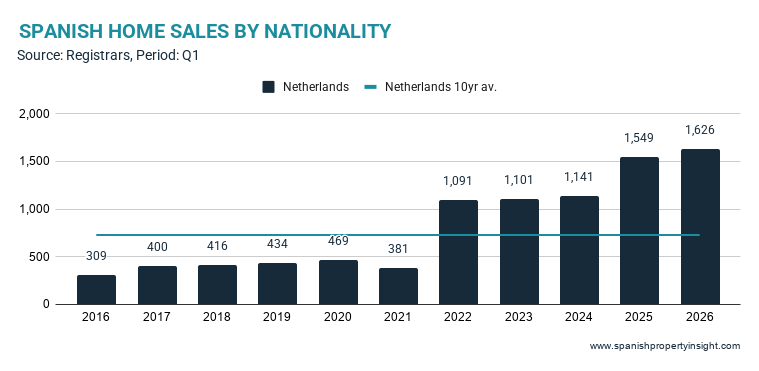
Dutch buyers continue to stand out in Spain’s foreign property market. The latest Land Registrar figures show demand from the Netherlands rising in Q1 2026, even as the wider foreign market declined.
Spanish property acquisitions involving a buyer from the Netherlands reached 1,626 in the first quarter of 2026, according to the latest figures from the Spanish Land Registrars’ Association.
That was up 5pc compared with the same period last year, whilst total foreign demand fell by 3.2pc. So Dutch demand clearly outperformed the wider foreign market in the latest quarter.
More strikingly, Dutch demand was 123pc above its ten-year average for the first quarter, making the Netherlands one of the strongest-performing foreign buyer markets in Spain.
More than five times higher than in 2016
Taking 2016 as a base of 100, the Dutch buyer index stood at 527 in Q1 2026. In other words, Dutch demand is now more than five times higher than it was in 2016.
That compares with 193 for the foreign market as a whole, underlining how exceptional the growth in Dutch demand has been over the last decade.
Market share hits a new high
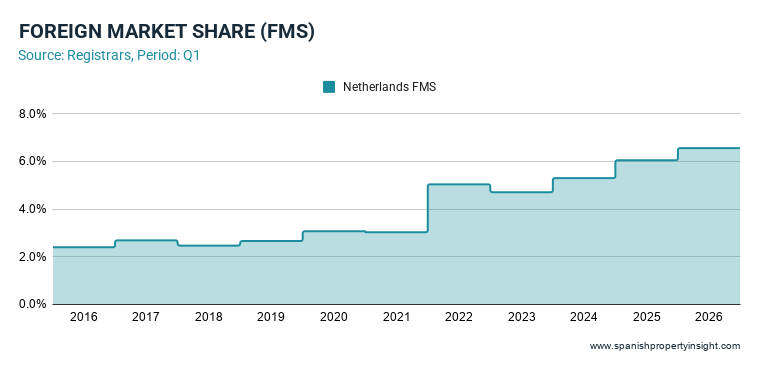
Dutch buyers accounted for 6.6pc of all foreign purchases in Q1 2026, compared with a previous ten-year high of 6.1pc and a low of 2.4pc.
That means the Netherlands has moved from being a relatively small source market to one of the most important foreign buyer segments in Spain.
The rolling trend is still positive
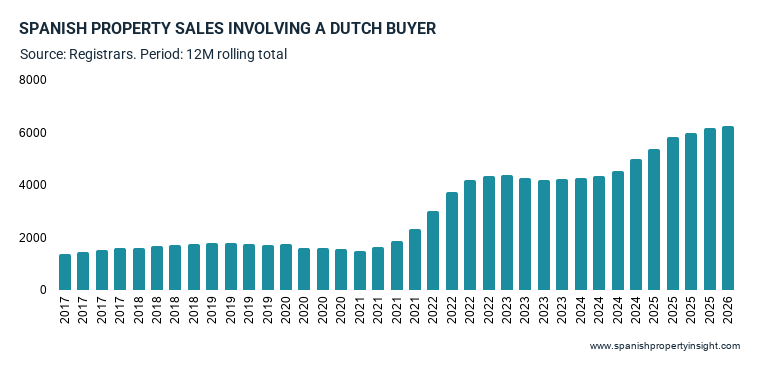
Looking at the four-quarter rolling total, Dutch buyers acquired 6,232 homes in Spain over the latest twelve-month period.
That was up 1.2pc compared with the previous quarter, suggesting the underlying trend remains positive, even if growth is likely to be less spectacular than in the post-pandemic surge.
Demand drivers
What is driving this growth in Dutch demand? Along side the usual ‘pull factors’ like Spain’s sunshine, quality of life, and lower living costs, there are some recent ‘push factors’ like a recent wealth tax on savings and investments (seen as punishing cash savers), elevated transfer taxes and regulations on second homes/investment properties, and an overall expensive/tight domestic housing market. These make buying or holding additional property at home less attractive, encouraging capital flight and diversification into Spanish real estate as a lifestyle asset less burdened by Dutch fiscal pressures.
The takeaway is that Dutch demand remains one of the bright spots in Spain’s foreign buyer market. Whilst some traditional markets are cooling, Dutch buyers are still expanding their presence, supported by lifestyle demand, remote working, fiscal policy back home, and Spain’s relative value compared with property prices back home.