BIC
Endangered Heritage: Why Spanish Palaces Are Collapsing

On September 1, the small town of Almazán, in Spain’s Soria province, found itself robbed of a large portion of its heritage. A section of the palace of the Hurtado de Mendoza family collapsed. Twenty days later a further section fell into ruin, prompting an emergency intervention. The disintegration of part of the façade, the gallery and the roof has affected the interior of the 15th-century Gothic building in which the Catholic Monarchs once temporarily took up residence. It is not the only palace that has crumbled. Its decline flags up an increasingly prevalent phenomenon in Spain.
“There have been many palaces and historic houses that have fallen into disrepair after being uninhabited, rented or sold for a use at odds with their historical dignity,” says María José Martínez Ruiz, a professor of art history at the University of Valladolid, who speaks of “a sad process” that began in the 19th century, with an aftershock in the 20th. “Many of the evils that the architect Chueca Goitia analyzed in 1977 were also those of the [Franco] dictatorship and the race to development,” she adds.

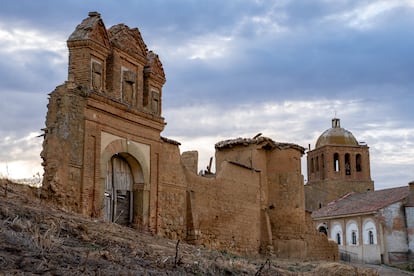
This descent into ruin has been accelerated by neglect, rural depopulation and a lack of funds. As a result, hundreds of historic buildings, many of them built during the 15th and 16th centuries when the nobility thrived, risk disappearing altogether. The Hispania Nostra association includes 123 of these buildings on its Red List, which brings together serious examples of reported deterioration.
Professor Martínez Ruiz has investigated the reasons behind the decay of 100 buildings throughout the country, traveling back in time to the origin of the problem. While the seat of the Spanish monarchy remained itinerant, the nobility built their residences wherever the monarchs happened to be. “The definitive establishment of the court in Madrid was the first step towards the decline of certain properties throughout Spain, abandoned by the families who owned them,” she says.
The houses that the nobility had built to show off their prestige ended up being used for the most incongruous of purposes. “They were used for coal storage, as agricultural estates and warehouses,” says Martínez Ruiz.
Then an even more painful phenomenon emerged. “Dealers and agents from national and international antique businesses gathered like flies to honey around the palaces and the heirs to old noble mansions to get their hands on the treasure within,” says Martínez Ruiz, one of the top scholars on the plundering of Spain’s heritage.
It is not only that the properties were sold to extract their works of art. They were literally “liquidated as a quarry of materials,” she says, referring to the dismantling of features such as wooden beams, doors, bars, doorways, windows, stairs and balconies.

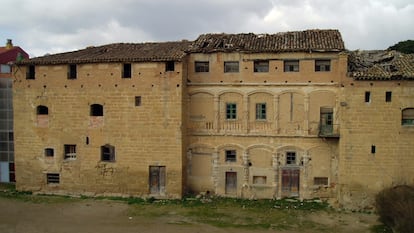
This happened on numerous occasions. Martínez Ruiz highlights the case of the palace of Torrijos in Toledo, where “nothing remains” after the sale of its features was even promoted in a magazine. In Curiel de Duero in Valladolid, the public auction of the most sought-after elements of a historic Mudéjar-style house was advertised in the local press.
The plundering and the sales are now a thing of the past and the challenge is different. “When people leave, it is difficult for the buildings to be maintained,” says the architect Fernando Cobos, a specialist in the recovery of historic buildings. He says that hundreds of old homes that belonged to the nobility are currently in danger due to depopulation – some of them, in a particularly vulnerable situation.
“In Tierra de Campos, the buildings were luxurious, but they were built with adobe,” says Cobos, alluding to a region shared by four provinces in Castile and León, where the lack of maintenance is striking even though its buildings have been standing for 500 years. “When they lose the roof, the water does a lot of damage to the mud brick wall,” he says.
This is the case in Villagómez la Nueva in Valladolid, a town of just 50 inhabitants where a 15th-century palace has been gradually collapsing. “There is still some of the façade left, but it is deteriorating very quickly along with the adobe walls,” says the mayor, Laura Fernández, who has witnessed since she was a child the decomposition of a structure where the Villagómez’ coats of arms can only just be identified.

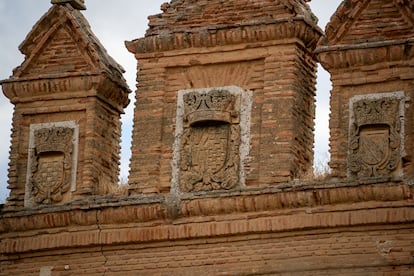
While saving the property is still possible, and the owners are willing to cede it to the municipality, Fernández points out: “If I manage to sort this heritage for the town, I may be leaving the people here with a problem.”
An architect by profession, Fernández does not know if the next mayor will share her feelings towards the building. “An institution like the Provincial Council of Valladolid should be in charge, not just because it has the capacity, but to give continuity to the long-term project that its conservation requires,” she says.
Fernández points to the lack of resources that prevents the municipalities from guaranteeing the maintenance of their heritage, whether they have 50 residents or 1,000. This is the case in Casalarreina, which has a population of 1,119, where they want to restore the 16th-century Palace of the Condestables, residence of the powerful Fernández de Velasco family, which is now in the throes of collapse.
“It is the oldest civil building in the municipality, it has a high emotional value for all of La Rioja Alta,” says the mayor, Félix Caperos, who is patiently waiting for the opportunity to acquire it, though he has his misgivings. “We cannot mortgage the present for a building that can also lead us to ruin,” he adds.
When Caperos was a child, the mansion belonged to several families. A carpentry shop and a cellar were the last signs of activity. Then it was left empty. In 2007, a business group reached an agreement with the owners and bought it, with the intention of transforming it into a hotel. But the 2008 economic crisis and the collapse of one of the façades paralyzed the project.
Caperos then began a long battle to demand conservation measures from the company, even resorting to the regional government of La Rioja to shore up his demands. “We managed to get them to shore up the walls and put a cover over it, after the region threatened them with criminal action,” he says.
During the past 20 years, the Palace of the Condestables project has shifted from being one thing to another without a single stone being moved. “It was all a lie, they have deceived us like rabbits,” says Caperos. Faced with the latest idea of converting the palace into vacation rentals, the mayor sounds resigned: “Anything is preferable to the collapse of the building,” he says.
“Civil architecture is the big forgotten element of rural towns,” says the architect Alberto Sánchez, referring to the fact that most Spanish palaces are not designated assets of cultural interest (BIC). “In the United Kingdom, the ancestral home is a focus of devotion among the nobility, and getting rid of it is akin to disgrace,” says Sánchez, adding that, in Spain, “the great Spanish lineages have gotten rid of them.”
The architect expresses regret that erstwhile luxurious historic buildings are now paying the price in territories he knows well, such as Aragón or Castile-La Mancha. He flags up the example of the palace of the Viceroy of Manila, in Molina de Aragón in Guadalajara, and that of the Marquis of Villa Antonia, in Calatayud in Zaragoza, both of which are in poor condition.
To demonstrate that “this heritage can be rescued and turned into an engine of economic growth,” the architect acquired one of these buildings in his hometown of Used in Zaragoza with the aim of restoring it. For now, his effort seems like a drop in the ocean. Sánchez says that “when a tile or a piece of the façade falls, demolition is immediately on the cards.” This is due to the fact that “the Provincial Council of Zaragoza offers financial aid for demolition, but not for conservation.”
If, contrary to the expression “noblesse oblige,” the nobility is no longer obliged to take care of its heritage, it seems that royalty is not either. The most palpable proof of this is found in Segovia, about five kilometers from La Granja de San Ildefonso: “It is surviving in an absolutely regrettable way, totally plundered,” says architect Pablo Gárate, referring to Valsaín Palace.
Gárate flags up how the monarch Philip II transformed this Renaissance complex into a laboratory for his travels and personal passions in the 16th century. He built glazed galleries which he had seen in England, an elevated promenade in the Hispano-Muslim tradition, and steep slate roofs, characteristic of Flanders, to fend off damage from the snow.

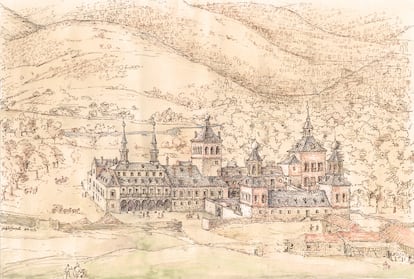
“The king was very happy there, first with Isabella of Valois, then with Anne of Austria,” says Gárate. On the other hand, the monarch’s heirs, Philip III and Philip IV, did not care about the palace. Finally, Charles II “organized a party in which there was a fire and a large part of it was burned, especially the roofs,” says the architect.
The Bourbon dynasty set its sights on La Granja de San Ildefonso and abandoned Valsaín to its fate. Already in decline, the building passed from the royal family into private hands. The abandonment seemed irreversible. Currently, the building is half-buried. “Only the main portico remains, the entrance to the stable courtyard and the new tower, the last one to be built,” says Gárate. Now, there are “some absolutely unworthy tin shacks that cover practically the entire palace.”
When Pablo Gárate looks at the ruins, he feels devastated: “I feel incredible sadness at the lack of respect that is shown in this country to everything we call culture,” he says.
Despite cases as devastating as that of Valsaín, alternatives such as consolidation, restoration and the search for new uses are still viable for hundreds of buildings. “We must do everything possible to protect and maintain what represents us,” says Professor Martínez Ruiz. And when that is not feasible, there is still a pending task, as Fernando Cobos points out: “At least, evidence of our past should remain.”
Sign up for our weekly newsletter to get more English-language news coverage from EL PAÍS USA Edition