
Donald Trump
Fear Of ICE Pushes Washington DC Daycare Workers Into Hiding


It’s about 10.30am, time to take the children out for a walk. The teachers settle the youngest into double strollers and take the older ones by the hand. Then they walk down the narrow, tree-lined street where Delia’s daycare operates, in a residential neighborhood of Washington, D.C. It won’t be a long outing. Since President Donald Trump stepped up his offensive against immigrants in the capital last year, the daycare workers — all vulnerable to deportation — avoid going very far. They used to take the children to the neighborhood public library, the capital’s free museums or the zoo. Now they have gone nearly a year without doing so.
The fear of being detained by agents from U.S. Immigration and Customs Enforcement (ICE) shapes their daily lives. Delia — the name was changed to protect her identity — has hardly left the house for months, watching out for WhatsApp alerts about immigration sweeps in the area. “We have examples from our own teachers: if two were walking together they would take one and leave the children with the other.”
Faced with that risk, she drew up “a plan” with the caregivers: the one who isn’t arrested must notify the children’s parents and contact her. She says she’s willing to risk the life she built over 20 years in the United States to protect her employees.
“I tell them: ‘If we’re found on the street and detained, don’t worry — I will turn myself in first.’”
The WhatsApp group that tracks ICE
At the start of his second term, Trump again targeted “sanctuary cities,” which limit cooperation with immigration authorities. Washington, D.C. was particularly exposed: unlike states, the district does not have the same protections over its autonomy. The net tightened around the capital in August last year, when the president deployed the National Guard, temporarily placed the local police under his command and declared a crime emergency, despite official data showing a decline in violent crime.
What followed was a wave of arrests that exceeded 1,500 detentions between August and November 2025, according to Relevant Research, a private firm led by Austin Kocher, an assistant professor at Syracuse University and an expert on the U.S. immigration system. A year earlier, in the same period under Democratic president Joe Biden, the figure had been seven arrests.
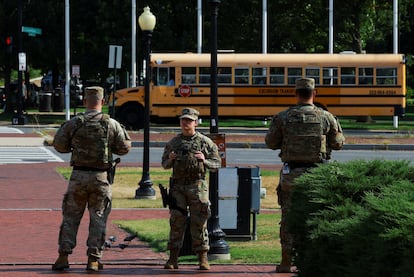
In December 2025, a judge limited warrantless arrests in Washington, and detentions in the capital fell. Even so, the strong federal presence keeps the immigrant community on edge. And the deployment will be reinforced this summer for the celebrations marking the 250th anniversary of U.S. independence, with measures that include doubling the number of Homeland Security Investigations (HSI) agents, a division of ICE, according to Gadyaces Serralta, director of the U.S. Marshals Service.
Under this climate of harassment, immigrant workers like Delia — who provide an essential service for D.C. families — have been forced to operate in the shadows. As early as June last year, she removed the sign at her entrance that identified her business: “Hiding like this makes me feel bad. Telling my teachers: ‘Let’s put it away,’ as if we were criminals, when we are only educating children for this nation’s future.”
Two months later, María also removed the sign with her daycare’s name. Her center is a few blocks from Delia’s; years earlier Delia had given her a first chance as a teacher. Although María is a lawful permanent resident, she asked to have her name changed out of fear that ICE agents could show up and arrest her four workers, who do not have legal status.
One of her caregivers lives in Maryland, a neighboring state, and drives to work every day, fearful of being intercepted and detained: “She always tells me: ‘My biggest fear is not being able to get home, that my child is waiting for me at night and finding out they have arrested me,’” María says.
This teacher is part of a WhatsApp group with nearly 670 members that shares real-time alerts about ICE presence in the city. On May 19 alone, EL PAÍS reviewed dozens of messages, photos and videos shared in that space. Among them, a woman said she had seen one of the vans supposedly used by agents: “My legs are a little shaky.”
Undocumented migrants who sustain childcare
The childcare and early education industry in Washington relies heavily on immigrant women: here, about 40% of early childhood workers are immigrants (both documented and undocumented), nearly double the national average. The figure is part of a state-by-state analysis that the Center for the Study of Child Care Employment at the University of California, Berkeley published in 2025 using Census data.

For Hannah Oppermann, senior analyst at the National Women’s Law Center (NWLC), who specializes in state childcare and early education policies, this sector is a key piece of the capital’s economy. “In Washington, D.C. most childcare services are required to be regulated: there are caregivers who look after children in their own homes, centers with many children, and all those spaces are critical for the city to keep functioning.”
At the entrance to her daycare, Delia has posted her early childhood education certificates and those of her workers. She also displays her license to operate what in D.C. is known as a ‘home daycare’: a childcare center that operates within a family residence. She lives there with one of her children and her husband, who once a week plays guitar and harmonica for the nine babies and children who attend the center. Until May, he also worked nights as a busser in a restaurant. He stopped going for fear of running into ICE agents and now delivers orders for Uber Eats.
Her studies, which include a two-year technical degree and English courses, are the result of a great effort to fulfill her dream of working in early childhood education, a calling she felt at a young age and which led her on an exhausting journey to the United States. To cross Mexico, she had to hide for three days inside a trailer with some 70 other migrants. She carried only some cookies and a canteen of water. “Many people fainted, others had to relieve themselves in there because it was a long trip.” She says she would not do it again.
It was so hard for her to get where she is now that she now devotes herself to training and helping others. She is known in the neighborhood as a sort of fairy godmother: she has guided more than five former employees who later set up their own home daycares.
Former and current parents of the center also say they are very grateful for the dedication with which Delia and her team care for their children. They fear they will be arrested. “It would be a devastating blow if they were affected,” a parent who used to leave their child with Delia tells EL PAÍS in a WhatsApp voice message. “(Being) our only child, our first child, we had a higher level of anxiety (…) and the way Delia and her team worked gave us confidence.”

Delia, who tries to limit trips outside the home to go to church or for medical appointments, hopes she won’t have to keep hiding, or have to conceal the daycare she is so proud of. “I’m going to celebrate the day I put my ‘banner’ on my house wall, saying I am a high-quality program here in D.C.”
Sign up for our weekly newsletter to get more English-language news coverage from EL PAÍS USA Edition








Donald Trump
Life In A ‘persecuted’ Migrant Community In Texas: ‘For Us, A Police Officer Is An Enemy’

Lidia and her family have become increasingly isolated at home as more neighbors are detained by local police or immigration agents. She used to walk for an hour every afternoon, going peacefully to the doctor, to do the shopping, or to take her mother-in-law to church. Not anymore. She doesn’t trust the police either: if she were in a car accident, she’d rather arrive home safely in the damaged vehicle. She lives in Colony Ridge, an immigrant neighborhood 40 minutes from Houston, which for years has been targeted by conservative politicians — including Texas Governor Greg Abbott — who consider it a magnet for undocumented immigration.
Since Donald Trump took office again in January 2025, for Lidia, those arrested in her community went from being someone’s acquaintance to being her own neighbors and friends. She recounts how the father of the family across the street was arrested and deported to El Salvador a few weeks ago; the house was abandoned as everyone subsequently left. Her neighbor on the corner was hit by a car on a nearby road and the police, instead of helping her, demanded her immigration papers and, since she didn’t have any, turned her over to Immigration and Customs Enforcement (ICE). Her 13- and 20-year-old children were left alone. A friend of her husband was also detained, and Lidia never found out if he got to try the goat meat she had just cooked for him.
“Now, when you see a police officer, you go around praying, ‘Lord, make me invisible to the enemy.’ We no longer see the police and think, ‘I’m safe.’ No. Now, for us, a police officer is an enemy,” says Lidia. That’s not her real name. She agreed to speak only under a pseudonym because she’s afraid of being recognized and detained by immigration authorities. Other residents of this community preferred not to share their stories for the same reason.
While she was talking, Lidia called a neighbor whose children were detained three days before Thanksgiving in 2025: one has already been deported to Mexico and the other has been held in an ICE facility ever since. “We had never felt like this: persecuted, harassed,” says the Honduran woman, who has lived in the United States for 13 years, 11 of them in Colony Ridge.
And she’s not just speaking for herself. Lidia says her six-year-old godson cries if his mother hasn’t arrived home by 4:15 p.m. “He’s heard the police are going to take his mom away. He starts asking where she is. It’s psychological trauma. This man [Trump] doesn’t see what he’s doing. Children have the right to feel safe.”

In January 2025, when Trump returned to the White House, Colony Ridge residents walked the streets or did their shopping without fear. They thought they couldn’t be arrested because they hadn’t committed any crimes. At that time, they believed Trump’s promises, the then-Republican candidate having stated during the 2024 election campaign that he would deport “the worst of the worst” — the criminals. They didn’t feel targeted.
However, as the months passed and they saw ICE agents, state police, and highway patrol officers stop them for any reason whatsoever — for having a burned-out taillight, for carrying tools in the trunk of the car, or simply for looking Hispanic — that feeling changed. Some families chose to keep their children at home, while others sent them to school in Ubers; American neighbors began buying for the undocumented immigrants; and some even sold their land or transferred it to relatives with legal immigration status so they wouldn’t lose it in case of deportation.
In June 2025, Alejandrina Morales, a resident of this community, summed up the neighborhood’s feelings: “We feel like we’re being hunted just for looking Hispanic.” Her husband was detained by ICE agents at his own tire shop, and after his release, she said he was never the same again.
The conservative view on Colony Ridge
The members of this community don’t call it Colony Ridge. That’s the name given to it by the media and the governor. Its residents — mostly families of mixed immigration status — refer to the six neighborhoods where they live, which have been developed by Colony Ridge Land LLC since 2013, individually: Grand San Jacinto, the first one built; Santa Fe, Camino Real, Rancho San Vicente, Montebello, and Bella Vista.
These are plots of land on the outskirts of Houston, in northeast Texas, cheaper than in the city, with access to basic services, and where owners can build homes — with restrictions — or park trailers. Lidia has lived in this community since 2015. She remembers that for years it was a safe place, where it was normal to see children playing in the street.
The fear now felt by this community — located in a county where 33% of the population is Hispanic, according to the 2024 Census — is well-founded. Along with Florida, Texas is one of the states most committed to Trump’s policy of mass detentions and deportations. According to ICE records, nearly 400 state police officers have cooperation agreements with the federal agency to hand over custody of those detained or arrested without legal immigration status. Three of these officers serve Liberty County, where Colony Ridge is located.
Governor Abbott himself has referred to this community as a “sanctuary” for undocumented immigrants, a concept he condemns. He has also taken direct action against them. In February 2025, he announced on social media that Colony Ridge would be “the target” of a joint operation between local and federal authorities to detain immigrants: 118 residents were arrested. Since then, the streets of this neighborhood look much like that day in February, some days with more officers and police, others with fewer, but they are always patrolling.
Furthermore, for the past three years, undocumented immigrants living in Texas, and in this community in particular, have felt the shadow of a law that would allow state authorities to arrest, detain, and deport them. This is the controversial SB 4. The implementation of this legislation — which has been described as one of the “most extreme” against immigration — has been blocked by the courts on several occasions. The latest setback came last week when a district judge in Austin blocked some of its provisions, ruling that they “conflict” with federal agencies, the only ones responsible for enforcing immigration law in the U.S. It remains to be seen what further legal action the state will take in its attempt to implement it.

This combination of realities is what makes Lidia and the Colony Ridge community continue to add restrictions to daily life: “We are tied hand and foot right now, hoping that God will take care of us.”
The ‘nightmare’ of deportation
Lidia says that in conversations with her neighbors there is a recurring theme: the deterioration of the mental and physical health of many of them as a result of stress.
She has high blood pressure. During a recent doctor’s visit, her doctor told her that her blood pressure was higher than normal. Lidia explained that it could be due to increased anxiety and fear that keeps her from sleeping at night.
“I have nightmares every day,” she says. “I’ve dreamt that we’re being chased and that later, when we’re in Honduras and want to go back, we can’t; that our relatives don’t answer the phone or that the phone doesn’t have our family’s numbers saved.” These dreams have taken her and her husband back to their childhood homes, which are no longer even owned by their families.
Lidia says the family doesn’t know what to do. Some days they wake up certain they must sell all their properties in the community and leave for Mexico or Honduras, where they are originally from. Other days they feel they should stay and wait for Trump’s remaining years in office to pass.
While they decide, she says she will continue to support her neighbors in any way she can. At the beginning of the year, she helped with a fundraising raffle to buy plane tickets for three children who were left alone after their parents were deported. She recalls donating about three more times, whenever she can.
Although they have lost a great deal over the past few months, Lidia is glad that this time has brought them one benefit: “A community that has learned to stick together more closely.”
Sign up for our weekly newsletter to get more English-language news coverage from EL PAÍS USA Edition


Charl Kleinhaus’s life took a dramatic turn on May 12, 2025, when his plane landed at Dulles International Airport, in a suburb of Washington, D.C. He arrived with his two children and grandson. Waving an American flag and brimming with excitement, he had finally achieved his long-held dream: leaving South Africa.
Kleinhaus was one of the first 59 Afrikaners to enter the United States through the refugee program that President Donald Trump created. He welcomed white South Africans, while closing the doors to all other foreigners fleeing persecution or torture in their home countries. According to the State Department, from October 1, 2025, to April 30, 2026, a total of 6,069 refugees arrived in the United States. Three of them are Afghan. The rest are South African.
Kleinhaus, 47, is employed on a farm in South Dakota. He’s never had a job in agriculture before (he used to work as a stonemason on construction sites). Still, despite the difficulties of such a large-scale move, he’s confident that he’ll soon be able to start his own business in the country that has welcomed him. He never wants to leave.
“The people are much better than what I ever expected,” he gushes over the phone to EL PAÍS. What he values most is that the U.S. is a “Christian country, where you have rights — where it’s [fair] — no matter the color of your skin. You’ve got the same right[s] as everybody else,” he explains.
In the first few months after arriving, he couldn’t sleep. This was because there were no security bars on his windows… something he wasn’t used to. Kleinhaus says that, in South Africa, he feared for his life, which led him to apply for the refugee program as soon as he saw Trump announce it. He recounts how his neighbor was hacked to death with machetes: he cites this as an example of the persecution that, he claims, whites face in a country marked by the legacy of apartheid. The system of racial segregation and institutionalized discrimination against Black people was in effect in South Africa from 1948 until the 1990s, largely driven by the Afrikaner population.
The situation following the fall of that regime — with a majority-Black party in power and affirmative action laws instituted to compensate for the inequalities created by decades of discrimination, coupled with attacks suffered by white people — has led to talk of genocide. Trump, for his part, has used the term, referring to the brutal murders of white farmers in recent years as an example. But the reality is that violence in South Africa is widespread: analysts point out that most violent crimes occur in poor, predominantly Black areas, thus refuting the notion of a white genocide. The homicide rate per capita in 2022 was 43.7 per 100,000 inhabitants. In the United States, that same year, the rate was 6.5 per 100,000 inhabitants.

Preferential treatment
Trump froze the entire Refugee Admissions Program as soon as he returned to the White House. And, the following month, on February 7, 2025, the administration reinstated it… but only to accept Afrikaners, who are white South Africans descended from Dutch, French, and German settlers (although Indians and other mixed-race South Africans were later also admitted). Other foreigners — such as Afghans who had worked with the U.S. Army — were notified that their flights had been canceled. They were left in limbo, despite the fact that they had waited for years to be granted asylum and even had tickets to the United States.
At the time, Bishop Sean Rowe, head of the Episcopal Church, declared: “It has been painful to watch one group of refugees, selected in a highly unusual manner, receive preferential treatment over many others who have been waiting in refugee camps or dangerous conditions for years.”
During Joe Biden’s administration, approximately 125,000 refugees were admitted annually to the United States. But last September, the Trump administration announced that the quota for fiscal year 2026 (from October 1, 2025, to September 30, 2026) would be 7,500, with the spots “primarily allocated to Afrikaners from South Africa.”
Recently, Reuters and The New York Times reported that the Trump administration intends to double the number of white South Africans in the refugee program. According to The New York Times, the administration plans to declare an “unforeseen emergency” to attract more Afrikaners. This would represent a radical shift away from a program that was originally created to welcome people fleeing wars, famines, and natural disasters worldwide, transforming it instead into a channel primarily for white people seeking to live in the United States.
“It is ironic that the executive order makes provision for refugee status in the U.S. for a group in South Africa that remains amongst the most economically privileged, while vulnerable people in the U.S. from other parts of the world are being deported and denied asylum despite real hardship,” the South African government noted in a statement.
The killings of white farmers in South Africa represent less than 1% of the more than 27,000 annual murders that occurred between 2023 and 2024 across the country, according to Afriforum, a non-profit organization. Experts say that these deaths don’t constitute genocide. There are approximately 2.7 million white Afrikaners in South Africa, while roughly 80% of the population is Black.

An unexpected welcome
Some of the Afrikaners who have entered the program report suffering the consequences of having been chosen over other nationalities. Johanna (a pseudonym, because she fears reprisals) arrived in the United States this past March with her three children and her mother. Her experience has not been what she expected.
“I’m experiencing persecution by my supervisor, my agency… this is more because they’re Muslims and I’m a woman, so I’m experiencing this on a daily basis. And my caseworker for the [Matching Grant Program] is a Black man from the Ivory Coast. And it’s difficult. These people, they’re furious with the administration, because all other immigrants are blocked [from coming] in, so all their family and friends are outside the country. So now, [they] take this out on us,” she explains by phone from Florida, where she now resides.
Johanna applied to enter the U.S. through the program as soon as it was announced because “if we had stayed in our country, sooner or later, they would have ended up killing us all,” she says. Her experience in the United States, however, hasn’t been as positive as Kleinhaus’s. She lashes out at the resettlement agencies contracted by the government to help refugees during their first few weeks in the country. “Everybody back home thinks this is just the best thing ever. They [think that they’re] going to get here, they’re going to get [a] nice place to stay, they’re going to get furniture, they’ll get all the food [they need]… but that’s not the case,” she sighs.
Johanna recounts that, upon arrival, the agency housed her in a dangerous neighborhood, where one of her compatriots was stabbed. “Since I arrived, we’ve been placed in a Black motel. They wanted to place us in a Black neighborhood. They wanted to put my kids in a Black school. And I just said, ‘Listen, this is what I fled from. How can you do this to us again?’ We couldn’t sleep at night, as the people in the motel [were] fighting and [there were] drugs and prostitution… the police [were] in and out of there,” she recounts.
While she acknowledges that other Afrikaners have had better experiences, she complains of corruption in many of the agencies tasked with helping them. In her case, an agency managed the allocation of $2,450 (per person) provided by the government for a period of 90 days. After 28 days, however, the agency informed her that the money had run out, between payments to the motel and the security deposit for the house where they were going to put her family (without her consent). She was also unhappy with the food and furniture that was purchased for them with the allocated funds, which was done without her input.
Through a Facebook group of fellow South Africans, she managed to rent a house elsewhere, but she’s still worried about her financial situation and finding employment. “You must go and pack shelves, or you must work in a garden, or whatever. Then, you work for their friends (referring to employers who are connected to the agency) and then they pay you like minimum wage, so you cannot survive,” she says.
Johanna says that she’s in a difficult situation. On the one hand, she wants to warn people about the problems they’ll face upon arriving in the United States… but, on the other, she doesn’t want to discourage her compatriots, since her goal “is to get all my people here as soon as possible and in as many numbers as possible.”
Shelly Hepburn is intimately familiar with the hardships faced by those who have felt disillusioned upon arrival. Years ago, after watching a documentary about the violence in South Africa, she decided to help Afrikaners seeking asylum in the United States. Divorced and with two grown daughters, she took in several families. Over four years, she housed about 15 people. She offered each family free housing for seven months and provided them with support to get by. Although she paused the program for a few years, she maintained a Facebook page to help them. When Trump announced the refugee program, she shifted the focus of her page to assist those admitted under it. In Connecticut, where she lives, there are a dozen South African families whom she stays in touch with. She supports them by delivering food and relocating them to safe areas.
“We’ve had good experiences. People are doing great. Their feeling of safety and freedom… they haven’t felt [it] ever. And they’re getting in touch with their American community, they’re becoming one with their community. And then, you have the bad stories, where the [resettlement] agency is pressuring them, lying to them, putting them in housing that’s filthy, [rundown], dangerous,” she explains.
In recent weeks, it has come to light that at least four beneficiaries of the refugee program have returned to their countries of origin for various reasons. Most, however, will not return. “My son and my grandson will enlist in the army; they will go to war to defend this country,” says Charl Kleinhaus proudly.
Sign up for our weekly newsletter to get more English-language news coverage from EL PAÍS USA Edition

When Christine Lagarde addressed a central bank conference late last year, her frustration was clear. Europe had been debating a digital euro for years, but it was still nowhere close to being done.
Progress was so slow that it was likely her eight-year term would be up before the project saw the light of day. “This is too long,” she said. “We don’t want to be left in the dust.”
In the months since, the sense of urgency has increased among European officials. But with the first issuance of a digital central bank currency expected only in 2029, and delays still cropping up, so have fears that the bloc may have already fallen behind.
The European Central Bank president’s push is about far more than jumping on the digital currency bandwagon or creating a new crypto toy for speculators. It’s part of a broader geopolitical effort for independence and autonomy, where the bloc is less reliant on others and can reduce exposure to major economies like the U.S. and China.
It also aligns with the ambition of some euro-area officials to strengthen the global role of the euro. In Donald Trump’s unpredictable policies, they see a threat to faith in dollar stability and a chance for the single currency.
The slow headway so far is to the benefit of the U.S. and so-called dollar hegemony. In Washington, Trump’s pro-crypto administration has thrown its weight behind stablecoins, a type of cryptocurrency typically pegged to a fiat currency and backed by reserves of liquid assets. The dollar is by far the dominant force in that world.
Banks in Europe have also started to wake up to the threat of America taking an unassailable lead in the race to control the future of money. Some argue that the digital euro isn’t the only solution, and are pushing their own euro-denominated stablecoins. They also say they can be up and running faster than the ECB.
“We are here now and stablecoins are ready to go,” said Jan-Oliver Sell, chief executive of Qivalis, a consortium including big-name banks like ING Groep and UniCredit SpA, which plans to issue a coin later this year.
Europe is already vulnerable on multiple fronts, from energy to critical minerals to weaponry, which hands others leverage to exert influence. It’s also heavily dependent on US companies for its payments systems, yet another worry.
“If we lose control of our money, we lose control of our economic destiny,” ECB Executive Board member Piero Cipollone, who leads the institution’s digital project, said earlier this year. “We surrender a key attribute of sovereignty.”
Warnings
The blunt warnings about sovereignty look to be getting through to politicians, who have begun to push the digital euro topic up the priority list.
But it’s still a slog through European Union bureaucracy, disagreements over regulation, and battles between competing national interests. A European Parliament committee vote expected to take place this month has been postponed until at least June.
Banks have also lobbied against the digital central bank euro, fearing an erosion of their deposit bases.
Now, many lenders are pushing harder into stablecoins. Societe Generale SA was among the first, launching EUR CoinVertible through its digital asset unit in 2023, while another is backed by asset manager DWS Group, market maker Flow Traders, and crypto firm Galaxy. Qivalis emerged in late 2025, and participants now include BBVA SA and BNP Paribas SA.
While such private initiatives in one sense rival a central bank-backed digital euro, Qivalis sees it differently. It’s all part of a so-called payment stack ranging from central bank currencies to digital tokens to stablecoins, with the ultimate aim being independence.
“We see ourselves solving that problem,” Sell said. “The European answer to that digital dollar dominance problem.”
Unease about dollar dominance is being inflamed by Trump’s confrontational approach to international relations.
This isn’t an abstract fear. Europe’s leaders have seen firsthand how weak a position they are in when it comes to key resources. Late last year, it was Nexperia and China’s restrictions on computer chip supplies vital for carmakers. Right now, it’s the disruption to oil and gas because of the conflict in Iran, an echo of the inflation shock that followed Russia’s invasion of Ukraine in 2022.
The euro is the world’s second-largest reserve currency, though it trails well behind the dollar. A meeting of euro-area finance ministers late last year featured a heated debate around whether stablecoins would increase the greenback’s dominance, and what, if anything, Europe should do in response.
The ECB, favoring a digital central bank currency, had already fired a pre-emptive strike, pushing to ban so-called multi-issuance stablecoins. These are issued in multiple jurisdictions, which the ECB says raises concerns around supervision and contagion risks. At the meeting, some countries argued against this ban, claiming that Europe was fighting a battle it had already lost.

The US’s stablecoin push was formalized through last year’s GENIUS Act, legislation for dollar-linked tokens aimed at providing a framework for the new form of money.
“The U.S. is using regulation to shape innovation in ways that reinforce existing monetary arrangements,” Barry Eichengreen, an economist at the University of California Berkeley, wrote recently in Intereconomics, a European policy journal.
Stablecoins offer what’s effectively a 24/7, low-cost and instant dollar-based banking for anyone, anywhere in the world. As they spread beyond crypto markets into real-world payments, Trump sees them as a way to extend the U.S. currency’s influence. Of the $322 billion in stablecoins in circulation, roughly 99% are pegged to the greenback.
That’s also created demand for U.S. government debt. Figures from El Salvador-based Tether, which issues the world’s largest stablecoin, USDT, show it holds about $117 billion worth of Treasuries.
Last month, French Finance Minister Roland Lescure said the stablecoin market has been “overwhelmingly dollarized,” and spoke of strengthening sovereignty “and the role of the euro in the global economy.”
In February, European Parliament lawmakers gave their backing to the ECB’s project, saying it’s “essential to strengthening EU monetary sovereignty.” Spain has since pushed for a faster rollout than the 2029 date, saying the advance of U.S. stablecoins means there’s a greater urgency.
A delicate relationship
Europe is already heavily dependent on US firms for the plumbing behind the payments people make in their daily lives. That ranges from card transactions processed by Visa Inc. and Mastercard Inc. to mobile wallets provided by Apple Inc. and Google.
Currently, nearly two-thirds of euro-area card-based transactions are processed by non-European companies. As cash usage continues to decline, growth of stablecoins could add a new layer of reliance.
“You need to think about stablecoins as the payments rails of the world of the future,” said Marieke Flament, co-founder of Currency of Power, which advises governments and financial firms on digital money. “If you are not building the rails for the euro to be on in the future, then the euro might not exist.”
China, Russia, and Iran are also pushing ahead with versions of digital money or taking advantage of existing crypto assets to bypass traditional banking rails and controls, further underscoring the broader geopolitical contest taking place.
Russia has firsthand experience of being shut out of the global payments infrastructure. Its access was restricted after the invasion of Ukraine in 2022, inflicting an instant blow to the country’s economy.
“The rapid weaponization of SWIFT and card payment networks against Russia, as well as the growing use of geoeconomic tools by the Trump administration, helped raise awareness of the EU’s dependencies in financial markets,” said Nicola Bilotta, coordinator of the EU Supervisory Digital Finance Academy. “If systems such as Visa and Mastercard were to be weaponized, the EU would need an alternative infrastructure that is readily available and usable.”
Visa and Mastercard both said they have made long-term investments in Europe and are committed to the region.
Meanwhile, Lagarde keeps pushing. Last week, she repeated that the digital euro “will enhance Europe’s strategic autonomy.”
Conscious of the ticking clock, the ECB has also launched a wholesale digital currency initiative designed to modernize interbank settlement and support tokenised money for use between large financial institutions.
But it’s playing catch-up. At the signing of the GENIUS Act, Trump said it would “secure the dollar’s status as the world’s reserve currency for generations.”
“There has to be a realization that digital money isn’t about crypto libertarians trying to bend financial regulation or overtake banks,” said Andrew Whitworth, founder of fintech and crypto consultancy Global Policy. “It’s actually about the sovereignty of your economy. It’s a geopolitical issue.”
Sign up for our weekly newsletter to get more English-language news coverage from EL PAÍS USA Edition

E

New EU Rule Prepares Cars For Alcohol Tests

S


-

 Competiciones3 weeks ago
E
-
blackout April 20253 weeks ago
Insurance company Mapfre decides to pay out €14 million compensation for 2025 blackout
-
 Foreign demand3 weeks ago
Who Bought Where In The Second Half Of 2025?
-

 New Developments3 weeks ago
Stylish 3-Bedroom Apartment With Panoramic Sea Views – Benalmádena
-

 New Developments3 weeks ago
Inside The Most LUXURIOUS Apartment Building In Spain!
-

 New Developments3 weeks ago
Luxury Villas For Sale, Estepona – ProjectL1
-

 America3 weeks ago
E
-
Costa Blanca South3 weeks ago
Alicante police chief to retire after 17 years of service