Claudia Sheinbaum
Final Countdown To Defuse Protests Against Mexican Government Ahead Of World Cup Opening Game

Only 24 hours remain before the World Cup kicks off in Mexico and the country is going though its final dress rehearsals. Preventing demonstrations on opening day is already a pipe dream: negotiations with teachers have stalled and search groups will march to make their missing relatives visible. With everyone in position and the cards on the table, attention is focused on avoiding the worst-case scenario for the government of Claudia Sheinbaum — an image of a police officer striking a teacher circling the globe on the day the country is playing for its international image. The concern is not unfounded: on the first day of protests a teacher lost an eye in clashes with police. The past two weeks have tested containment measures, and Wednesday will be the last chance to fine-tune the public staging. To ease the pressure, authorities have canceled classes for Thursday and ordered remote work for public servants.
The opening match will be the first of five games played in Mexico City. There are 13 matches in total across the country, which is expected to receive more than five million fans, according to official forecasts. The government is banking on World Cup fever to dilute the complaints. The tournament — the third to be hosted at Estadio Azteca — has acted as a catalyst in a country riven by social crises. Thousands of teachers — 10,000 according to the union, 3,000 according to the government — have camped in the historic downtown for two weeks with the same demand they made 18 months ago: a return to public pensions, a request the government considers unworkable. After 50 working tables, neither Rosa Icela Rodríguez nor Mario Delgado, the Interior and Education secretaries leading negotiations, have managed to stop the National Coordination of Education Workers (CNTE) from returning to the streets, despite warnings given a year ago. So far, the massive police deployment has prevented them from reaching Estadio Azteca and the Zócalo, where the president had planned to attend the opening match — now uncertain and pending the protest’s evolution.
Collectives that search for the disappeared have also announced marches for this Wednesday and for Thursday morning. It was the last recourse they had left. Mothers have already put their children’s faces on national team shirts, in a sticker album, on banners along avenues — they have done everything to force people to look into the eyes of the roughly 133,000 people who remain unaccounted for in the country. The opening date is their last spotlight. At the last minute, a protest for judicial independence in the city’s south and a contingent of Ayotzinapa students — who arrived on Monday with explosives that were confiscated — also joined them. The government has managed, however, to halt the powerful farmers’ front, which told EL PAÍS that it has given the executive this week’s breathing room because talks with the new head of the Agriculture Secretariat are on track.

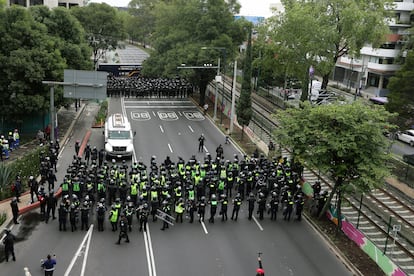
With the Colossus of Santa Úrsula sealed off for a one-kilometer radius, Sheinbaum’s government will focus on keeping all elevated roads leading directly to the stadium open. Authorities will allow entry to this last protected stretch from 6.00 a.m., that is, seven hours before kick-off. “Fans’ access is guaranteed. We only ask that they arrive early. If someone wants to arrive at the last minute, they may face more complications. Be more prepared — that’s what we ask,” Mexico City’s secretary of government, César Craviotto, said on Tuesday. With the planned marches and tourists in the capital, authorities are now relying only on peaceful coexistence. The aim is to contain, not confront. The president has repeatedly said during her morning briefings that the right to protest is guaranteed and that her government will never punish public demonstrations. Sheinbaum is less concerned about Tlalpan Avenue being closed than about Mexico projecting an image of repression before Shakira takes the stage.
Teachers explode, countryside concedes
Over the past year Sheinbaum has faced two major domestic challenges: the organizing power of the CNTE and the farmers’ pressure on the highways. The government has chaired one negotiation table after another for months to prevent unrest from getting out of control, but the results have been mixed. While teachers press in the streets to unblock their main demand — the return to public pensions — the countryside says it is tentatively satisfied with the course of talks. “We don’t feel completely attended to, but we do feel we will make progress,” says Eraclio Rodríguez, one of the leaders of the National Front for the Defense of the Countryside, which has granted the government the enjoyment of the opening match, though it does not rule out mobilizations afterward.
Interlocutors play a different role in each case. While teachers point to dissatisfaction with the proposed measures — the latest being to strengthen the only public pension fund and create a public insurer — the farmers’ representative speaks of a change “like night and day” at the Agriculture Secretariat, previously headed by Julio Berdegué and now by his former undersecretary, Columba López. “We are doing better, things are going well,” Rodríguez says, contrasting that with the difficulties they face with the economy minister, Marcelo Ebrard. The picture changes on the teachers’ side. “This is not a personality issue. She [Rosa Icela Rodríguez] has the disposition. They are decent people, they have treated us well; the problem is substantive: they are not proposing to repeal the ISSSTE law (which governs public-sector retirement),” summarizes Pedro Hernández, CNTE’s general secretary in Mexico City.
The head of the public body, Martí Batres, and Sheinbaum herself once mobilized in the streets in the same way they are now. They know each other, they are the same people on both sides, and, broadly speaking, they respect one another. That adds a layer of complexity to negotiations, but it does not resolve them. “They have a history of fighting for rights. Sometimes power makes you forget that. We would think that sympathy should favor negotiation frameworks,” the union leader laments.
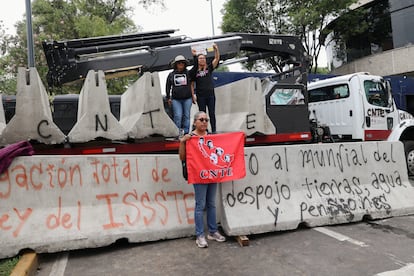
Disappointment has spread through the most radical sector of the teaching ranks while the government bets on fatigue and a deterrent police presence in mobilizations that always manage to secure some additional measure, but never the one they want. According to the government, a return to public pensions would require a disbursement equal to 20% of national GDP — an interpretation teachers reject and one that has driven them to escalate tensions on the eve of the tournament’s opening. It is unclear which side time will favor once the collective euphoria takes hold of the national mood.
The disappeared, a perpetual crisis
Among all of Mexico’s crises there is an old lament: a country where, government after government, thousands go missing and no authority halts the tragedy. International bodies have described it as a humanitarian emergency, but inside the country it is so common that it sometimes goes unnoticed. Every World Cup venue has its square, its memorial to the disappeared, a space where families insist on leaving that reminder: many are still missing. So far Sheinbaum’s government has presented a package of laws and a reinterpretation of the missing persons registry, both heavily criticized by collectives. With the World Cup’s imminent arrival, the president stepped up the pace. “In recent months we have had meetings to build some improvements to the investigation protocol and the law,” says Jacky Palmeros, who founded the collective Una luz en el camino after the disappearance of her daughter, Monserrat Uribe, in 2020 in Iztapalapa, east of the capital: “But there is a lack of willingness and commitment.”
These meetings, however, have been accompanied by what the collectives define as “a new way of repressing and violating families”: removing the photos and banners of the disappeared as soon as families put them up. Faced with that scenario, they decided to march. “Our intent is never to sabotage the World Cup; it is not to prevent people from going, watching and enjoying themselves, only to make visible what you have so strenuously tried to hide. In that context, we ask that upcoming actions be respected,” Palmeros told Secretary of Government César Craviotto this week. “They told us we will not be able to approach, to make ourselves visible and to protest freely because they will close access to free movement,” the activist adds, saying there “is a feeling of hostility in the air”: “There is fear, I think, on both sides. No one knows what will happen. All that remains is to wait. Neither they nor we will change our minds.”
Sign up for our weekly newsletter to get more English-language news coverage from EL PAÍS USA Edition