expats
Foreign Demand Slumps As Spain’s Housing Market Cools In Q1
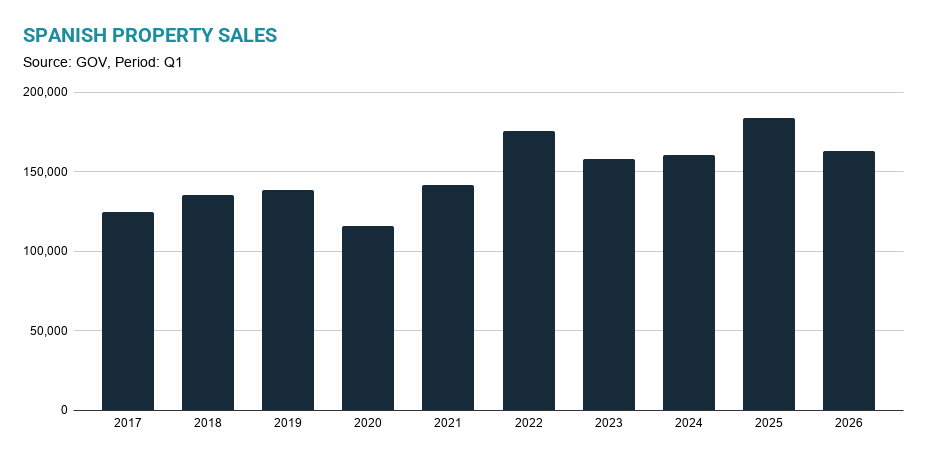
The first Housing Ministry sales figures of 2026 are now out, and they suggest the Spanish property market has shifted down a gear. Sales are still running well above long-term norms, but the market is cooling, with foreign demand weakening particularly fast.
These figures are based on transactions completed before notaries in Q1, making them the most up-to-date view we have of who is actually buying property in Spain this year.
The notaries’ figures published recently also pointed to a slowdown in sales, but they don’t break the market down by buyer type. The registrars’ Q1 figures do provide information on foreign demand, but they include transactions completed in previous periods that were only registered in Q1, meaning they lag the market.
As a result, these Housing Ministry figures provide the clearest and most current picture of what is happening in the foreign-buyer segment right now.
Sales fall, but remain above normal
A total of 163,322 homes were sold in Spain in Q1, down 11.3% year-on-year. But it’s worth remembering that sales remain almost 14% above the ten-year average.
In other words, activity has cooled significantly from recent highs but remains elevated by historical standards.
Foreign demand weakens sharply
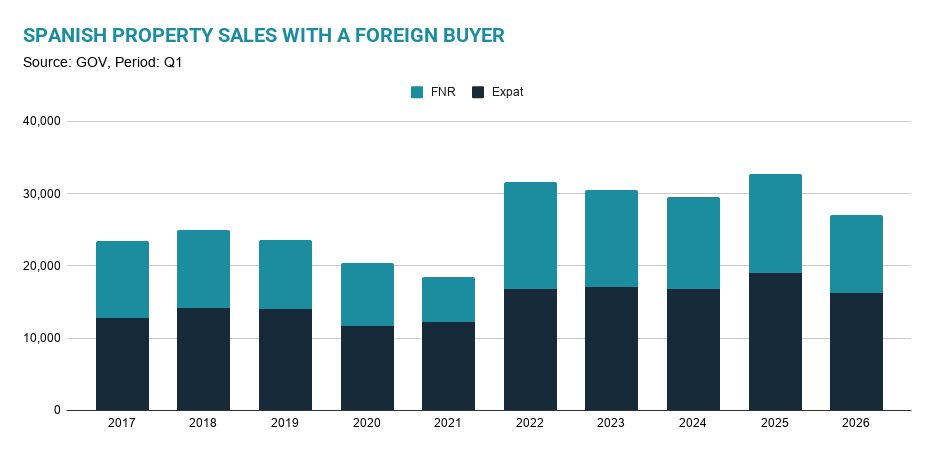
The biggest story in the data is the deterioration in foreign demand.
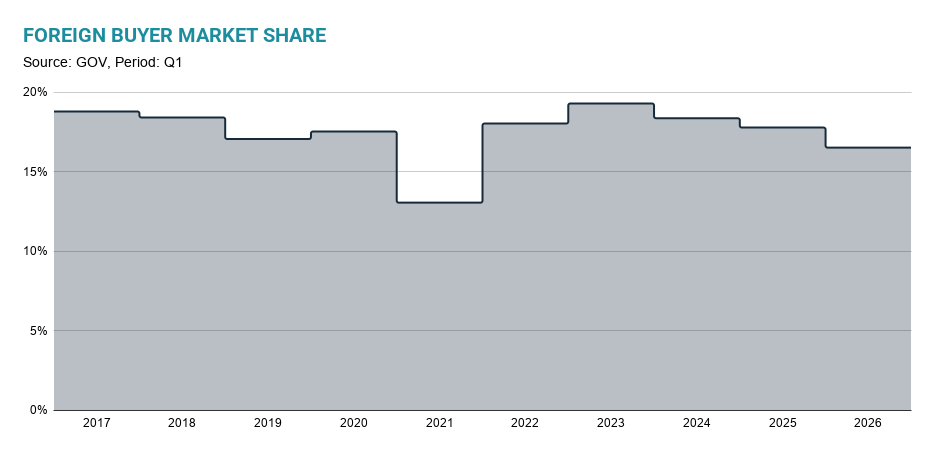
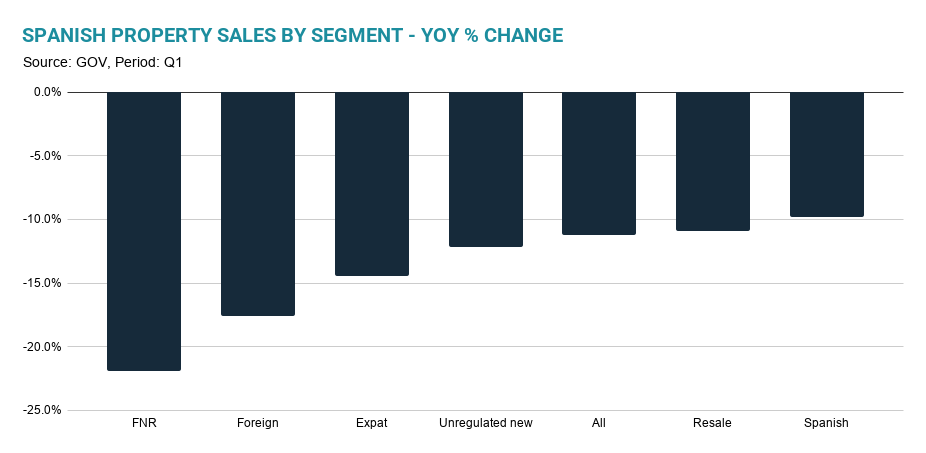
Foreign buyers purchased 26,977 homes in Q1, down 17.6% compared to the same period last year. As a result, the foreign share of the market fell to 16.5%, down from 17.8% a year earlier.
The weakness was particularly pronounced amongst foreign non-residents (FNRs) — the segment most closely associated with holiday-home purchases and lifestyle buyers.
FNR purchases fell by almost 22% year-on-year to just 10,704 transactions. More strikingly, this segment is now running slightly below its ten-year average, making it the weakest of all the major buyer groups.
Expat demand also softens
Foreign residents, often referred to as expats, also reduced their purchases, though less dramatically.
Expat purchases declined by 14.4% year-on-year to 16,273 transactions. However, unlike the FNR segment, expat demand remains comfortably above its long-term average.
This suggests that people relocating to Spain continue to support the market, whilst discretionary second-home demand is fading more rapidly.
Spanish buyers holding up better
Domestic demand also weakened, but proved more resilient than foreign demand.
Spanish buyers accounted for 136,160 transactions, down 9.8% year-on-year. Despite the decline, local demand remains more than 15% above its ten-year average and continues to represent the backbone of the market.
A market entering a new phase?
The data suggest that the extraordinary post-pandemic boom is now fading, particularly amongst foreign buyers.
Higher prices, reduced affordability, limited supply, and growing economic uncertainty are all likely contributing factors. The sharp decline in foreign non-resident demand also raises questions about whether Spain’s increasingly hostile political rhetoric towards foreign property buyers is having an effect.
Prime Minister Pedro Sánchez has repeatedly singled out foreign non-resident buyers as part of Spain’s housing problem, proposing punitive taxes and even floating the idea of restrictions on purchases. Whether or not such measures ever become law, some overseas buyers may already be getting the message that they are less welcome than they once were.
It’s still too early to draw firm conclusions from one quarter of data, but these figures are the first detailed buyer-segment numbers of 2026, and they suggest that foreign demand is cooling considerably faster than the domestic market.
For a country that has relied heavily on foreign buyers to support many coastal and island markets, that’s a trend worth watching closely.