Connect with us

%

Fuengirola Kitchen Fire Fills Centre Of Town With Thick Smoke

Published

on

fuengirola-kitchen-fire-fills-centre-of-town-with-thick-smoke

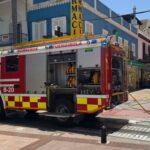
Fuengirola fire teams arrive at the scene. Credit: Ayuntamiento of Fuengirola

Those in central Fuengirola on Saturday, June 20, got a bit of a shock around lunchtime when a large plume of smoke billowed through the Plaza de la Constitucion after fire broke out in a nearby restaurant kitchen. The blaze started at the crossing of Calle Marbella and Calle Alemania streets. Many people in the area stopped to watch the column rise into the sky.

Kitchen blaze starts in fryer

Local firefighters mobilised several units to the scene immediately following the alert. Teams entered the premises and brought the fryer fire under control within a short time. Extinguishing came without any reported casualties. Council representatives joined emergency staff in confirming only limited material losses inside the kitchen area. People in the area expressed relief once the smoke began to clear from the square. Officials stressed that quick action prevented any spread beyond the kitchen itself. People nearby described the smoke as very dense and dark.

Morning crash leads to car fire

Earlier in the day another smoky emergency took place on the AP-7. A vehicle veered off the carriageway at the kilometre 1008 marker by Higueron in Benalmadena. Impact with the barrier caused it to overturn before flames took hold. A quick-thinking passer-by raised the alarm with 112 and extracted the driver from the interior. Fire threatened to reach nearby brushland.

Benalmadena crews concentrated on containing the spread. Urgent treatment at the roadside preceded ambulance transport to hospital. The car itself ended up a write-off according to photographs released by firefighters. Western Costa del Sol teams dealt with two separate incidents on the same day. Coordination between different local services ensured both situations received full attention without delay.

Emergency services confirm positive outcomes

Both incidents ended without serious consequences for those involved. Firefighters from Fuengirola and Benalmadena worked efficiently to limit damage and protect nearby areas. The 112 service played a central role in coordinating the responses across the western Costa del Sol. Local council statements emphasised the professionalism of all teams on duty during the busy Saturday period. Residents in Fuengirola and road travellers on the AP-7 and A-7 benefited from the fast intervention that kept further problems at bay.

Sign up for personalised news

Subscribe to our Euro Weekly News alerts to get the latest stories into your inbox!

By signing up, you will create a Euro Weekly News account if you don’t already have one. Review our Privacy Policy for more information about our privacy practices.

%

Málaga CF Promoted To La Liga As 2–1 Victory Over Almería Ends Eight-Year Wait

Published

on

malaga-cf-promoted-to-la-liga-as-2–1-victory-over-almeria-ends-eight-year-wait

Málaga’s return to La Liga comes after eight seasons away from the top division. Photo credit: Vazquez Fernando/Shutterstock

Málaga CF have secured their return to La Liga’s first division after a dramatic 2–1 victory over UD Almería, ending an eight-year absence from Spain’s top flight and sparking emotional celebrations among players and supporters.

Goals from Chupe and David Larrubia sealed the win at the UD Almería Stadium, confirming promotion and completing a long and difficult return journey to the Primera División.

A night of tension, goals and shifting momentum

The decisive clash was finely balanced in the early stages, with neither side fully taking control in a match that carried significant pressure for both clubs. After a tight opening period, Málaga broke the deadlock in the 64th minute when Chupe finished a well-worked move, giving his side a crucial advantage in a game where margins were minimal.

Just six minutes later, Málaga doubled their lead. David Larrubia struck in the 70th minute, finishing another key attacking sequence and sending travelling supporters into celebration as promotion moved within touching distance. Almería responded quickly. In the 75th minute, Leo Baptistao pulled one back, reigniting tension and forcing Málaga into a long defensive final phase.

As the match came to a close, Almería pushed forward in search of an equaliser, but things got more chaotic when Thalys and, later, Ramón Enríquez for Málaga were both shown red cards in stoppage time, leaving each side with ten men as Málaga held firm under pressure.

Eight years of rebuilding finally rewarded

Málaga’s return to La Liga comes after eight seasons away from the top division following relegation and a prolonged period of instability both on and off the pitch. At various points, the club appeared to be drifting further from elite football, before a structured rebuild began to take shape under former head coach Sergio Pellicer, who focused on stabilising the squad and introducing younger players into the first-team environment.

That long-term approach helped form the base of the current squad, which has grown together across multiple seasons rather than being rebuilt in short cycles.

A project completed under Juan Francisco Funes

The promotion campaign itself has been overseen by current head coach Juan Francisco Funes, who has guided the team through a season built on consistency, discipline and development of that young core.

Rather than dramatic reinvention, Málaga’s success has come from continuity, refining an existing structure and maximising a squad that has matured together over time. That balance ultimately proved decisive in securing promotion in a tightly contested campaign.

La Rosaleda returns to La Liga football

For supporters, the most immediate impact of promotion is the return of La Liga football to La Rosaleda, which will once again host Spain’s biggest clubs after years outside the top flight.

The stadium is expected to regain the atmosphere and intensity associated with top-tier football, with renewed attention on matchdays and a significant rise in expectations.

A new chapter begins

With promotion now confirmed, Málaga turn their focus to preparation for life back in La Liga, where the level of competition will increase significantly. Recruitment, squad depth and adaptation will be central to their planning in the coming weeks as the club looks to establish itself once again among Spain’s elite.

For now, though, the focus remains on the achievement itself. After eight years away, Málaga are back in La Liga, earned through a season defined by hard work, patience, structure and a decisive night in Almería.

Continue Reading

%

Prime Minister’s Wife Begoña Gómez Faces Trial As Passport Is Confiscated

Published

on

prime-minister’s-wife-begona-gomez-faces-trial-as-passport-is-confiscated

its highly unusual for the spouse of a sitting prime minister to face trial under such intense public scrutiny. Photo credit: Oscar Gonzalez Fuentes/Shutterstock

Begoña Gómez, the wife of Spanish Prime Minister Pedro Sánchez, will face trial after Judge Juan Carlos Peinado ordered the opening of oral proceedings and imposed a series of precautionary measures, including the confiscation of her passport and a requirement to report to court every 15 days. The decision marks a major escalation in one of Spain’s most closely watched legal cases and is likely to intensify both political and legal scrutiny in the months ahead.

Under the judge’s order, Gómez will be unable to leave Spain while the case progresses. She must also appear regularly before the court, a measure usually imposed to ensure defendants remain available to judicial authorities. The same restrictions have reportedly been applied to her adviser, Cristina Álvarez.

What is Begoña Gómez accused of?

The case centres on allegations relating to Gómez’s professional activities and her links to several organisations and business initiatives. Judge Peinado has decided there is sufficient basis for the matter to proceed to trial, where accusations including alleged influence peddling, corruption in business dealings, embezzlement and misappropriation will be examined in court. Gómez has consistently denied wrongdoing throughout the investigation.

The proceedings have been driven by private prosecutors, while Spain’s Public Prosecutor’s Office has repeatedly argued that the case should be dismissed, creating a stark divide between those pursuing the allegations and those who believe there is insufficient evidence to justify a trial. That disagreement has helped turn the investigation into one of the most politically charged legal battles in recent Spanish history.

Why has her passport been taken away?

One of the most striking elements of the judge’s decision is the removal of Gómez’s passport. The measure prevents her from travelling abroad and is intended to reduce any perceived risk that a defendant could avoid future court appearances. The move has attracted particular attention because similar restrictions had previously been rejected during earlier stages of the investigation.

Judge Peinado has now concluded that the circumstances justify tighter controls as the case moves towards trial. Gómez’s legal team has already indicated that it intends to challenge the decision through the appeals process, arguing that the restrictions are unnecessary.

For now, however, the measures remain in place.

A case that has dominated Spanish politics

The investigation has generated months of political controversy, with opposition parties demanding accountability and government supporters accusing critics of using the courts to attack the Prime Minister through his wife. The case has repeatedly dominated headlines, fuelled parliamentary clashes and intensified an already polarised political climate. For many Spaniards, the latest development represents the most significant turning point since the investigation first began.

While allegations against relatives of political leaders are not unprecedented, it is highly unusual for the spouse of a sitting prime minister to face trial under such intense public scrutiny. The decision is therefore likely to be viewed not only as a legal milestone but also as a moment with potentially far-reaching political consequences.

Political fallout continues

The latest ruling is also likely to increase pressure on Prime Minister Pedro Sánchez, who has consistently defended his wife and argued that the investigation forms part of a politically motivated campaign against his family.

While Sánchez has not publicly commented on the judge’s latest decision, the reaction from his government has been swift. Officials at Moncloa have reportedly described the ruling as part of a pattern of “persecution”, “obsession” and judicial prosecution lacking legal basis. The PSOE has also continued to defend Gómez’s innocence, insisting that the proceedings amount to political and judicial harassment rather than a legitimate corruption case.

The case has already dominated political debate for months and Saturday’s developments are unlikely to ease tensions between the government and opposition parties. With a trial now on the horizon, the scrutiny surrounding both Gómez and the Prime Minister looks set to intensify.

What happens next?

The opening of oral proceedings does not represent a finding of guilt.

Instead, it means the case has advanced to the next stage, where evidence will be examined in court and both prosecution and defence arguments will be heard before a final verdict is reached. Gómez will continue to benefit from the presumption of innocence throughout the process.

In the meantime, attention is likely to focus on the appeals against the travel restrictions and on how the case develops as it moves closer to trial. Whatever the outcome, the proceedings are expected to remain firmly in the public spotlight.

With a passport confiscated, mandatory court appearances every two weeks and a trial now on the horizon, the legal challenges facing Begoña Gómez have entered a new and more serious phase, ensuring that a case which has already dominated Spanish politics is unlikely to fade from the headlines any time soon.

Continue Reading

%

Government Finally Funds €6.1 Million Drainage Project To Stop Flooding

Published

on

government-finally-funds-e6.1-million-drainage-project-to-stop-flooding

A yearly occurrence no more. Salobreña flooded. Credit: Ayuntamiento de Salobreña

Salobreña council leaders have received confirmation of more than €six million from the Spanish government for new drainage infrastructure to prevent flooding in the town centre. This scheme forms part of a new law on urgent measures for damage from adverse weather events. Council representatives described the investment as a response to a historic demand from the town.

Background to flood problems in Salobreña

Insufficient capacity in parts of the current pipe network, lack of decent upkeep and changes made over time to the drainage system cause regular flooding every year, overflows from inspection chambers and effects on the urban layout during episodes of heavy rain. Surface drainage contributions, minor watercourses and irrigation channels meet the existing rainwater network at the northern edge of the built-up area and create repeated hydraulic dysfunctions, and for those living in the area it all adds up.

Path for the new surface and rainwater collector

Construction of the collector will start near the industrial estate and the access road to the sports area before crossing under the CN-340 opposite the sports centre. Route planners have set the line to follow the Cuesta del Comediante and Pago de Sotillos before connecting to the low-water channel of the Guadalfeo River and continuing to the river mouth. This layout addresses the interaction between surface drainage and the irrigation network.

Choice of technical and economic solution

Planners have examined several possible routes and construction methods before selecting the option that provides the best balance of technical performance and cost while remaining compatible with replacement of existing services and with future maintenance needs. Rapid execution of the works also formed part of the decision criteria.

Statements from Salobreña leaders

Mayor Javier Ortega and municipal architect Francisco Morejon set out the details during a press conference and stressed that the project meets a long-standing demand from the town. Planned continuous infrastructure for collection, transport and evacuation of rainwater will raise the hydraulic capacity of the system and reduce the risk of overflows and flooding across the town centre. Local people have waited years for a structural answer to the drainage challenges and a stop to yearly flooding. This might just be it.

Continue Reading
Advertisement
Advertisement

Spanish Real Estate Agents

Tags

Trending

Copyright © 2017 Spanish Property & News