Abraham Lincoln
George Saunders: ‘With Great Short Stories, The Writer Doesn’t Know What’s Going On Until The Very End’

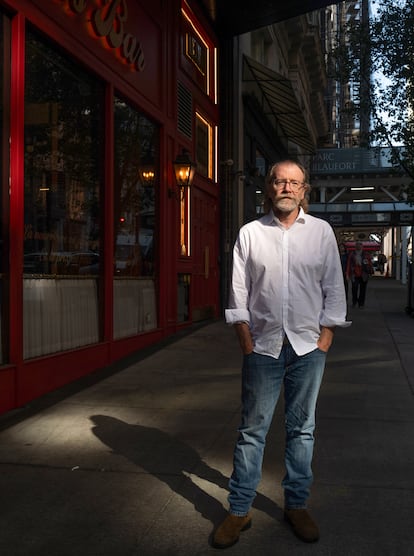
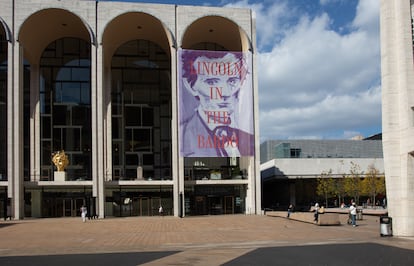
George Saunders, one of the most prominent North American short story writers, has agreed to meet EL PAÍS to discuss the Spanish translation of A Swim in a Pond in the Rain, just released by Capitán Swing, an independent imprint. The interview takes place in the café of a hotel near Central Park, a few minutes away from Lincoln Center. Two weeks earlier, the MET, one of the world’s most prestigious opera houses, staged the premiere of Lincoln in the Bardo, based on the novel of the same title, for which Saunders won the Booker Prize in 2017. The author, who teaches creative writing at Syracuse University in upstate New York, where he lives, had come down to Manhattan to see the critically acclaimed production for a second time. The opera, by Missy Mazzoli, a composer, who, at 46, has become the first woman ever commissioned by the Metropolitan to create an original work, is a masterpiece. It says a lot about Saunders’s character that, despite the significance of such an achievement, he’s fine if the topic is not addressed, gladly agreeing to focus on the reason for the interview: a discussion of Un baño en una laguna mientras llueve, as the translation of this most unusual book’s title reads in Spanish.
“How did it come into being?” I ask. “Over a period of 20 years, on and off,” he explains, “I taught a course on narrative form focused on the short story, a genre whose absolute masters are, for me, the great Russian writers: [Leo] Tolstoy, [Ivan] Turgenev, [Nikolai] Gogol and, above all, Anton Chekhov, from whom the book takes its title,” A Swim in a Pond in the Rain, an allusion to the climactic moment in Chekhov’s “Gooseberries,” perhaps the most emblematic short story included in the collection, when the main characters plunge into a lake when a storm suddenly breaks out. The episode evokes an anecdote Chekhov told, in which he and Tolstoy plunged into a lake when it suddenly started to rain. Saunders does not mention it in the interview, but as he makes clear in the book, the scene symbolizes the magical transformation that occurs when reading reaches its climax. “One day,” he says, “I was told that the class I had taught so many times, perhaps eight or nine, would no longer be offered, which deeply saddened me. I thought, oh, you know, together we learned so much… and now, all of the things that we [the students and I] had gotten to do would just dissipate. So I thought, I’ll just type my notes up. It took me three years to go over those stories. I read and reread them again and again, correcting my own texts about them, but it was a beautiful process.”
To everyone’s surprise, including his publisher, the book — a collection of short stories and essays in which Saunders meticulously analyzes the selected stories — became a bestseller, which is unusual for such a work. “The most extraordinary thing,” he says without hiding his surprise, “is that the book sells today even more than when it first came out.” The writer is not entirely sure why or how this came to be: “I really don’t know. I mean, I get a lot of emails from people saying, thank you for talking to me so honestly. I think people appreciate feeling guided. And I do love those stories, they’re critical to my artistic life. I really want to know how they work, but I don’t actually understand it. When I try to write stories the way Chekhov does, I can’t do it. So, it’s true worship from my end. There’s a lot of people who can’t do MFA programs. I get letters from people who say: I want to write stories, but I need some direct teaching. So, I think there was some frankness in there that people appreciate being taught…”

The question is inevitable: “Can creative writing be taught?” He responds quickly: “We get 700 applications, and we pick six. You don’t really have to teach them to write. You help them find their own voice for their own subject. I just… guide them. I do a lot of line editing. That’s my main role. Line editing and structural reconsideration. And then I kind of try to be quiet, you know, and help them get better at that. But this book is a little different. This book, I think, is geared towards maybe not lower, but rather a general reader, may be beginning writers, people who are just trying to understand what a short story is. As someone who published stories for most of my career, I find that there are certain people who just haven’t read enough of them to enjoy them. They would say, I don’t know how short stories work. So I thought, well, I can teach you that, using Chekhov and the others, I can show you that a story is not a novel. The story is not real life. It’s compressed, so part of my mission in that book is to say, you know, if somebody would like to reach your story, but doesn’t know how, maybe I can give them a ramp to get on and reach it.”
The distinction he makes between novels and short stories is intriguing: “What does a short story have that a novel doesn’t?”
“I think it’s a more magical form,” he responds. “If you try to explain what a story is, you’ll never succeed. I’ve never heard anybody really explain it well. It either does or doesn’t happen. There’s a little uplift that the reader never fails to feel. One theory I use when I’m writing is that there’s an overstory, which deals with practicalities: Will they get married? Will the guy in the sled be rescued? That’s the overstory. And we want to know that. But meanwhile, there’s an understory coming up, which is what the story is really about. And I think that with the greatest short stories, the writer doesn’t know what’s going on until very late in the game, when the epiphany occurs. So, you’ve got a story going along and meanwhile, the writer is wrestling with something else, and then that breaks through. And the readers have the exact same experience. In the story, there’s metaphor, the satisfaction comes from the fulfillment of metaphor, which is something somewhat esoteric. And I think people who don’t know stories often reach the end and ask themselves: What happened? My sense is that the art form is fulfilled when that thing comes, when the understory rises, and you kind of know it’s been there all along. That’s what happens in ‘The Dead,’ by James Joyce, right? I mean, it’s so beautiful. You don’t really know that you’ve been having complicated feelings about Gabriel until that moment. It’s something magical and it doesn’t come as a surprise. It’s always been in your mind. You’ve been feeling it throughout. And then Joyce makes the connection. And that’s a very high-level art, that kind of feeling. I learned that from engineering school because in engineering, if the bridge doesn’t remain standing, it’s because there was a mistake.”

It is reflections of this kind, not always easy to follow, that explain George Saunders’s impact on his readers: not only as the author of a remarkable number of near-perfect stories, imbued with an inexplicable magic, but also as a sort of enchanter or shaman capable of entering other writers’ imaginative worlds and reaching the very core of what they are trying to achieve. It is the only way to explain how he has built a Substack with 330,000 subscribers, Story Club with George Saunders.
“It came right out of this book. And what I thought was, I love doing that kind of analysis. So let me try to do it on some other stories. So, we did some [Ernest] Hemingway, some Joyce, and some Katherine Anne Porter. People would just sign up, and every Sunday I put up a new story there. Then we turn the comments on for a week. Everyone reads, and then the next Sunday I write a little essay, something like, let’s think about this. The comments fill up, people respond at length. It’s intelligent and interesting, and there’s no snark. People are very respectful. They’re very rigorous. They’re very positive. They disagree, but always, respectfully.”
“What’s the last story you put up?”
“‘The Good Denis’ by Marie Ndiaye, I’m not sure I pronounce her name right. She’s a French writer.”
“When readers write to you, what do they thank you for?”
“Well, with this book, they thank me for opening reading back up to them, and specifically with the Russians, for giving them a way to approach a work that they didn’t like at first… That’s one thing. Sometimes it’s just about taking away the facade and saying things like let’s talk about death, let’s talk about fear. I’ve also received letters from people who lost their children and, after reading Lincoln in the Bardo they share their grief with me. It’s very sad, but it also brings them some closure. Once someone who had lost a son four years earlier wrote to me saying that the book allowed him to openly understand what he felt. That kind of connection is what matters, a connection I didn’t know I was looking for, but which ultimately proves deeply rewarding. It makes you feel that what you have written is of use.”
Time’s up. The conversation must end. George Saunders notices the paper’s photographer, who stands patiently at the end of the café. It’s obvious that he feels uncomfortable making him wait. He stands up, and offers his hand: “Don’t hesitate to call me if you need to ask me anything else,” he says graciously before walking away.
Sign up for our weekly newsletter to get more English-language news coverage from EL PAÍS USA Edition