Connect with us

%

Giant Rats Invade Málaga’s Beachfront As Alarmed Residents Say ‘they’re Entering Our Homes’

Published

on

giant-rats-invade-malaga’s-beachfront-as-alarmed-residents-say-‘they’re-entering-our-homes’

Rats are becoming an increasingly common sight in Spanish coastal towns. Credit: merinsda / Shutterstock

Diners on Pedregalejo’s seafront terraces have started worrying more about what could be weaving underneath the tables rather than what to order, after residents counted 20 rats scurrying under boats and beach bars in a single evening. Málaga’s town hall insists its rodent-control contract is working, but this is the second September running locals have said otherwise. 

Residents count 20 rats along the beach in a single evening

Pedregalejo, the fishing-village-turned-favourite among Málaga’s coastal neighbourhoods, has spent this September watching for rats rather than sunsets. Residents told El Debate they counted at least 20 rodents along the beach in a single evening, tunnelling under moored boats and through the sand near the promenade’s restaurant terraces.

Ángel Maese, who has lived in the area for several years, said the problem is getting worse every year. María Ángeles Vázquez, another resident, described the animals as unusually large, adding that neighbours do not know if they bite.

The neighbourhood is one of the Costa del Sol’s most popular spots for British residents and holidaymakers, drawn to its chiringuitos beach bars serving grilled sardines on the sand just metres from where the rats have been spotted.

‘They’re entering our houses,’ residents tell local radio

The complaints link to an earlier warning, as days before residents interviewed by COPE Málaga said rodents were no longer confined to the seafront, with one describing “more rats than ever” and reporting that they were now entering people’s houses as well as bins and terraces. 

Neighbours point to warm weather extending later into the year as a reason why this latest rat-race is continuing, plus, food being left out by beachfront restaurants and burrows dug into the sand beneath the wooden boat shelters that line Pedregalejo’s shore.

A €904,000 contract that the council says is working

Málaga’s Ayuntamiento (town hall) said it had deployed extra traps and stepped up extermination work in response to the latest complaints. Since July 2025, the city’s rodent and pest control has been run by Lokimica under a three-year contract worth €904,035.

The council says the contract has cut complaints by half compared with the first half of 2025, when it logged 2,451 pest reports, an average of three a day, and describes the current situation as “under control.” Outside emergency callouts, the standing programme runs three rat treatments a year across public areas citywide, plus monthly checks in around 20 higher-risk zones including beaches, parks and commercial streets. Residents can report a pest problem directly to the town hall’s environmental department.

The same neighbourhood, the same complaint, two years apart

This is not the first time Pedregalejo has topped the city’s rat complaints. In September 2024, the council tripled its annual pest-control budget from €142,000 to €400,000 after its previous contractor went bankrupt, naming Pedregalejo alongside Carranque, Huelin, Churriana, El Perchel and the historic centre as one of the worst-affected districts.

Environment councillor Penélope Gómez announced the increase at the time, while opposition councillors, including the PSOE’s Begoña Medina and Vox’s Yolanda Gómez, pushed for faster action, and Con Málaga’s Nicolás Sguiglia criticised the decision to outsource the service at all. Officials also pointed to rising temperatures extending rodents’ breeding season, a pattern also reported across the rest of southern Europe.

Two years and a bigger budget later, Pedregalejo’s rats are back in the headlines. It follows a summer in which Málaga’s beaches were also linked to sewage-related closures and the city’s historic palm trees battled a separate infestation of red palm weevil, adding rats to a run of environmental headaches for the coast in 2026.

%

Opposition In Spain Vows To Bolt Country Shut

Published

on

opposition-in-spain-vows-to-bolt-country-shut

Sunday’s political rally in Badalona. Credit: ANF FB

Alberto Núñez Feijoo, leader of Spain’s main opposition party, used a packed rally in Badalona on Sunday to set out a harder, tighter immigration line, tying work, law-abiding behaviour and the Spanish passport to one another. He said Spain should welcome people who come for hard graft and obey the country’s rules, then slam the door on anyone arriving to break them.

His remarks landed as Ceuta is still dealing with the fallout from mass crossings earlier in the summer, a crisis with of the city’s new port camp and pressure for a royal visit. Feijoo is due in Ceuta on Monday with European People’s Party president Manfred Weber.

What was said in Badalona

Feijoo argued that a country with self-respect should be demanding of people born here and of those who move here. Nationality, he said, brings rights and duties. Recovering “the prestige of the Spanish passport” means reviewing how citizenship is granted, how it is kept, and how it can be lost.

He put the message in plain language. Spain, if he governs, would stay open to “hispanos” and to anyone arriving to work and respect the law. Those who come to dodge the rules would find the country “cerrada a cal y canto”, or “bolted shut”. He also called it a “sinsentido” that irregular entry can look easier than arriving with a job contract, and said public services cannot hold if people arrive without control while nationality is handed out on a mass scale.

That line builds on earlier PP ideas already reported by Euro Weekly News, including tighter residency rules and a harder approach to arraigo.

Law-abiding Brits already living in Spain legally are not the target of these pledges. Feijoo’s speech was aimed at irregular arrivals and at naturalised citizens who later commit serious crimes, not at residents who work, pay their way and keep to the rules.

Immigration plans point by point

  • Run an ordered immigration policy rather than uncontrolled arrivals.

  • Keep Spain open to people who come to work and follow the law, including Latin American arrivals he described as “hispanos”.

  • Bolt the country shut to those who arrive irregularly or come to break the law.

  • Make work the normal route in, so a contract is not harder than an irregular crossing.

  • Strengthen border protection, with Ceuta used as the immediate example.

  • Review how Spanish nationality is granted, kept and withdrawn.

  • Strip nationality from naturalised citizens convicted of serious crimes, including gang membership, murder and repeat sexual assault.

  • Treat the passport as something earned, not gifted.

He challenged critics directly: if anyone objects to taking nationality from a convicted killer, gang member or repeat sex attacker, they should explain why.

Why this matters now

The next general election in Spain is expected in 2027. Feijoo, beginning his electioneering, also used the rally to attack Pedro Sanchez’s government over Ceuta, budgets and taxes, promising a “limpieza total”  if his party, PP, returns to office.

For readers already in Spain, the practical point is the passport and residency test he wants to rewrite. Current nationality law is set out in the Spanish Civil Code on the official BOE site, and any withdrawal of citizenship would need a huge legal change, not just a speech.

Whether that package ever becomes law depends on an election Feijoo is openly inviting. For now, Badalona was the pitch: work and obey the law, or Spain stays locked.

Continue Reading

%

Parking On Torrevieja’s Calle Ramon Gallud

Published

on

parking-on-torrevieja’s-calle-ramon-gallud

New parking restrictions on Calle Ramon Gallud in Torrevieja. Credit: Ayuntamiento de Torrevieja.

Drivers using Calle Ramon Gallud in central Torrevieja will need to take into account new parking restrictions limiting stays to a maximum of two hours during the working day.

The regulation came into effect on September 15 and applies on working days between 8:00 AM and 8:00 PM. Torrevieja Town Hall says the measure is designed to increase the turnover of parking spaces on the busy town centre street.

Two-hour limit applies during the working day

Under the new rules, vehicles parked on Calle Ramon Gallud can remain in the same space for a maximum of two hours between 8:00 AM and 8:00 PM on working days.

The restriction does not apply overnight. From 8:00 PM until 8:00 AM the following morning, vehicles can remain parked without being subject to the two-hour limit.

The restriction is also lifted on non-working days.

Torrevieja Town Hall has installed new signs along Calle Ramon Gallud explaining the times and conditions. Motorists are being encouraged to check the signs carefully when leaving their vehicles to make sure they comply with the new regulations.

Council aims to free up more parking spaces

Local Police councillor Federico Alarcon said the change is intended to improve the turnover of available parking spaces on one of Torrevieja town centre’s main commercial and service streets.

By preventing vehicles from occupying the same spaces throughout the entire working day, the council hopes more drivers will have an opportunity to find somewhere to park.

This could particularly benefit people making shorter visits to the centre to go shopping, attend appointments or use nearby businesses and services.

Calle Ramon Gallud experiences high levels of activity for much of the day, increasing demand for the limited parking spaces available.

Drivers urged to check new parking signs

The measure forms part of wider efforts to better manage parking in central Torrevieja and make existing spaces available to a greater number of motorists.

Drivers using Calle Ramon Gallud should therefore pay particular attention to the newly installed signs, especially if they are accustomed to leaving their vehicle in the street for longer periods.

The two-hour restriction is now in force between 8:00 AM and 8:00 PM on working days, while overnight parking and parking on non-working days remain exempt from the limit.

Continue Reading

%

British Couple On Holiday In Morocco Face Bizarre Roadside Encounter On Final Day

Published

on

british-couple-on-holiday-in-morocco-face-bizarre-roadside-encounter-on-final-day

The couple were stopped by a Moroccan police officer. Photo credit: Mary. W

Picture this: you spend a wonderful week driving through Morocco, taking in the sights, food, traditions and some of the country’s most fascinating cities, only to have the whole trip end on an odd note when getting pulled over by a police officer, and that is exactly what happened to a British couple during their Moroccan road trip. Frank and Mary W., who live in Almería, had been looking forward to visiting Morocco for a while.

When they finally managed to arrange their holiday, they spent several days exploring the country. Their trip had taken them through several Moroccan cities, including Fez, Chefchaouen, Al Hoceima and Rabat, giving them the chance to experience the country’s culture and traditions at their own pace. But on their final day, as they were leaving Rabat, the holiday took a turn that left the couple more confused than anything else.

Pulled over by police

The couple were stopped by a Moroccan police officer, and when Frank asked why they had been pulled over, the explanation seemed remarkably simple. They had, the officer told them, “driven over a white line.” For the couple, that raised more questions than it answered.

They tried to understand exactly what they had done wrong and why crossing the particular road marking warranted a fine, but before they had managed to make sense of the situation, the officer began writing out the penalty. The amount, they were told, was 400 Moroccan dirhams, around €37. There was just one problem: they did not have 400 dirhams on them. That was when the situation became even more confusing.
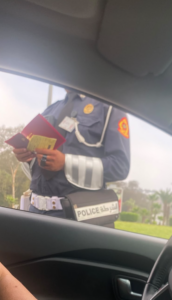
Moroccan Police officer writing a fine
The officer lowered the amount to 350 dirhams. Photo credit: Mary. W

When a fine starts to look negotiable

After being told they could not pay the full amount, the officer lowered the figure to 350 dirhams, around €32. For the couple, this was difficult to understand. A fine is normally a fixed penalty: you break a rule, you receive the corresponding fine and you pay it. At this point, however, the amount appeared to have some room for negotiation. The officer began haggling with them over how much they could pay, rather than simply telling them how to settle a fixed penalty.

They were not trying to negotiate the fine; they were simply trying to explain that they did not have the amount the officer had initially demanded. Eventually, the officer agreed to accept 150 dirhams, roughly €14, and they were allowed to continue their journey. After a week of sightseeing, driving and exploring Morocco, their final encounter with the country’s roads had left them with a very strange impression of how a traffic fine was supposed to work.

What the rules actually say

There is an important distinction between the couples experience and the formal Moroccan system. Being stopped by police while driving is not unusual in Morocco, and current government travel advice warns motorists that driving conditions can differ considerably from those in Britain and Spain and advises particular care on the roads. Morocco does have an official system of fixed traffic penalties. The country’s General Treasury publishes three classes of road offence, with standard amounts of 700, 500 and 300 dirhams.

Reduced amounts can apply when fines are paid promptly, meaning the amount paid can legitimately vary according to the offence and when the penalty is settled. That is different from what happened here, however. In this case, the amount appeared to change after the couple explained that they did not have enough cash to pay the original 400-dirham demand.

Not necessarily the usual process

There are, however, published reports of corruption involving Moroccan law enforcement, including allegations of officers soliciting money during traffic stops. A 2025 review by the U4 Anti-Corruption Resource Centre, operated in collaboration with Transparency International, says such reports include motorists paying less than the prescribed fine.

That does not establish that corruption occurred in this case, but it pretty well seems like it. The experience left them questioning how the system worked after the officer repeatedly changed the amount he was prepared to accept.

A strange end to the trip

For the couple, the experience left them questioning how the system worked and, in particular, how a penalty could change during a roadside conversation. For anyone from Spain considering driving to Morocco, it is worth remembering that roadside procedures may work differently from those they are used to at home.

A police stop itself is not unusual, and Morocco has formal traffic penalties, but this experience was far removed from the straightforward fixed fine they had expected. They paid their 150 dirhams and were able to continue on their way, but the explanation they were left with was still the same one that had started the whole episode. So remember when visiting, don’t drive over white lines, regardless of where on the road they are located.

Continue Reading

Trending

Copyright © 2017 Spanish Property & News