Boston
Harvard Wins The First Battle Against Trump, But The War Is Far From Over: ‘Democracy Is At Stake’

At the end of a long conversation in his cluttered office at Harvard Law School, Professor Randall Kennedy looks back and says: “You know? I remember what happened in this country in 1968 because I lived through it. They killed Martin Luther King. Then Robert F. Kennedy. There were riots in the streets. A lot of fear. An election was held in which [Republican Richard] Nixon narrowly beat [Democrat Hubert] Humphrey. Did anyone seriously think then that the votes wouldn’t be counted? That the loser wouldn’t concede? Were we afraid of a military reaction? No! Don’t tell me what we’re living through now is normal, because it isn’t. What’s at stake now is democracy, preventing the government from controlling all institutions. And in this battle, what happens at this university is going to be crucial,” says the esteemed professor off the cuff, wearing a T-shirt bearing the face of the abolitionist William Lloyd Garrison, one of his favorite historical figures.
With summer just around the corner, Kennedy hasn’t left his office, which is piled with books, notebooks, photos and academic diplomas. He has stayed to finish a book about what Harvard University has experienced over the past 15 months. The manuscript already has a title: The Siege of Harvard. But it is very likely to go to press without the final chapter of the story, simply because it has yet to be written.
Over the past year, Harvard has managed to withstand the assault from the Donald Trump administration. But it is too early to decide who will win the war between the world’s most powerful government and the nation’s wealthiest, most prestigious university, which will mark 500 years of history in 10 years.

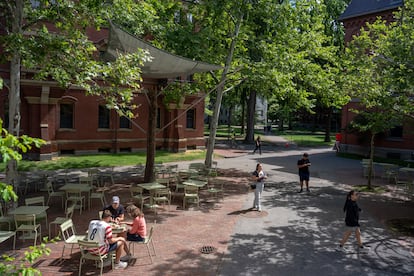
At the height of the confrontation, Harvard stood its ground and said no. It risked losing $2.2 billion in federal funding rather than comply with the administration’s demands on issues such as the admission of international students, efforts to curb anything resembling support for minorities, and what Republicans label “woke” ideology. It did so at a time when media outlets such as ABC and CBS, major law firms, and universities including Penn and Columbia were bowing to the president’s wishes. Back then, recalls Professor Ricardo Hausmann, there was an atmosphere of “absolute panic.”
Administrators at the Kennedy School, where the Venezuelan-born economist has taught for more than 20 years, feared that visas for all international students could be revoked. At this public policy school, foreign students make up more than half of the student body. Faculty members were already preparing to return to the pandemic-era model and move all classes online.
In the end, however, the worst did not come to pass. The bleakest scenarios never materialized. International students continued to arrive, and federal funding was not cut off — largely because the courts stepped in to check the president’s actions.
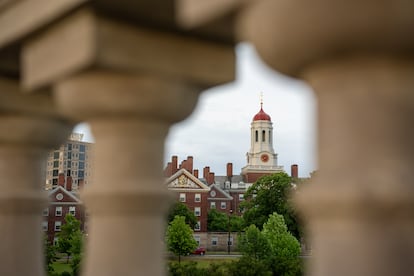
“Refusing to accept extortion was extremely important,” Kennedy continues. “Because then the government felt energized and powerful. And Harvard was one of the few that held firm. But the university remains embroiled in a real battle. And my fear is that it will ultimately reach an agreement, perhaps not as offensive as what Trump sought a year ago, but one in which it concedes on certain points.”
Turning up the pressure
Because, despite the legal setbacks it has suffered, the government has continued to step up pressure in its overall aim to seize control of higher education, a war in which Harvard was the most prized target. Last March, the Justice Department sued the university, alleging that it had violated the rights of Jewish and Israeli students by failing to protect them when it allowed demonstrations against Benjamin Netanyahu’s policies following the outbreak of the Gaza war in 2023.
In addition, Trump announced in February that he would seek $1 billion in damages from Harvard for what he described as “harm and losses” — a vague claim that he neither substantiated nor explained, offering no reason why the figure should be $1 billion rather than twice that amount or half as much.
Through this strategy, the administration is threatening one of the chief sources of the country’s wealth and prosperity over the past century: its remarkable ability to attract talent from around the world.
As noted by Steve Levitsky, who in addition to authoring How Democracies Die teaches Latin American Studies at Harvard, it is impossible to know whether the new announcements mean the siege of Harvard will continue next academic year or whether Trump, distracted by matters such as Iran or the November midterm elections, now has other priorities: “This is a very chaotic, incoherent and internally fragmented administration, a highly personalized government run by many inept people competing to please the boss. It’s very hard to identify any medium- or long-term strategy. I think they wake up each day and decide what to do.”

What seems clear is that the Republican cannot be satisfied with having failed to achieve the goal he set himself upon returning to the White House: turning this centuries-old institution inside out.
These days, the mood in Cambridge, the small town next to Boston that is home to Harvard, is very different from a year ago. Panic no longer reigns. Each new announcement is interpreted as part of the Trump administration’s tiresome cacophony. Few people here now keep track of all the lawsuits and threats coming out of Washington. But that does not mean nothing has changed.
Unease over budget cuts
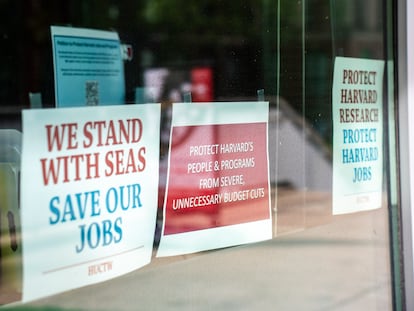
For one thing, anxiety remains. Elizabeth Dabek feels it keenly as she faces the effects of cost-cutting measures. The 30-year-old researcher has seen her contract reduced by half and has had to start a company to supplement an income that was no longer enough to make ends meet.
“Many graduate students in my lab want to call a strike over increasingly worse conditions while the cost of living keeps rising,” she says. “And that’s despite Harvard usually paying better than other universities.”
Over the past year, the university carried out deep cuts and layoffs in anticipation of what the future might bring. And it did so despite its exceptionally healthy finances, supported by an endowment that stood at nearly $57 billion last year.
Secondly, the institution led by Alan Garber has taken several steps that could be interpreted as attempts to temper Trump’s anger. These include dismissing the faculty leaders of its Center for Middle Eastern Studies, cracking down on student protests, and eliminating activities that could be perceived as supporting the Palestinian cause.
In the words of Levitsky, one of the foremost scholars of how democracies slide down the slippery slope toward authoritarianism, this resembles the strategy of a child whose parents tell him to clean his room and who replies: “Fine, but I’m doing it because I want to, not because you told me to.”
He explains: “Garber has followed a smart strategy that has worked, but it has had costs. Harvard continues to act out of fear, being extremely cautious so as not to be perceived as too woke or too pro-Palestinian, which I think is a mistake.”
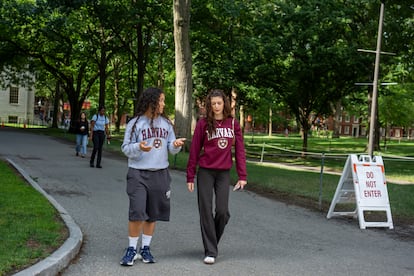
Finding voices supportive of the Trump administration at Harvard is difficult, but not impossible. Some conservatives believe that left-wing ideology had become too entrenched, making open debate increasingly difficult.
That is the view of Milton — a pseudonym, as he prefers not to reveal his identity — a science student enjoying lunch outdoors from a container he brought from home.
“Some criticisms made sense. In China there are elite universities intended to train their young people and no one finds that strange. Why shouldn’t the same happen here? I also think the quality of teaching has declined due to ideological capture by the left,” he says, acknowledging that his views often put him at odds with classmates.
Most Harvard students and professors are away from campus these days, recovering from an exhausting academic year. Those who remain are busy preparing articles or teaching summer courses. They know the coming year will not be easy either.
The successes Trump has achieved in shaping a media landscape more favorable to him — such as the impending merger of Paramount and Warner into a giant media company controlled by his allies Larry and David Ellison — have not been replicated across higher education.
The question is not so much whether he will return to the offensive, but when and how.
Sign up for our weekly newsletter to get more English-language news coverage from EL PAÍS USA Edition