Foreign demand
Has foreign demand for Spanish property peaked? Latest figures suggest so
Foreign demand for Spanish property appears to be running out of steam after the extraordinary boom that followed the pandemic, according to the latest figures from the Spanish Land Registrars’ Association.
The latest numbers for Q1 2026 reveal that 24,791 Spanish home sales involved a foreign buyer, down 3% on the same period last year. That marks the third consecutive quarterly decline, suggesting that the foreign market has shifted from post-pandemic boom to gentle cooling phase.
A market losing momentum after the post-pandemic surge
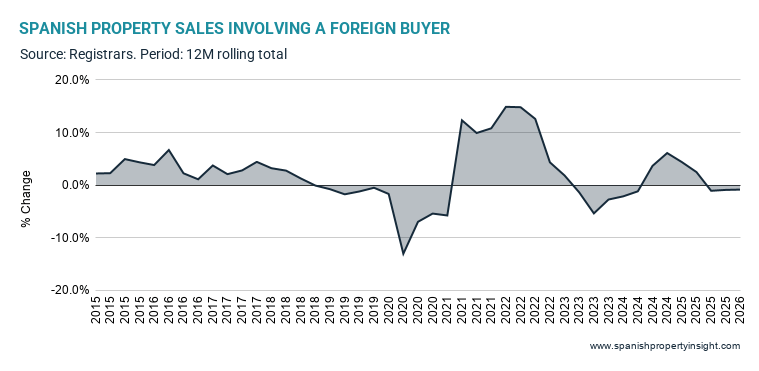
The foreign market has already had one false dawn. After cooling in 2023 following the frenetic rebound that came after Covid lockdowns, the market found a second wind in 2024 before slowing again. The latest figures suggest that second rebound has now also run its course.
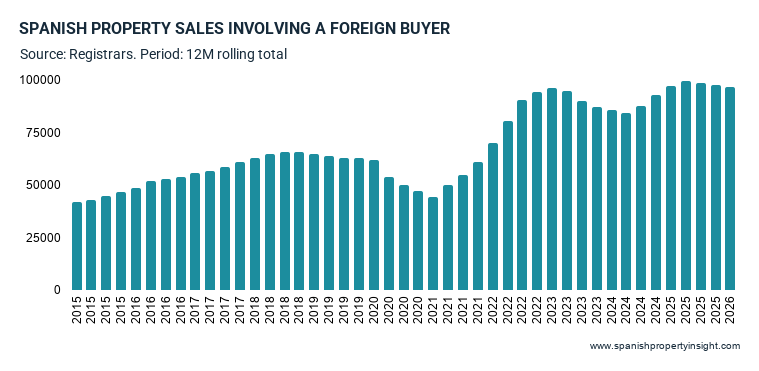
One of the best ways to understand the underlying trend is to look beyond volatile quarterly figures and focus instead on the 12-month rolling total of sales involving foreign buyers (chart above). This smooths out seasonal swings and gives a clearer picture of direction.
Using this measure, the transformation in the market over the last decade is striking. Before the pandemic, foreign demand typically hovered around 65,000 purchases every 12 months. In the wake of Covid, however, demand surged to above 90,000 as lifestyle changes, remote working, accumulated savings, and renewed appetite for sunshine destinations fuelled a buying spree across coastal Spain.
But the latest figures suggest that the market has now reached a plateau.
The 12-month rolling total peaked in Q2 2025 at 99,458 purchases involving a foreign buyer—just shy of the symbolic 100,000 mark—and has edged lower every quarter since. By Q1 2026 the rolling total had slipped to 96,696, down just under 1% compared to Q4 2025.
Still historically strong
Importantly, this is not a collapse. Foreign demand has now declined for three consecutive quarters both year-on-year and on a rolling 12-month basis, but the declines remain relatively modest—typically around 3% to 4% year-on-year, and closer to 1% when viewed through the smoother rolling-total lens.
In other words, the foreign appetite for property in Spain appears to be cooling rather than crashing.
And even after the recent softening, demand remains dramatically above the levels seen during most of the previous decade. The 2020s have, so far, been an exceptionally strong period for Spain’s foreign property market despite—or perhaps partly because of—the chaotic start to the decade with the pandemic.
Not all foreign markets are behaving the same
The headline numbers also conceal important differences between nationalities. Some buyer groups, such as the Polish market, continue to expand, while others—notably the British market—have been weakening.
So whilst the overall market may now be plateauing after the post-pandemic boom, beneath the surface the composition of foreign demand is still evolving. That, however, is a story for another day.
What this means for sellers
For sellers, the shift matters because foreign buyers have been one of the main engines driving many coastal and lifestyle markets in Spain over the last few years. If there are fewer buyers around, even modestly fewer, the balance of power in the market begins to change.
We are not yet in a full-blown buyers’ market. Buyers are not quite “in the saddle” yet. But the direction of travel increasingly suggests that negotiating power is slowly moving away from vendors and towards purchasers.
That means sellers will increasingly find themselves competing for a smaller pool of buyers, whilst also facing growing competition from new-build developments and professional developers who are often better prepared, better marketed, and more flexible on incentives.
In a market like that, simply putting a property online and hoping for the best may no longer be enough. Vendors will need to price more carefully, present properties better, sort out documentation and legal issues in advance, and think more strategically about marketing and negotiation.
In other words, as the post-pandemic frenzy fades, preparation and professionalism are likely to matter more than ever.
Thinking of selling a property in Spain?
A successful sale starts before you put your property on the market — and before you even speak to estate agents or lawyers. The first step is to understand what you own, what your property is worth, what sort of market you are selling into, how the sales process works, who you can trust, and what strategy makes most sense for you.
Too often, owners enter the process without independent advice and end up being steered by agents or others whose priorities may not fully align with their own. SPI offers expert guidance designed to put your interests first, helping you get organised, make sense of the market, and prepare for sale with a clear plan and personalised strategy.
Fill in the form below to find out more about the service.