America
In Miami, Food Banks Are Overflowing Ahead Of Thanksgiving

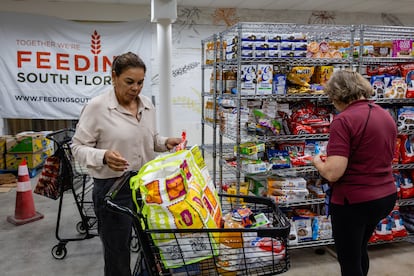
There are times of the year like Thanksgiving, when schools where some children receive food are closed, and the hunger crisis in Miami —one of the most expensive cities in the United States — is most noticeable. Despite heavy rains and the risk of flash flooding this Wednesday, hundreds of people, mostly working families, turned to free food pantries and food banks to secure a turkey and vegetables for the traditional dinner, and to offset the expenses that keep rising with inflation and the war against Iran.
At 60 years old and with three jobs, Sonia still needs to go at least once to pick up free food to complete the month’s diet. She cleans houses, takes care of children and pets, and earns $15 an hour. She bikes to work so she doesn’t have to spend on car, insurance, and fuel. What she earns goes to pay rent, electricity, and her son’s university in Chile, her home country. There she worked almost two decades as a secretary in a local government, and in the U.S. she has been changing fields as opportunities arise. She is now saving for dental treatment, which without health insurance costs thousands of dollars.
“I’ve been coming for about eight months and I keep seeing more people,” says Sonia, who prefers not to use her full name. She’s not surprised, because all the prices of all the products have gone up, “even at Dollar Tree,” the American store chain that boasted of selling all its products for one dollar.
The cost of living in Miami has risen so much that many families’ incomes are not enough to pay the minimum: shelter, food, and utilities.

In a 2026 survey conducted by Aspect Strategic for No Kid Hungry Florida, 82% of respondents said that the cost of food had increased more than their income in the past year. Around 70% indicated that their economic situation has worsened as a result of rising food prices, and 49% admitted to going into debt to cover that expense. One in two families also say they skip meals or eat less, and two out of three families have had to choose between buying food or paying essential bills.
Demand for free food pantries has skyrocketed, explains Jessica Benites, chief of staff at Feeding South Florida, a nonprofit organization that receives and distributes donations in four counties in the region through 300 branches. “We are experiencing a very large increase in families coming to Florida to ask for food aid and we’ve had to expand our operations. Before, we served until 5:00 p.m., now we are serving until 8:00 p.m. We also had to increase Saturdays and Sundays to meet the very high demand we have now,” she says.
Federal and state aid for low-income families and elderly people to buy food has been reduced. Just over a year ago, the Donald Trump Administration approved the largest reduction of the Supplemental Nutrition Assistance Program (SNAP) since its creation in 1939. As a result, about two million people lost the benefit. In Florida alone, enrollment in the program fell by 22%, according to data calculated by the Associated Press agency.
The federal government’s immigration policy, which has set out to deport as many undocumented immigrants as possible, has also added pressure to the hunger crisis in the southern part of the state. Miami and the surrounding cities are home to the largest diasporas of Haitians and Venezuelans and other communities that have lost work permits and protections granted by TPS, the Temporary Protected Status that Trump has been chipping away at since returning to the White House.
On an average day, about 200 families look for food at Feeding South Florida’s largest location, in the Hallandale Beach area, about half an hour from downtown Miami. Many of them are immigrant families who have lost their work permits and mixed-status families—where at least one member has U.S. citizenship and access to public benefits—who have chosen not to apply for the SNAP benefit for fear of retaliation.
“Many people are already afraid to share the information, and sometimes people prefer not to apply because they feel exposed and don’t receive as much money as they used to,” says Benites. “And with TPS, people could work and can’t anymore, and when they lose their jobs, they have to look for organizations that can help them. In our case, with food.”
Sign up for our weekly newsletter to get more English-language news coverage from EL PAÍS USA Edition