
ElPais
Inside Mexico’s Gay Cowboy Parties: Tequila, Dancing And Romance


Every spring, hundreds of cowboys make a pilgrimage to cities across central and northern Mexico to take part in a very particular kind of cowboy convention. It is not the sort of gathering where people discuss techniques for raising sardo negro cattle — a Mexican breed of cow — or rope calves. Instead, they dance, eat, flirt, and play. These events are opportunities to meet other men who share the same interests and passions, make friends and, who knows, perhaps enjoy a weekend romance or even meet the love of their lives.
Gay cowboy parties have flourished in Mexico and in the United States as symbols of identity, resistance, and activism. For Mexican journalist and writer Guillermo Osorno, “they are like oases in the middle of the country, far from the capital, Mexico City, where LGBTQ+ visibility does exist.”
In April 2025, Osorno attended one of the largest gay cowboy gatherings, held in Zacatecas. He was accompanied by Spanish photographer Pablo Sáez after a mutual friend, stylist Alba Melendo, recognized the potential of these events. The result of their foray into this world is a portrait of the social and intimate lives of these men in the form of a photography book titled Vaquero (Cowboy).
At the heart of cowboy ritual
Cowhide, crocodile, or ostrich-skin boots; tight-fitting skinny jeans that accentuate the figure; python-skin belts; shirts with embroidery flamboyant enough for a showgirl; wide-brimmed felt or palm hats. The look is instantly recognizable, varying only in color, fabric, or leather, but always embodying the cowboy archetype. People toast with Tecate beer and caballitos — as tequila shots are known in Mexico — before heading to the dance floor, moving to the rhythms of banda music, faces and chests pressed together, legs intertwined.
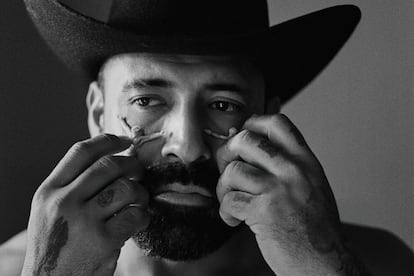
Osorno says these gatherings emerged about two decades ago out of the need felt by gay men in northern Mexico, an industrial and ranching region, to create safe spaces where they could meet one another without fear of judgment and, above all, dress the way they wanted.
“They did not feel represented in a homophobic society that was suffocating them,” the author explains. In those parts of the country, it was far more difficult for gay men to build a sense of community than in Mexico City, where the LGBTQ+ movement was then engaged in a vigorous struggle for equal rights. That effort culminated in the capital’s legalization of same-sex marriage in 2009, a right that was not extended nationwide until 2022.
At these parties, men are free to be themselves because they feel safe. Some, Osorno notes, are activists who have fought for LGBTQ+ rights in places such as Chihuahua, Zacatecas, Baja California, and Ciudad Juárez. “Others come from very small towns and communities where they haven’t come out of the closet,” says Osorno. “They travel up to 200 kilometers [124 miles] to attend one of these gatherings. While back home, they may run a fruit and vegetable stall at the market; at the cowboy party, they are different men, more authentic.”

The celebration Osorno and Sáez photographed took place in Zacatecas during Easter Week. The event lasts three or four days and features live music, dancing, and plenty of food. “They also choose the Cowboy Face, which is a popularity contest rather than a beauty pageant,” says Osorno.
The competition echoes the long-standing tradition of crowning local queens and princesses at community festivals. “And on Holy Saturday there’s a horseback parade through the streets of Jerez de García Salinas, a nearby town, where local residents join the cowboys as they ride through town.”
Music is a central part of these gatherings. According to Osorno, the soundtrack is the same one heard throughout the region: cumbia sonidera, a distinctly Mexican style closely associated with the sonideros, roaming DJs and MCs who traditionally hauled massive sound systems and organized open-air dances. The playlist also includes corridos norteños. “Their lyrics tell stories of love, heartbreak, and drug trafficking,” the journalist says.

Tradition and fetishism
Participants have embraced the cowboy aesthetic of their fathers and grandfathers. In this part of the country, jeans, boots, and wide-brimmed hats are everyday attire. “Many come from ranching families,” Osorno says. He adds: “The real cowboys come from New Spain — that is, it was Spain’s conquest of that territory that gave rise to the first cattle ranches and the riders who tended the cows. With the division between the United States and Mexico in the 19th century, they ended up on both sides of the border.” American literature and cinema later appropriated and romanticized the cowboy figure, turning it into a global icon.
Many of the attendees are not cowboys by profession. They are teachers, police officers, nurses, veterinarians… “Others come from humbler backgrounds, running market stalls, but all are very familiar with the cowboy uniform,” he explains.
Adopting the cowboy aesthetic is not only a way of reclaiming their identity. It also carries an element of fetishism, Osorno concedes. It is a symbol of strength, passion, and eroticism that challenges the notion of the cowboy as an exclusively heterosexual archetype. “It is a hypermasculine representation of the man who lives and works on a ranch and faces the forces of nature alone,” the author explains.

Looking beyond that heightened image of masculinity was one of the main goals of Osorno and Sáez’s photographic project: to discover the people behind the denim and leather boots. “There were some who didn’t want to appear in the photos, but many were delighted to take part,” says Osorno.
The gatherings attract people of all ages and body types, though Osorno notes that it is primarily a world of middle-aged and older men. “Unlike in many other subcultures, age is valued here.” That reality is reflected in the selection of images featured in the book.
It all began in Mexico City…
Osorno first heard about these gatherings from one of the organizers of the event held in León, in the state of Guanajuato, about three hours from Mexico City. “The first time I saw more than 600 men dressed in those distinctive outfits, I was stunned. From that moment on, I started researching,” he says.
In 2025, during a dinner party, he met Alba Melendo, and later that evening they ended up at a small gay cowboy bar in Mexico City. The Madrid-born stylist suggested producing a fashion editorial and recruited photographer Pablo Sáez for the project. What began as a magazine shoot soon grew into a book, prompting them to approach the publisher Casa Siete. In less than a month, they assembled a team and traveled to the Zacatecas party. They also brought Levi’s on board as a partner. “What brand could better represent the cowboy?” Osorno says.
Sign up for our weekly newsletter to get more English-language news coverage from EL PAÍS USA Edition










Banco Sabadell
From Opus Dei Alumni To McKinsey Consultants: The Clans That Run Spain’s Biggest Companies


An invisible web of connections links the executives and board members of Spain’s largest companies. Having spent time at certain elite consulting firms, business schools or government institutions opens more doors than any headhunter ever could. Former state attorneys sitting on the boards of major Spanish companies, ex-McKinsey executives running some of the financial sector’s most powerful firms, and alumni of leading business schools such as IESE and ICADE holding top positions in multinational companies all illustrate a network of influence, as subtle as it is enduring, that has been woven through Spain’s corporate elite.
“We all know each other here, and when someone comes from McKinsey we already know what will happen,” says an executive at one of Spain’s largest insurers.
McKinsey & Company is a U.S. strategic consultancy founded 100 years ago. Its owners? Its own partners. Unlike other firms such as Accenture, PwC, Deloitte or KPMG, which have a broader range of businesses, McKinsey focuses primarily on advising top executives to launch large-scale projects within organizations: from mergers and acquisitions to entry into new markets.
In the book When McKinsey Comes to Town, journalists Walt Bogdanich and Michael Forsythe explain one of the firm’s most common practices: a large corporation hires the firm for specific assignments, such as improving efficiency, reviewing processes or overseeing procurement projects. Consultants develop close relationships with senior management and, after a few years, some of them are recruited by the client company and recruit other colleagues.
In Spain, McKinsey’s influence is far-reaching. During the Spanish bank BBVA’s attempted takeover of Banco Sabadell, three of the four key players had previously worked for the consulting firm. BBVA Chairman Carlos Torres, Chief Executive Onur Genç and Banco Sabadell CEO César González-Bueno had all been partners at McKinsey.
Throughout the failed bid, many investors questioned the management style of Torres and Genç, attributing it to what they described as the “McKinsey playbook.” “They think they’re smarter than everyone else, but in the end they lack street smarts, they don’t know people well enough, and they dug in with a timid 10% improvement to the offer that failed to tip the balance,” explains a veteran fund manager who oversees more than $110 million in assets.
McKinsey has also had a significant presence at the bank Santander. Until a few months ago, Víctor Matarranz was the right-hand man to CEO Héctor Grisi and also headed the bank’s powerful insurance and asset-management division. He has since moved to the British banking giant HSBC.
The network extends well beyond finance. Fuencisla Clemares, Google’s country manager in Spain, as well as Ignacio Eyries, the new chairman of media group Vocento, publisher of the conservative newspaper ABC, and Sergio Oslé, the recently appointed chairman of media company Mediapro, were also McKinsey partners. Oslé began his tenure by launching a redundancy plan affecting 20% of the workforce. Ignacio Madridejos, the CEO of transport company Ferrovial, also belongs to this circle.
These networks of influence do not exist in isolation. Sometimes they overlap. Madridejos is a case in point. Before joining McKinsey, he studied civil engineering in Madrid, another of the most prolific breeding grounds for Spain’s corporate elite, particularly in the construction sector. Florentino Pérez (chairman of ACS), Manuel Manrique and Juan del Rivero (Sacyr), Juan Miguel Villar Mir (who died in 2024 and founded the Villar Mir group, now OHLA) and José María Entrecanales (founder of the Acciona group, died in 2008) all studied that engineering degree.
“Spain’s major infrastructure has been built by a handful of leading companies founded by civil engineers who were also very successful in internationalizing,” sums up an octogenarian Madrid businessman who worked with many of the engineers mentioned above.
Another engineering pipeline to Spain’s corporate elite is the Institute of Catholic Arts and Industries (ICAI), part of Comillas Pontifical University. The private institution is controlled by the Society of Jesus, the Catholic order better known as the Jesuits, which, alongside Opus Dei, is one of the most influential forces in Spanish education.
At the ICAI engineering school, located on Madrid’s Alberto Aguilera Street, Ignacio Sánchez Galán, chairman of Spain’s energy giant Iberdrola, studied industrial engineering before also earning a business management degree from ICADE, the university’s business school. Other ICAI alumni include Gloria Ortiz, CEO of Bankinter; José Bogas, vice chairman and former chief executive of energy company Endesa; Francisco José Riberas, founder and chairman of auto-parts manufacturer Gestamp; and Amparo Moraleda, chair of the European aerospace group Airbus.
Together, ICAI and Icade boast what is arguably the most extensive and influential alumni network in Spanish business, with more than 50,000 registered graduates. The roster of prominent executives that have passed through the two Jesuit-run institutions is so long that it has its own Wikipedia entry. According to Comillas Pontifical University, the alumni network aims to “facilitate networking, mentoring, access to job opportunities and exclusive events.”

Icade was a pioneer in Spain’s higher-education system, becoming the first university to offer double-degree programs. In 1960, it launched its flagship E-3 program, combining law and business administration. It later extended the model to other degree combinations. The program was so successful that most Spanish universities copied it.
A former ICADE student who now works as an executive at a multinational marketing company acknowledges that the quality of education is “excellent,” but believes there are other reasons so many alumni reach senior management positions. “Networking plays a role, of course, but it also matters that many of the wealthy families from Madrid and nearby areas do everything they can to send their children there.” The executive recalls that “there were many classmates with compound surnames, whose lives you ended up reading about in the society pages of ABC or Hello magazine.”
Ignacio de la Torre, chief economist at investment firm Arcano Partners, questions how influential these contact networks really are. “In executive selection processes, they look for profiles with certain skills who have demonstrated their capacity throughout their careers, and sometimes they come from engineering backgrounds or certain business schools, but reaching those positions isn’t because a university friend pulled strings,” says the economist. “HR departments seek diverse profiles, because it has been shown that only then do you build stronger and more successful teams.”
The Jesuits’ influence extends beyond Comillas Pontifical University. They also run the University of Deusto in Bilbao, a major breeding ground for the Basque Country’s political and business elite, particularly in banking.
Deusto Business School has produced a long list of prominent figures in Spanish finance. Its alumni include José Ignacio Goirigolzarri, former CEO of BBVA and later chairman of Bankia and CaixaBank; Emilio Botín, the longtime Santander chairman who died in 2014 and father of current chair Ana Botín; and Gregorio Villalabeitia, former chairman of Kutxabank. Historic banking figures such as José Ángel Sánchez Asiaín of Banco de Bilbao, Emilio Ybarra of BBV and Pedro Luis Uriarte also emerged from the same institution.
In addition to ICADE and ICAI in Madrid and the University of Deusto in Bilbao, the Jesuits also run the Higher School of Business Administration and Management (ESADE) in Barcelona, which also has a campus in Madrid. Established in 1958 with support from a group of Catalan business leaders, Esade is a postgraduate institution specializing in executive education. Among its alumni are prominent business figures such as Tomás Muniesa, the current chairman of CaixaBank, and Gabriel Escarrer, chairman and CEO of Meliá Hotels International.
That same year, at the height of Spain’s economic-development drive under dictator Francisco Franco, Opus Dei, through the University of Navarra, founded the IESE Business School, another institution focused on executive education. Its first campus was also in Barcelona, but it soon opened a second campus in Madrid’s Aravaca district, on the wooded slopes of Cerro del Águila, near the exclusive Real Club de Campo.
For decades, the Jesuits and Opus Dei have competed to place their business schools among the world’s most prestigious. Both have partnerships with Harvard University and educate thousands of students each year. According to the latest Financial Times rankings, IESE ranks third worldwide for open-enrollment executive programs, while Esade ranks fifth.
Both schools offer programs for senior executives as well as recently graduated students, including the MBA. At IESE, the program currently costs €114,000 ($132,000).
One of IESE’s most influential supporters is Isidro Fainé, chairman of the La Caixa Foundation and one of the most powerful figures in Spanish business. The veteran banker, who is also a member of Opus Dei, studied at Harvard and later completed an executive program at IESE. CaixaBank, along with companies such as Mango and the Basque engineering group Sener, is among the business school’s principal sponsors. Oversight of IESE’s budget, as well as appointments of faculty and governing-board members, falls to the vice chancellor of the University of Navarra, Father Ignacio Barrera Rodríguez, Opus Dei’s regional vicar in Spain.
Andrés Villena Oliver, a professor of applied economics at Madrid’s Complutense University, has spent years studying Spain’s ruling elites. His latest book, Las élites que dominan España (The Elites That Rule Spain), examines these networks of influence. “Business schools, both ESDAE and IESE, are ultimately creations of large industrial groups to train new business generations and continue maintaining power,” he says. In his view, these elite selection models “are a way of filtering candidates so that only similar people access senior roles.”
In addition to strategy consulting firms, engineering schools and Catholic universities, another important pipeline into Spain’s corporate elite is the civil service. One of the clearest examples is the State Attorneys Corps, one of the country’s most prestigious branches of the public administration, whose members are responsible for representing and advising Spain’s central government on legal matters. Of the corps’ 675 lawyers, nearly half are currently on leave from public service, most of them working for major law firms and large corporations.
Moving to the private sector
One of the most common destinations for state attorneys who leave public service is the role of corporate secretary, the executive responsible for overseeing the work and governance of a company’s board of directors. At major Spanish corporations such as Santander, Mapfre and Iberdrola, the person responsible for the functioning of the board is a state attorney. Their influence extends beyond those administrative roles. At ACS, for example, six members of the board of directors have a background as a state attorney.
Their careers in the private sector do not always remain confined to legal advisory roles. Pablo Isla, widely regarded as one of Spain’s most respected corporate executives, former chairman and CEO of Inditex, the parent company of Zara, and now chairman of Nestlé, is a member of the State Attorneys Corps. So is Óscar García Maceiras, who succeeded him as Inditex’s chief executive.
Professor Villena Oliver finds it “to some extent logical” that large companies want these profiles on their governing bodies, as they combine deep knowledge of the state’s legal mechanisms with a powerful network of professional relationships. “The 20 to 25 new state attorneys who enter each year know each other well, and the company that hires them not only gets them but also their valuable contact book,” says the economist.
In his book Los dueños del Estado (The Owners of the State), journalist Rafael Méndez examines the inner workings of this elite group. “The entrance exams are brutal, and it is not easy to pull strings to get someone in. But there are many double-barreled surnames and a certain degree of endogamy,” he explains.
Another branch of the civil service that has served as a breeding ground for politicians and business leaders is the State Trade Corps, an elite body of economists and trade specialists. Known in Spain as tecos, its members have occupied many senior positions within the Economy Ministry and the Bank of Spain. Many have also jumped to the private sector.
One example is José Manuel Campa, a former secretary of state for the economy and former chair of the European Banking Authority, who spent four years as Santander’s global head of regulatory affairs and now teaches at IESE Business School.
The financial sector is probably where these elite networks are most concentrated. Because banking is one of the economy’s most heavily regulated industries, banks have long been attracted to former senior civil servants with regulatory expertise. At the same time, most top banking executives have passed through one of Spain’s leading business schools.
The financial sector is probably the one in which these networks are most heavily concentrated among senior executives. Because it is so highly regulated, banks have tended to recruit former top-ranking public officials into leadership positions. And almost all of their executives have attended a business school.
Another group that played a major role in shaping the Spanish stock market and still maintains a presence today is that of the former agentes de cambio y bolsa (stockbrokers), a regulated profession with similarities to that of notaries public.
Some of them went on to found their own firms. That was the case of Francisco González, who established FG Valores Bursátiles and later became chairman of BBVA.
Another brokerage founded by former stockbrokers was AB Asesores. After the firm was sold to the U.S. bank Morgan Stanley, this network dispersed, with its members turning up across many of Spain’s leading financial institutions, from Bankinter to Mutua Madrileña.
Its most famous partner? A little-known teco named Luis de Guindos, who would go on to head Lehman Brothers in Spain, serve as Spain’s economy minister, and later become vice president of the European Central Bank.
It is another textbook example of the networks of influence, overlapping circles and privileged relationships that help shape economic power in Spain.
The making of elites around the world
The formation of economic and administrative elites follows different patterns from country to country, but in every case it involves a combination of academic achievement, social networks and mechanisms of social selection.
France provides perhaps the clearest example of a system that reproduces elites through specific educational institutions. For decades, the École Nationale d’Administration (ENA) — which was abolished in 2022 and replaced by the Institut National du Service Public — together with the École Polytechnique, served as the principal breeding grounds for the country’s senior civil servants and corporate leaders. Their classrooms have produced presidents, ministers, top bureaucrats and the leaders of some of France’s largest companies.
What sets the French system apart is the close relationship between the state and big business. Many graduates of these grandes écoles begin their careers in the civil service before moving on to senior positions in industrial, energy and financial groups. Companies such as AXA, Société Générale, BNP Paribas, Carrefour, Orange and Vivendi have all been led by executives trained at these institutions.
This phenomenon has led many sociologists and historians to describe these institutions as a kind of “state nobility” or “bureaucratic nobility”: an elite legitimized by competitive examinations and academic achievement, but one that also occupies a disproportionately large share of positions of power.
Economist and sociologist Andrés Villena considers it “natural” for countries to develop specific pathways to power, describing them as “a tool for ensuring the continuity of the state.” As he notes, “the first to develop such methods of elite selection were the Chinese, with the imperial examination system some 15 centuries ago.”
In the United Kingdom, the logic is different, though power is similarly concentrated. The universities of Oxford and Cambridge, collectively known as Oxbridge, continue to play a central role in training the country’s political, legal and business elites. Their influence is reinforced by the longstanding prestige of private schools such as Eton and Winchester, which often serve as a pathway to the country’s most selective universities. Unlike France, where the state occupies a central position, the British model is more closely tied to the weight of finance, the professions and the social networks forged during education.
In Germany, economic elites frequently emerge from technical universities, engineering schools and a highly developed vocational training system. Access to top corporate positions is generally less concentrated in the hands of graduates from a small group of institutions.
The United States has a more open and decentralized system, though it is no less hierarchical for that. Universities such as Harvard, Stanford, Princeton, Yale, and MIT continue to wield considerable influence in Wall Street firms, Silicon Valley technology companies, and major corporations. At the same time, entrepreneurship and geographic mobility make it possible to follow a wider variety of paths to positions of power than is typically the case in Europe.
Sign up for our weekly newsletter to get more English-language news coverage from EL PAÍS USA Edition
Argentina
Dinosaur Fossils, The Latest Obsession Of The Ultra-Rich: ‘Some Enjoy Knowing Only They Can Admire It’

“Look, with this I can solve the origin of vipers,” a European collector snapped at Argentine paleontologist Federico Agnolín a few years ago. Then he shut the drawer, consigning the fossil to darkness. “It was like a little blind viper, a creature that never saw the light of science. It’s a very complicated issue. I can’t say much more,” the scientist admits today.
This summer, The Guardian revealed that one of the most spectacular collections of Jurassic fossils in the United Kingdom had been sold to a museum in Abu Dhabi, a move British experts described as an irreparable loss for a country more used to seeing prized collections arrive on its shores than leave them. The 318 specimens assembled by a private fossil collector fetched “an eight-figure sum.”
Public fossil auctions, such as those regularly organized by Sotheby’s, are becoming increasingly common and lucrative. Prices have soared from the more than $8 million paid for Sue, the Tyrannosaurus Rex, in 1997 to the more than $50.1 million spent this year on Gus, another specimen of the species, in a bidding war that lasted barely 10 minutes. High-profile actors have bought dinosaurs of their own, including Leonardo DiCaprio, Russell Crowe and Nicolas Cage. Cage was forced to return a Tarbosaurus skull for which he had paid $276,000 after it emerged that it had been looted from Mongolia. The fossil craze can lead to dubious acquisitions, even when everything initially appears legal.
“A fossil is priceless because it is a unique item created by nature. Its value is exclusively scientific,” Agnolín argues. “There are collectors, people with a lot of money who don’t know what to do with it and devote themselves to collecting fossils. We cannot allow humanity to be deprived of knowledge simply because someone likes a piece and wants it on their windowsill. And that happens a lot.”
Agnolín has come across scenes like the one with the blind viper many times and is convinced that fossils have become the latest trophy for the wealthy. “Collectors seek out the unusual. I know that world very well. There’s the guy who has the Tyrannosaurus rex, who wants to show it off to his friends, and there’s the guy who has a new species — one not yet classified by science — who takes pleasure in knowing that only he can admire it, even though that specimen might solve an important scientific problem.”
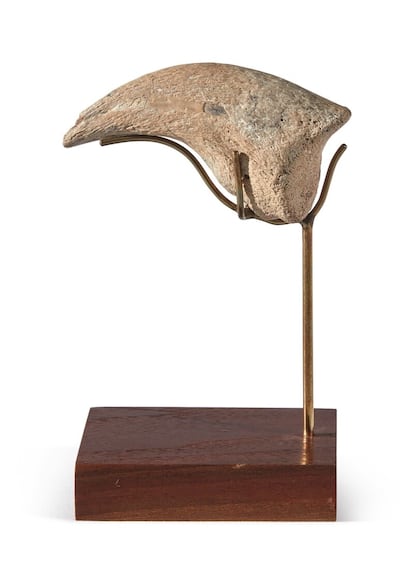
That lies at the heart of the controversy. As multimillionaires pour money into fossils, scientists worry that the trend could hinder research.
Legal grey areas
In many places where the fossil trade is legal, owners are under no obligation to inform scientific institutions about specimens they acquire, even though it is their scientific value that makes them important in the first place. Without the technical knowledge attached to them, any fossil would be little more than a bone or an oddly shaped rock.
The fossil market is legal in the United States and in parts of Europe, although regulations vary considerably depending on the jurisdiction and the type of land where a specimen was found. In Spain and Latin America, by contrast, such transactions are generally prohibited, and fossil discoveries are considered part of the national heritage. With no international framework establishing even minimum rules for the trade, collectors can exploit legal grey areas while traffickers take advantage of the differences between national laws.
“Often those legal gray areas are used to carry out what is known as huaquerismo, which is the extraction of archaeological or paleontological remains to take them out of the country,” warns paleontologist Horacio Padula, deputy manager in the Buenos Aires City Heritage Directorate and one of the architects of Argentina’s 2003 reform of its Archaeological and Paleontological Heritage Protection Law. “I have seen it, as many people have; there used to be a market selling fossils at the door of the Natural Sciences Museum,” Padula recalls.
Selling an Argentine fossil abroad is illegal, but selling a U.S. one is not. “These countries — where the fossil trade is lawful — have a different policy. What the state cannot or does not want to protect becomes appropriable,” says María Luz Endere, a PhD in archaeology and researcher specializing in cultural heritage law and management. “That is where speculation comes in, because it’s a form of investment, like buying art. You can buy a dinosaur as an investment,” she compares.
“How do you legislate to decide that fossils can be bought, but only those irrelevant to science? How do you know which one won’t solve a scientific puzzle?” Agnolín asks. “Once we went to study material in Germany, which is the great repository for fossils from the rest of the world, and there was a feathered dinosaur from China that had a sternum like a chicken’s. It’s the bone that allows birds to open their wings to fly. It was the perfect transition between a dinosaur and a bird. It had been bought illegally,” he remembers, still outraged.
The long tradition of trading prehistory
In the English-speaking world, the buying and selling of prehistoric specimens is not only legal but an old tradition. The Tucson Gem and Mineral Show in Arizona has been running for more than 70 years and is the world’s most important event of its kind. Thousands of exhibitors offer minerals, gemstones and fossils.
Fossil trading has always been legal in the United Kingdom. It was in this context that pioneers such as Mary Anning emerged, making a living and earning fame by selling the fossils she discovered along the coast of Lyme Regis. Today, there are numerous fossil shops and preparation workshops, where specimens are meticulously cleaned and restored.
On sites such as Dorset’s Jurassic Coast, collectors follow a general code of conduct that distinguishes between two categories of fossils: those of high scientific importance and those of more limited significance. Only the former, including potentially new species, rare finds or exceptionally well-preserved specimens, must be formally reported and recorded.
But even Britain can no longer keep such treasures at home: the fossils that ended up in Abu Dhabi made that journey because no British museum could afford to buy them. Hundreds of marine creatures, including ichthyosaurs and species that may yet prove new to science, were shipped to another continent.
For paleontologist Sebastián Apesteguía, the growing appetite of the wealthy for fossils reflects the return of a kind of imperial inequality. “It’s like a return to the Roman world, when the power gap between the rich and the plebeians was so great that they could afford to own impossible objects.”
The Inca Empire did something similar, he argues. “When Túpac Yupanqui sailed to Polynesia, he brought whale remains to keep in the palace, a brass chair and very dark-skinned slaves. He brought them as trophies to display objects from other parts of the world,” says Apesteguía, who also studies the Indigenous peoples of the Americas.
In Agnolín’s view, permissive legislation is perfect for plundering nations. “They’re tailor-made for them, because they need to allow the entry of fossils from other countries,” he argues.
What underlies the trend, the Argentine scientist believes, is a troubling idea: that money can buy anything and satisfy every whim. “Increasingly, real-world villains resemble those from comic books, who think they can achieve eternal life,” he says. “This madness happening with fossils is part of that — it’s the work of villains who seem straight out of Batman. States should put a stop to it. This is about understanding the history of life on Earth, and that belongs to humanity.”
The price of history
- Gus, the T. rex. Sold in July of this year by auction house Sotheby’s in New York for $50.1 million in 10 minutes. It is one of the most complete Tyrannosaurus rex skeletons.
- Ceratosaurus nasicornis. Sold in 2025 for $30.5 million by Sotheby’s. It is 150 million years old. Only four exist in the world. The one sold is the only juvenile specimen. It belonged to the Museum of Ancient Life in Utah, United States. The anonymous buyer promised to loan it to another institution for continued display, but its whereabouts remain undisclosed. A meteorite was also sold at the same auction.
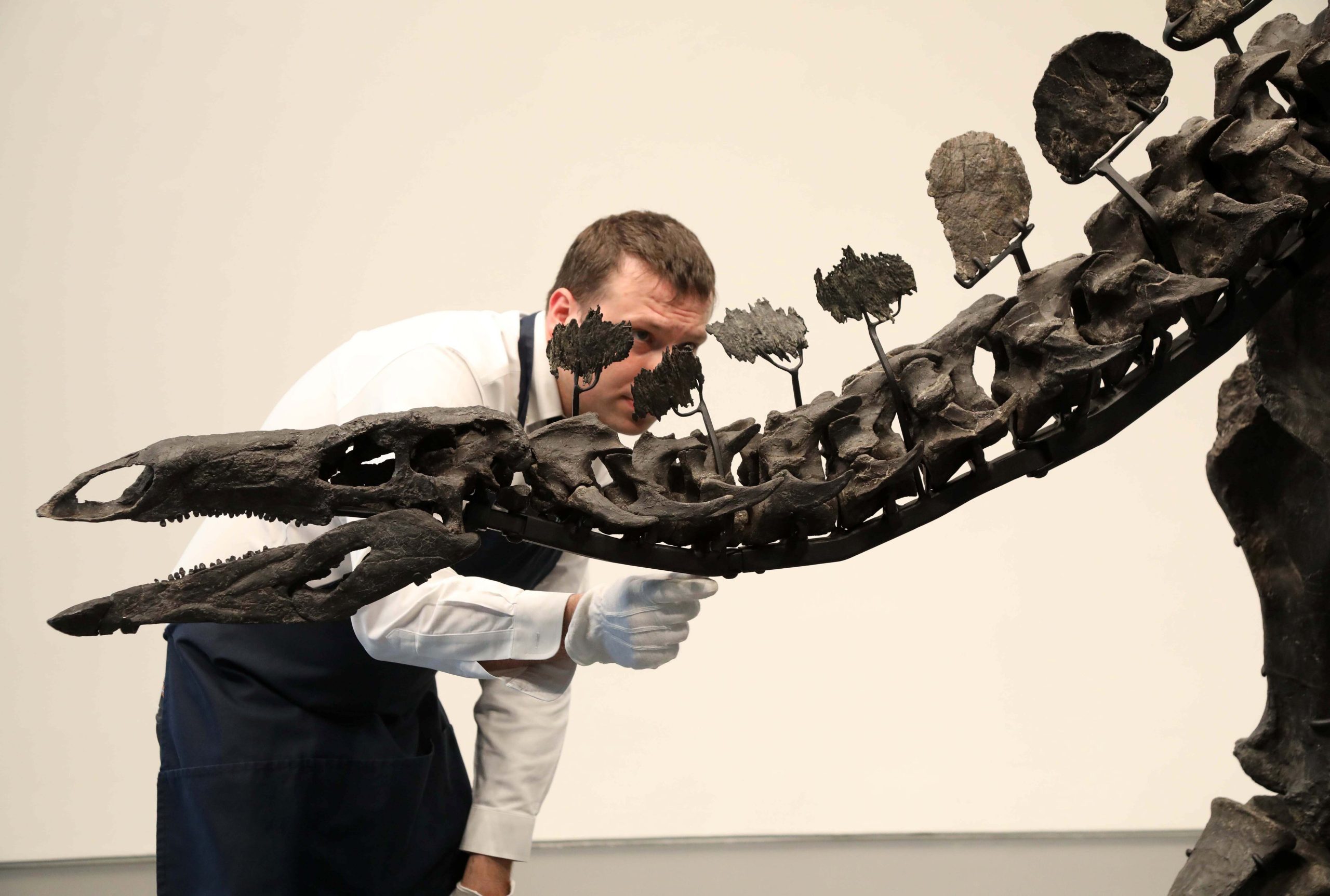
- Apex, the stegosaurus. Sold in 2024 for $44.6 million to financier Ken Griffin. The magnate loaned it to the American Museum of Natural History, where it can be seen through 2028. It was discovered in 2022, and there are 80 specimens worldwide. Apex is one of the most complete skeletons. Griffin pledged to fund research that could yield more details about its species, growth, metabolism and skeletal development.
- Stan, the T. rex. Sold in 2020 for $31,847,500 to an anonymous buyer in a virtual auction alongside works of art in the U.S. It was missing for two years until the Abu Dhabi Natural History Museum, which opened in late 2025, announced it would be exhibited there. The 67‑million‑year‑old specimen was discovered in 1987 in South Dakota’s Hell Creek Formation and is one of the most complete T. rex skeletons ever found. It is, to date, the most expensive fossil in history.
- Allosaurus and Diplodocus skeletons. Sold in 2018 by Binoche et Giquello in Paris for €1.15 million ($1.33 million) and €1.18 million ($1.36 million), respectively.
- Triceratops skull, sold in 2017 (also in Paris) for €177,800 ($205,000) to a Chinese multimillionaire who owns a hotel chain.
- Allosaurus and a Siberian mammoth. Sold in 2016 and 2017 by auction house Aguttes for more than €1.1 million ($1.27 million) and €548,000 ($632,000), respectively.
- Tarbosaurus skull. The 67‑million‑year‑old fossil, from a close relative of T. rex, was purchased by Nicolas Cage in 2007 for $276,000. He was later forced to return it after investigators determined it had been illegally smuggled out of Mongolia, highlighting the risks and legal ambiguities that can accompany the booming fossil trade.
- Sue, the T. rex. Sold in 1997 for $8.3 million to the Field Museum in Chicago.
Sign up for our weekly newsletter to get more English-language news coverage from EL PAÍS USA Edition

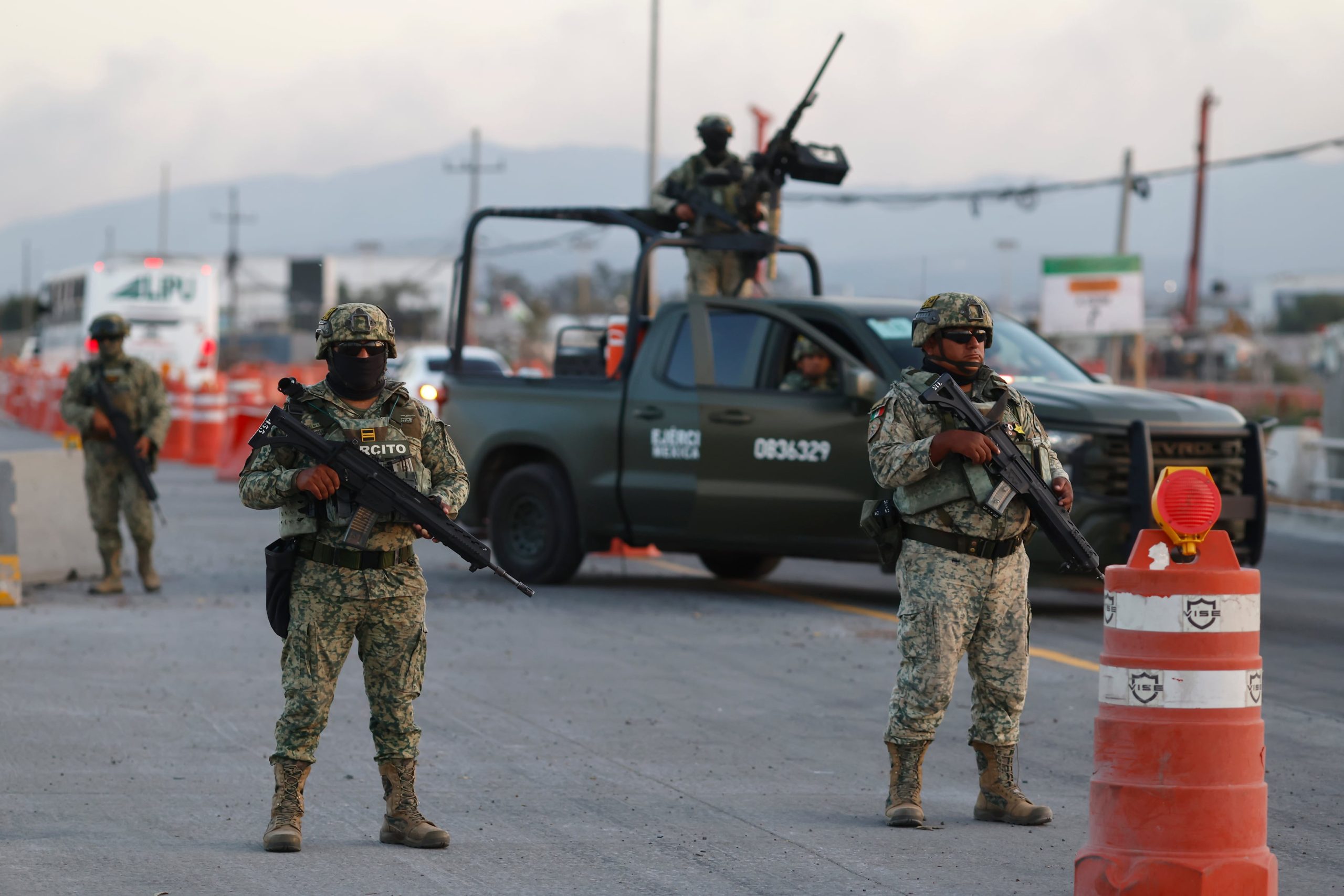
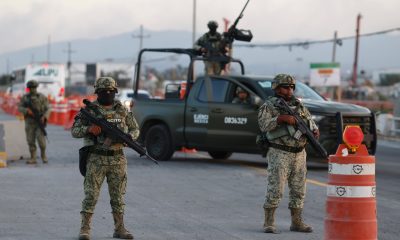
In mid-March of 2025, the Mexican Navy arrested José Remedios Araiza — alias “R1” — in the state of Yucatán. He led the group of “hitmen working for the Santa Rosa de Lima Cartel” (CSRL), one of the most violent criminal organizations in the lowlands of central Mexico, particularly active in the states of Guanajuato and Querétaro. Authorities simultaneously announced the arrest of nine other individuals, all part of the same criminal network. One of the detainees was even accused of committing a massacre in Querétaro in late 2024.
The arrests made headlines for a few hours, before fading into the background of current events. But members of the Secretariat of Security and Citizen Protection (SSPC) — a cabinet-level agency — sensed that this would have significant consequences for the region.
The arrest of R1 and Alfa 1 — the latter being the perpetrator of the massacre of 10 people in a bar in the state of Querétaro, in November of 2024 — ushered in a new era for the region (at least, statistically speaking), especially in the state of Guanajuato. The lowlands’ major industrial engine had suffered for years due to the violence of organized crime. Since 2012, the number of murders in the region has steadily increased, sometimes at a very high rate. From 600 in 2012, they rose to 800 per year. Then, 900. The number of victims climbed to 1,200 per year, then 2,220, then 3,500, eventually reaching more than 5,000 annually. The clashes between the CSRL, an organization dedicated to fuel theft and drug trafficking, and the Jalisco New Generation Cartel (CJNG) fueled the spiral. Until very recently, no solutions were in sight.
In early March of 2025, the governor of Guanajuato acknowledged a 33% increase in murders in the state. In the preceding months, there had been several massacres, high-profile assassinations and attacks on police officers. Even the case of the bar massacre in Querétaro seemed to have originated in Guanajuato, the neighboring state. Federal Security Secretary Omar García Harfuch indicated that it was a fight between criminal cells. By then, it was already known that the attackers were from the CSRL, while the targets were members of the CJNG.
Harfuch and his team had a new approach: they would go after the leading perpetrators of the violence, as the first step to stopping the bloodshed. In early 2025, it was time to test whether this strategy would work. Subsequently, the aforementioned arrests took place and, starting the following month, the murder rate in the region plummeted.
The federal agency, under Harfuch’s command, is currently using the case of Guanajuato to explain the merits of this new security strategy. The security directors believe that last year’s operations are responsible for the great statistical miracle achieved by the current administration: the more than 50% drop in homicides recorded since President Claudia Sheinbaum took office in October of 2024.
This miracle has been widely discussed, especially within academia. On one side are those who assume there must be some trickery involved: they point to changes in how statistical categories are defined, as well as the increase in disappearances as possibilities for the drop. On the other hand, there are those who accept the decline, but dismiss the idea that it’s solely due to the federal security strategy. Caught in the middle is the government, which is trying to explain itself.
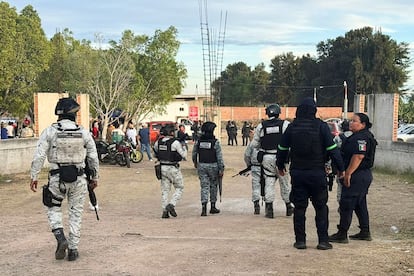
Marcela Figueroa, head of the Executive Secretariat of the National Public Security System (SESNSP), is responsible, among other things, for preparing the government’s crime statistics. “There are specific reasons why homicides are decreasing, at specific times, given specific arrests in specific states,” she explains. She points to the case of Guanajuato. “We used to have 13 homicides a day. We arrested these perpetrators of violence… and the numbers began to decrease. And we can see this in every state, in every municipality,” she argues.
In March of 2025, the state recorded 347 murders. This is according to the SESNSP, which gathers its figures from local prosecutors’ offices. In April of that year, there were 196. But the number hasn’t risen above that ever since: in July of this year, the total number of murders dropped to 97.
In his bi-weekly press conferences, Secretary Harfuch usually updates the number of arrests made to date during Sheinbaum’s six-year term (2024-2030), which amount to tens of thousands. However, the fate of almost all the detainees is unknown: whether they remain in prison, whether the arrests have led to trials, whether any have been convicted…
The statistics serve the government in its efforts to bolster its narrative of success. The claim is that it’s not just Guanajuato seeing an improvement – it’s every state. The arrests of those responsible for causing violence result in fewer murders, so goes the official narrative. And the statistics corroborate this, whether they’re from the SESNSP or the National Institute of Statistics and Geography (INEGI), which counts murders based on death certificates. From 2024 to 2025, practically all Mexican states saw decreases in homicides, with some minor increases, with the glaring exception of Sinaloa.
Figueroa maintains that there’s no trickery involved. “It’s very difficult to hide homicides,” she explains. This is how the head of the SESNSP addresses criticism over cases precisely like Sinaloa’s. The newspaper Noroeste has pointed to the possible cover-up of 133 murders by the State Attorney General’s Office, in addition to “310 discoveries of bodies and skeletal remains,” which the law enforcement agency didn’t include in the data it sent to the SESNSP. Figueroa states that “the National Information Center (CNI) monitors [statistics] to identify discrepancies. When we see them, we immediately speak with the prosecutors.” In the case of skeletal remains, the discovery “cannot be reported as a homicide, because we don’t know how many people the remains belong to,” she argues. “It takes a month, two months. But the [local] AGs have the obligation to update the information.”
Carolina Jasso holds a PhD in Social Science from the College of Mexico. A few months ago, she published a study titled Fewer Homicides, More Questions, in collaboration with the Ibero-American University. In short, the text attempts to examine the statistical decrease in homicides across Mexico, to determine why they have fallen so dramatically in such a short period of time. The most obvious conclusion is that the government’s security strategy alone doesn’t explain the drop. “I identify seven possible hypotheses,” Jasso points out, “and none of them fully explains the situation.”
“A causal relationship is being established between strategy and the reduction… but there’s no independent evaluation. We hear about destroyed labs, arrests and seized drugs, but there are no public databases that allow us to verify this,” she criticizes.
Jasso’s hypotheses certainly take the government’s recent strategy into account. But they also point to controversies, such as how exactly crimes are classified. The Attorney General’s Office and the National Public Security System (SESNSP) include categories such as “other violent crimes,” which account for more than 15,000 victims each year. Jasso and other academics suspect that this category is being used by prosecutors across the country to conceal murders.
“‘Other violent crimes’ shouldn’t include any type of violent death,” Figueroa argues. “The methodology used is clear and publicly available. And, in reality, this categorization gives us more information about each case.”
Jasso also warns about the number of murder victims recorded by the National Institute of Statistics and Geography (INEGI), a number that is increasingly higher than the figure recorded by the SESNSP, pointing to a widening gap. Figueroa responds to this: “It’s true that the difference has grown, but it’s lower than in other countries, such as the United States or Canada, where that difference can reach 40%.”
She continues: “Yes, we’ve identified states with differences greater than 15%.” This is, for instance, the case in Guanajuato, where the difference in numbers recorded climbs to more than 20%. “We want to understand why this greater disparity is occurring. Just last week, we went to the state of Mexico (EDOMEX),” she says. This region, which consists of the areas surrounding the national capital, Mexico City, has the greatest disparity between the INEGI numbers and the SESNSP numbers. Figuera notes that she and her team went there “to set up a working group, [in order to] identify possible causes.”
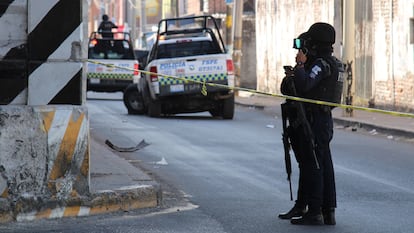
In addition to statistical issues, while looking at the decrease in homicides, Jasso also takes into account reasons that point to criminal groups attempting to work out a truce. “When criminal organizations, which have the capacity to regulate violence, reach agreements, homicides can decrease without their structure weakening,” she writes in her report. In such cases, reality goes beyond an Excel spreadsheet: fewer bodies may appear on the streets, but that doesn’t necessarily imply less violence. It’s possible, for instance, that criminals are making the bodies disappear. After all, Mexico has tens of thousands of missing people, a number that continues to rise.
This past March, Figueroa presented a reinterpretation of the official missing persons registry, then containing around 130,000 cases. She said that only a third of them showed no sign of activity from the missing person and actually had complete files. When looking at the rest of the cases, she suggested, it couldn’t be confirmed that they were indeed missing persons.
Jasso also criticizes Figueroa’s analysis when it comes to the reported decrease in homicides. “That exclusion criterion amounts to erasure. Instead of making an effort to corroborate [a murder], they say that, since the data is incomplete, they won’t count it,” she points out. “And, in cases where there was proof of life, I think there were many cases where this wasn’t enough to rule out their disappearance. The same goes for these cases of [people who disappear on purpose]: no matter what [the authorities] say, we don’t know what proportion they represent.
In turn, Figueroa argues: “We’ve made a great effort to better understand the registry. The work we’re done these past few years has been to begin standardizing these processes, to keep better records, to open case files… because, otherwise, no one is going to investigate. It’s not just about uploading a police report and that’s that: it’s about taking the necessary actions to search [for the missing].”
Sign up for our weekly newsletter to get more English-language news coverage from EL PAÍS USA Edition

Stylish 3-Bedroom Apartment With Panoramic Sea Views – Benalmádena

GP De Austria En Directo | Pedro Acosta Logra En Austria Su Primera Victoria De Domingo En MotoGP

Pedro Sánchez, En La Fiesta Del PSC: “Cada Nueva Crisis, Una Nueva Deslealtad De PP Y Vox”
Ibiza council hits illegal tourist rental with €793,000 fine – but will the owner pay that much?

94% Of Spanish Homes Are Energy Inefficient – Could Tighter Rules Be Coming?
10-year-old jumps from burning French farmhouse, saves two dogs and teddy


-
Holiday rentals1 week ago
Ibiza council hits illegal tourist rental with €793,000 fine – but will the owner pay that much?
-
 Energy efficiency & certificates1 week ago
94% Of Spanish Homes Are Energy Inefficient – Could Tighter Rules Be Coming?
-
bravery2 weeks ago
10-year-old jumps from burning French farmhouse, saves two dogs and teddy
-

 Uncategorized2 weeks ago
Max Verstappen hails
-

 Andalucia2 weeks ago
There’s One Chief Consultant Orthopaedic And Trauma Surgeon In Marbella You Can Trust Under The Knife
-
Affordable homes Spain2 weeks ago
Costa Blanca renters may be missing out on Spain’s new affordable homes
-
easyJet1 week ago
146 slide off easyJet flight after powerbank fire at Milan airport
-

 Caitlin Clark2 weeks ago
Zhang Ziyu, The 2.23-Meter World Cup Sensation