There is no driver or safety operator sitting inside the vehicle. Photo credit:Shamatha Pictures / Shutterstock.com
If you shop at Lidl in Spain, there is a good chance you have never given much thought to how the products on those shelves actually get there. Behind every supermarket is a huge delivery operation, with lorries constantly moving goods between warehouses and stores. But Lidl has just started testing something in Germany that could eventually change the way some of those journeys are made.
Even though the experiment is taking place elsewhere, it involves a major change to the way Lidl moves its products, and the results could be worth watching for anyone who regularly shops at the supermarket.
Lidl is testing a very different kind of delivery
The German trial involves a cabless electric truck that drives itself, operating on public roads between Lidl’s distribution centre in Edermünde, near Kassel, and a nearby store. There is no driver or safety operator sitting inside the vehicle and the truck operates at SAE Level 4, allowing it to drive autonomously within the conditions covered by its official approval. This is not a closed-course demonstration, the vehicle is literally carrying Lidl’s goods as part of an actual delivery operation.
It can transport 15 Euro pallets and make up to three trips each day. During the four-month project, Lidl expects more than 3,000 pallets to be transported using the vehicle. The German Federal Motor Transport Authority, known as the KBA, has authorised the operation. According to Lidl and Einride, this is the first permit of its kind in Germany for a cabless Level 4 autonomous truck operating on public roads.
Could Spain eventually see the same thing?
Whilst there is currently no announcement that Lidl is bringing these trucks here. The German project is a trial designed to establish how autonomous freight works in a real retail environment. Lidl is using the route to gather practical experience before considering how the technology could be developed further and which countries will benefit from it.
Another reason the trial is also worth watching in Spain, is because Lidl has a large network of supermarkets and distribution centres. Any decision to expand autonomous deliveries in the future would depend on the technology, the results of trials such as this one and the regulatory framework in each country. For now the, Spanish Lidl customers won’t suddenly find a driverless lorry arriving at their local store,
Lidl wants to take the trial further
The current journey is relatively simple, taking goods from the distribution centre to a nearby shop. The next stage could be more complicated. Lidl and Einride plan to develop the route towards a so called multi-stop “milkrun” model, in which one autonomous vehicle can serve several locations during a single operation.
Lidl also says further deployments involving companies within the Schwarz Group are being discussed. That would move the technology beyond a single delivery route and towards a much larger logistics operation.
Who is Einride?
Einride is a Swedish transport company that specialises in electric and autonomous freight. For Einride, the Lidl project represents an important step because the technology is being used for commercial deliveries on public roads rather than simply demonstrated in controlled conditions.
For Lidl on the other hand, the project provides a chance to see whether autonomous electric transport can become a practical part of its supply chain. There is still a long way to go before anything similar appears on Spanish roads, but Lidl has now put the technology into a real supermarket delivery operation, and what happens in Germany could help determine whether this remains a small experiment or becomes something much bigger.
The couple were stopped by a Moroccan police officer. Photo credit: Mary. W
Picture this: you spend a wonderful week driving through Morocco, taking in the sights, food, traditions and some of the country’s most fascinating cities, only to have the whole trip end on an odd note when getting pulled over by a police officer, and that is exactly what happened to a British couple during their Moroccan road trip. Frank and Mary W., who live in Almería, had been looking forward to visiting Morocco for a while.
When they finally managed to arrange their holiday, they spent several days exploring the country. Their trip had taken them through several Moroccan cities, including Fez, Chefchaouen, Al Hoceima and Rabat, giving them the chance to experience the country’s culture and traditions at their own pace. But on their final day, as they were leaving Rabat, the holiday took a turn that left the couple more confused than anything else.
Pulled over by police
The couple were stopped by a Moroccan police officer, and when Frank asked why they had been pulled over, the explanation seemed remarkably simple. They had, the officer told them, “driven over a white line.” For the couple, that raised more questions than it answered.
They tried to understand exactly what they had done wrong and why crossing the particular road marking warranted a fine, but before they had managed to make sense of the situation, the officer began writing out the penalty. The amount, they were told, was 400 Moroccan dirhams, around €37. There was just one problem: they did not have 400 dirhams on them. That was when the situation became even more confusing.

The officer lowered the amount to 350 dirhams. Photo credit: Mary. W
When a fine starts to look negotiable
After being told they could not pay the full amount, the officer lowered the figure to 350 dirhams, around €32. For the couple, this was difficult to understand. A fine is normally a fixed penalty: you break a rule, you receive the corresponding fine and you pay it. At this point, however, the amount appeared to have some room for negotiation. The officer began haggling with them over how much they could pay, rather than simply telling them how to settle a fixed penalty.
They were not trying to negotiate the fine; they were simply trying to explain that they did not have the amount the officer had initially demanded. Eventually, the officer agreed to accept 150 dirhams, roughly €14, and they were allowed to continue their journey. After a week of sightseeing, driving and exploring Morocco, their final encounter with the country’s roads had left them with a very strange impression of how a traffic fine was supposed to work.
What the rules actually say
There is an important distinction between the couples experience and the formal Moroccan system. Being stopped by police while driving is not unusual in Morocco, and current government travel advice warns motorists that driving conditions can differ considerably from those in Britain and Spain and advises particular care on the roads. Morocco does have an official system of fixed traffic penalties. The country’s General Treasury publishes three classes of road offence, with standard amounts of 700, 500 and 300 dirhams.
Reduced amounts can apply when fines are paid promptly, meaning the amount paid can legitimately vary according to the offence and when the penalty is settled. That is different from what happened here, however. In this case, the amount appeared to change after the couple explained that they did not have enough cash to pay the original 400-dirham demand.
Not necessarily the usual process
There are, however, published reports of corruption involving Moroccan law enforcement, including allegations of officers soliciting money during traffic stops. A 2025 review by the U4 Anti-Corruption Resource Centre, operated in collaboration with Transparency International, says such reports include motorists paying less than the prescribed fine.
That does not establish that corruption occurred in this case, but it pretty well seems like it. The experience left them questioning how the system worked after the officer repeatedly changed the amount he was prepared to accept.
A strange end to the trip
For the couple, the experience left them questioning how the system worked and, in particular, how a penalty could change during a roadside conversation. For anyone from Spain considering driving to Morocco, it is worth remembering that roadside procedures may work differently from those they are used to at home.
A police stop itself is not unusual, and Morocco has formal traffic penalties, but this experience was far removed from the straightforward fixed fine they had expected. They paid their 150 dirhams and were able to continue on their way, but the explanation they were left with was still the same one that had started the whole episode. So remember when visiting, don’t drive over white lines, regardless of where on the road they are located.
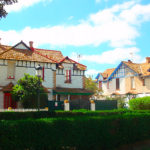
Walk through the Barrio Reina Victoria and the British influence is difficult to miss. Photo credit: Jose A CC 2.0/Wikipedia
Would you believe me if I told you there is a little British neighbourhood hidden away in Huelva? Known as the Barrio Reina Victoria, the Barrio Obrero and, rather fittingly, the Barrio Inglés, it isn’t an expat community living in Spain. The entire neighbourhood was built in British styles, with pitched roofs, chimneys, timber details, gardens and the sort of architecture you would expect to find in Britain rather than southern Spain.
But the really fascinating part is that Huelva became home to what has been described as Spain’s first unofficial British colony. Long before British retirees began settling along the Spanish coast, the Rio Tinto mines attracted a British community that established its own homes, clubs, sports and way of life in this corner of Andalucía. The Barrio Reina Victoria was one of the most visible results of that extraordinary period, a British-built neighbourhood that has survived for more than a century.
When Britain arrived in Huelva
The story starts in 1873, when the Rio Tinto mines were sold to foreign investors and the British-owned Rio Tinto Company Limited took control of the operation. The mines were enormously important to the local economy, and British engineers, managers and workers began arriving in the province, many bringing their families with them. The community became remarkably self-contained. The British established housing, social clubs and recreational facilities, while bringing familiar customs and pastimes from home. Huelva was developing a British presence unlike anything most people would associate with Spain today.
As the population connected to the mining company grew, so did the demand for suitable housing. In 1916, the Rio Tinto Company commissioned architects Gonzalo Aguado and José Pérez Carasa to design a new residential neighbourhood in Huelva. The development followed the principles of the British garden-city movement, with houses surrounded by gardens and plenty of open space. The first plans contained 71 buildings and 213 homes, with the first phase completed by 1919. More houses were added during the 1920s, creating the neighbourhood that remains today.
A British neighbourhood under the Andalucían sun
Walk through the Barrio Reina Victoria and the British influence is difficult to miss. The houses feature pitched roofs, chimneys, exposed brick, timber framing, gables and dormer windows, while gardens and open spaces form an important part of the neighbourhood’s layout. Some of the later homes designed by British architect R.H. Morgan in the 1920s made the connection even more obvious, incorporating Old English architectural features and decorative timber work.
Yet this isn’t simply an English village transported wholesale to Spain. Local Andalusian influences were incorporated into the designs, producing an unusual combination of British architecture and southern Spanish surroundings. The result is particularly striking under the Huelva sunshine. Traditional British-looking houses sit behind gardens and colourful façades, creating a neighbourhood that feels familiar and completely foreign at the same time. The Barrio Reina Victoria was declared a Cultural Heritage Site and protected as a Historic Site in 2002, ensuring that this unusual piece of Huelva’s history is preserved.
The British brought football to Huelva
Believe it or not the mining community didn’t just come to mine, they also left an extraordinary sporting legacy. The Real Club Recreativo de Huelva was founded on 18 December 1889, emerging from the British community and its sporting activities. The club is officially recognised as the oldest football club in Spain. Its first recorded football match followed just days later, on 29 December 1889, when the then called ‘Huelva Recreation Club’ played against sailors from ships in the city’s port.
Huelva continued to make football history. On 13 August 1892, the Velodrome was inaugurated, becoming the first purpose-built football ground in Spain. So while football is now inseparable from Spanish culture, one of the country’s earliest chapters in the sport was written by British residents in Huelva more than 130 years ago.
And they brought golf too
Football wasn’t the only British sport to take root, golf arrived with the British mining community too. The North Lode Golf Club was established at Minas de Rio tinto in 1914, making it one of Spain’s earliest golf clubs.
Then, in 1916, the Club de Golf de Huelva was founded on land provided by the Rio Tinto Company. Huelva consequently became one of the country’s early centres for the sport, decades before golf courses became such a familiar sight to visitors and expats across Spain. The British miners had brought the sports they enjoyed at home and established them in their new surroundings.
The British legacy is still here
The Rio Tinto Company and the British mining era are no longer the force they once were, but their fingerprints remain all over Huelva. They can be found in the old mining and railway infrastructure, in the history of Recreativo, in the city’s early golf clubs and, perhaps most charmingly, in the streets of the Barrio Reina Victoria.
For British expats living in Spain, it is a reminder that the British connection with Andalucía didn’t begin with package holidays, cheap flights or retirement communities on the coast. It stretches back to the 19th century, when British workers arrived in Huelva in search of opportunity in one of the world’s most important mining regions. More than 150 years later, the neighbourhood they helped create still stands, with its British-style houses sitting beneath the Andalusian sun. You don’t need to cross the Channel to find ‘little Britain’, It’s hiding in Huelva.
Rats are becoming an increasingly common sight in Spanish coastal towns. Credit: merinsda / Shutterstock
Diners on Pedregalejo’s seafront terraces have started worrying more about what could be weaving underneath the tables rather than what to order, after residents counted 20 rats scurrying under boats and beach bars in a single evening. Málaga’s town hall insists its rodent-control contract is working, but this is the second September running locals have said otherwise.
Residents count 20 rats along the beach in a single evening
Pedregalejo, the fishing-village-turned-favourite among Málaga’s coastal neighbourhoods, has spent this September watching for rats rather than sunsets. Residents told El Debate they counted at least 20 rodents along the beach in a single evening, tunnelling under moored boats and through the sand near the promenade’s restaurant terraces.
Ángel Maese, who has lived in the area for several years, said the problem is getting worse every year. María Ángeles Vázquez, another resident, described the animals as unusually large, adding that neighbours do not know if they bite.
The neighbourhood is one of the Costa del Sol’s most popular spots for British residents and holidaymakers, drawn to its chiringuitos beach bars serving grilled sardines on the sand just metres from where the rats have been spotted.
‘They’re entering our houses,’ residents tell local radio
The complaints link to an earlier warning, as days before residents interviewed by COPE Málaga said rodents were no longer confined to the seafront, with one describing “more rats than ever” and reporting that they were now entering people’s houses as well as bins and terraces.
Neighbours point to warm weather extending later into the year as a reason why this latest rat-race is continuing, plus, food being left out by beachfront restaurants and burrows dug into the sand beneath the wooden boat shelters that line Pedregalejo’s shore.
A €904,000 contract that the council says is working
Málaga’s Ayuntamiento (town hall) said it had deployed extra traps and stepped up extermination work in response to the latest complaints. Since July 2025, the city’s rodent and pest control has been run by Lokimica under a three-year contract worth €904,035.
The council says the contract has cut complaints by half compared with the first half of 2025, when it logged 2,451 pest reports, an average of three a day, and describes the current situation as “under control.” Outside emergency callouts, the standing programme runs three rat treatments a year across public areas citywide, plus monthly checks in around 20 higher-risk zones including beaches, parks and commercial streets. Residents can report a pest problem directly to the town hall’s environmental department.
The same neighbourhood, the same complaint, two years apart
This is not the first time Pedregalejo has topped the city’s rat complaints. In September 2024, the council tripled its annual pest-control budget from €142,000 to €400,000 after its previous contractor went bankrupt, naming Pedregalejo alongside Carranque, Huelin, Churriana, El Perchel and the historic centre as one of the worst-affected districts.
Environment councillor Penélope Gómez announced the increase at the time, while opposition councillors, including the PSOE’s Begoña Medina and Vox’s Yolanda Gómez, pushed for faster action, and Con Málaga’s Nicolás Sguiglia criticised the decision to outsource the service at all. Officials also pointed to rising temperatures extending rodents’ breeding season, a pattern also reported across the rest of southern Europe.
Two years and a bigger budget later, Pedregalejo’s rats are back in the headlines. It follows a summer in which Málaga’s beaches were also linked to sewage-related closures and the city’s historic palm trees battled a separate infestation of red palm weevil, adding rats to a run of environmental headaches for the coast in 2026.