Argentina
Milei Government Protests British Military Vessel’s Presence In Argentine Waters

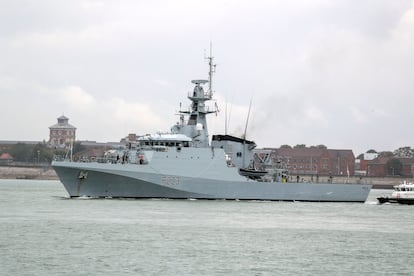
Barely two hours had passed since Argentina’s victory over England at the 2026 World Cup, and television screens were still showing Argentine players celebrating with a banner reading “The Falkland Islands [known in Argentina as the Malvinas] are Argentine.” It was at that moment that Javier Milei’s government chose to publicize a formal diplomatic note it had submitted at least two days earlier to the British Embassy, expressing its “strongest rejection” of the deployment of the military vessel HMS Medway in waters of the South Atlantic that Argentina considers to be under its jurisdiction.
Argentina’s Foreign Ministry released the information on Wednesday night, as thousands of people in Buenos Aires and other cities celebrated Lionel Messi and his teammates’ 2-1 comeback victory over England in the streets. According to the official statement, the Royal Navy patrol ship HMS Medway, “illegally deployed in the Falkland Islands,” made movements that “were not properly notified in accordance with existing bilateral agreements and declarations,” and that “involved transit through Argentine territorial waters.”
The government statement added that Argentina “firmly rejects this British military incursion into areas under Argentine jurisdiction, which forms part of a longstanding policy of unilateral actions incompatible with United Nations resolutions and with the obligation of both parties to refrain from altering the situation while the sovereignty dispute remains unresolved.”


Argentina considers the Falkland Islands and other southern archipelagos that remain under British control to be part of its national territory. In 1982, the military dictatorship then governing the South American country attempted to retake the islands by force but was defeated by the United Kingdom in a war that claimed the lives of 649 Argentine and 255 British servicemen.
The presence of the military vessel had been denounced a week earlier by the government of Tierra del Fuego province, at Argentina’s southern tip, whose jurisdiction includes the islands.
“This is not an administrative oversight nor an isolated incident, but a new display of British bad faith in the South Atlantic,” said Andrés Dachary, the provincial secretary for the Falklands, at the time.
Since then, authorities in Tierra del Fuego and opposition leaders have been demanding a formal protest from the national government.
“The Foreign Ministry issued its protest to the United Kingdom about the British ship two hours after the match ended. They didn’t dare do it before. They couldn’t be more spineless,” said lawmaker Germán Martínez, head of the Peronist bloc in the Chamber of Deputies.
In Argentina, the World Cup semifinal was seen as far more than a sporting contest, with the Falklands issue front and center. Before the match, the governments of Argentina and the United Kingdom had agreed with FIFA that spectators would not be allowed into the stadium in Atlanta, Georgia, with signs or flags containing political messages.
The Argentina national team, however, displayed a banner on the pitch while celebrating their victory. Made from a hotel bedsheet by a group of supporters, it bore a slogan asserting Argentina’s sovereignty over the islands.

After the match, Milei celebrated Argentina’s victory and commented on the banner displayed by the national team. Such things, he said, are “things that happen on the field with the players; they are not part of diplomacy.” In the president’s view, “at worst, Argentina [the national team] will receive a financial penalty […] What the players did is understandable. Emotions take over, and that leads to discussion of a sanction,” he told El Observador.
“Through diplomatic channels, we are getting closer every day to recovering the Falkland Islands, South Georgia and the South Sandwich Islands, as well as the surrounding maritime area,” Milei wrote on social media on Thursday. (He likely meant surrounding rather than circulating, the word he actually used.) His post accompanied another message claiming that Marc Zell, chairman of the Republican Party in Israel, had asked Donald Trump to support Argentina’s position on the South Atlantic archipelago.
Argentina’s claim to the Falklands is an uncomfortable issue for the libertarian president, who has tried to strike a balance between prevailing public sentiment at home and his own views. Milei has openly expressed admiration for Margaret Thatcher, the British prime minister during the 1982 war; defended the islanders’ right to self-determination, saying that “we want them to choose to be Argentine”; and advocated closer ties with the United Kingdom.
In fact, although there has been no official confirmation, Milei is expected to visit London, possibly as early as October. If it goes ahead, it would be the first visit by an Argentine president to the British capital since 1998.
Sign up for our weekly newsletter to get more English-language news coverage from EL PAÍS USA Edition